Archive for the 'Pueblo Chieftain' Category

Pueblo Chieftain General Manager unleases shady email pressuring State Senator to vote against gun bills

Monday, March 11th, 2013

The email boxes of Colorado lawmakers haven’t been pretty lately, unless you appreciate personal threats, F-bombs, and general references to some other reality where facts as we know them don’t exist.

But a shady email from the general manager of a newspaper? You’d never expect it.

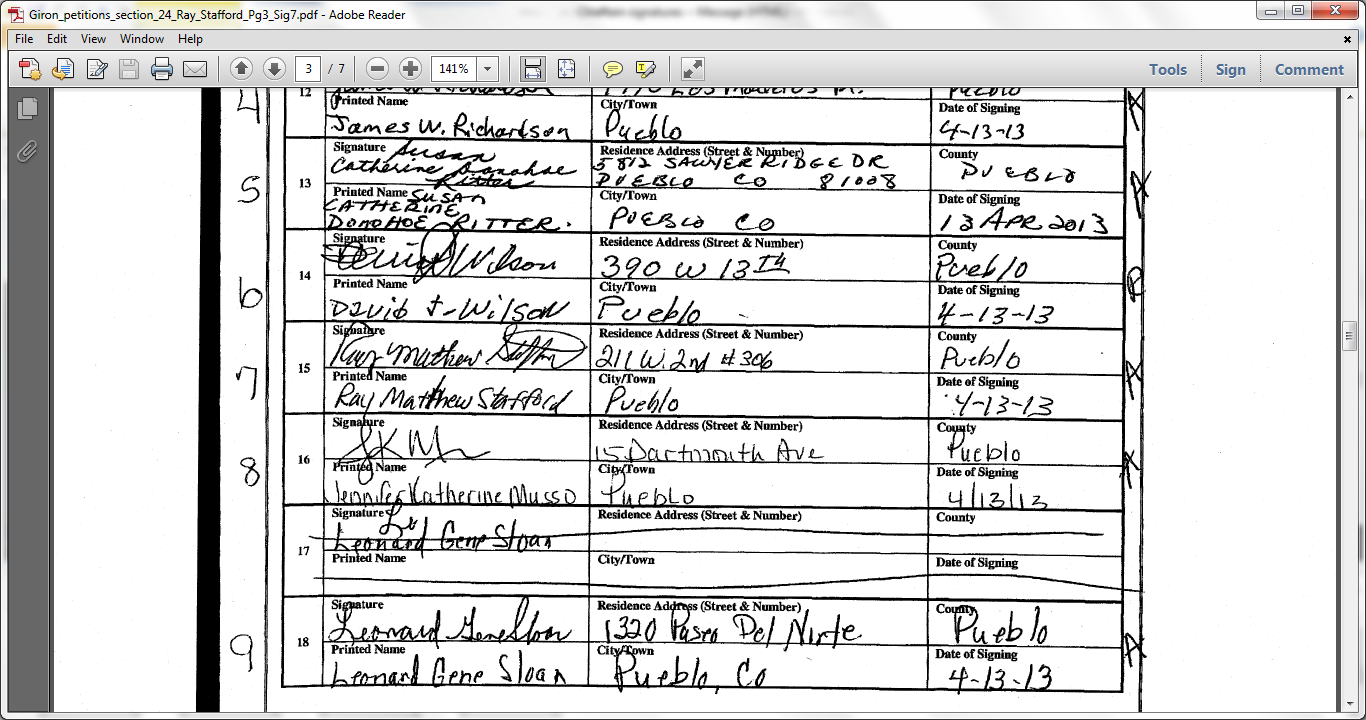
But, as first reported by KRDO TV in an excellent piece, that’s what State Sen. Angela Giron received March 3, from Pueblo Chieftain General Manager Ray Stafford.

In his email, Stafford first introduced himself to Giron as the person “responsible for the entire newspaper, including the newsroom,” and then wrote: “Please do not vote for the current gun legislation. To vote for it would be an affront to the citizens of this state, Pueblo, and America.”

Stafford signed the letter with his title and the phase “And gun owner.” Yikes.

As General Manager of the newspaper, as opposed to, for example, the news editor, Stafford is entitled to his opinion and to express it freely, but to me, this private email undermines the Chieftain’s credibility as an impartial news source, raising the possibility that Stafford will use his influence to direct the newspaper’s journalism against Giron personally or to tilt coverage against gun safety legislation.

I mean, why send the letter privately and tell a State Senator specifically how much power you wield at the newspaper?

I described the letter to Kevin Z. Smith, who’s chairman of the Ethics Committee of the Society of Professional Journalists.

He said the position of “general manager” position can probably be equated to that of publisher, and newspaper publishers often try to “affect some kind of influence” in the community, by sitting on boards or expressing opinions.

There needs to be a “clear delineation between what the publisher is attempting to do” and “what the responsibility of the newsroom is, Smith told me. adding that “often times that’s where the line gets crossed.”

Smith: It’s hard when the General Manager says, openly, ‘I’m also in charge of the newsroom and news coverage.’ To me that says, ‘This paper is going to take a news-coverage stance that we’re not going to support any types of gun legislation.’ If that’s what I’m reading, between the lines, then that’s patently unfair and unethical.

When this happens, the newsroom will have to “work very hard” to regain credibility, Smith said.

Fred Brown, another former Society for Professional Journalists Ethics Committee Chair, said Smith’s opinion should have been expressed in public, possibly on the opinion page. Brown doesn’t think Stafford’s email was unethical, but Brown wrote,  “the vehicle chosen to deliver the sentiment does raise some flags. Why not do it publicly?”

For more on the ethics of this, see the New York Times ethics policy, for example, here.

So, the bottom line, from my perspective, is that this is an unseemly, shady way for a newspaperman to operate, bringing into question the neutrality of the Chieftain’s news department. Certainly, everyday readers of the Chieftain would look askance at it. Common sense says it’s wrong.

Stafford did not immediately respond to my telephone call seeking comment, but he told KRDO:

“You have a copy of my e-mail and it’s not threatening at all. In fact, I point out that that was my opinion and I certainly have a right to that opinion and it doesn’t matter what e-mail account I send it from. The fact is the e-mail doesn’t contain any kind of a threat whatsoever,” Stafford said.

An assistant publisher and vice president also told KRDO that the newspaper has published balanced stories on gun-safety legislation.

Still, Stafford owes the Chieftain’s readers an apology. He should assure them that he will not direct the newsroom to produce stories unfavorable to Giron or to gun-safety legislation.

Stafford would be doing his profession a favor if he acknowledged his mistake publicly. Journalism is taking enough hits as it is, without gun-owning general managers embarrassing themselves in public.

Chieftain should reconsider its decision to exclude Casida from debate

Thursday, September 20th, 2012

The Pueblo Chieftain has excluded independent candidate Tisha Casida from a Chieftain-sponsored debate Oct. 10 featuring 3rd congressional district candidates Scott Tipton, a Republican, and Democrat Sal Pace.

“Voters want to hear from the candidates who do have a chance,” the Chieftain’s Managing Editor Steve Henson wrote in an email to Casida. “And we feel that we are reflecting the desires of our area voters and readers to focus on the candidates of the major parties.”

It’s a strange position for a newspaper to take, running contrary to journalism’s core job of airing out ideas, no matter how unpopular or meek.

But, it’s also true that a debate could get so diluted and unwieldy with lots of candidates on stage that voters would get little or nothing out of it.

So, if I were running a debate, I’d take a practical approach and see how many legitimate candidates, like Casida, wanted to participate and go from there.

If there were too many candidates, like there were during those loony GOP presidential debates recently, and I had no way of knowing which ones were most viable, I’d rotate them in and out. If there were only three or four legitimate candidates on the ballot, I’d include all of them them.

“You’re coming at it from the perspective of putting all the ideas out there,” Henson told me when I suggested this to him. “Our perspective reflects the wishes of our readers.” (He added that the Chieftain has given Casida a fair shake on its news pages, and this appears to me to be true.)

Henson says third-party or other candidates have gotten scant support over many years in southern Colorado.

“If a Libertarian were to get 15 percent of the vote in this election, they’d probably be included in our debate in the next election,” he said. “But that just hasn’t happened. It has nothing to do with the expression of ideas. For us, it’s really a numbers issue.”

The business organization, Club 20, apparently agrees with me that in an election debate, ideas should trump numbers, as Casida was included in the Sept. 9 Club 20 debate in Grand Junction, standing between Pace and Tipton on stage. The event worked just fine, I thought.

In a statement, Casida stated: “It is disappointing to be excluded from a debate in which we do represent a population of voters, and it is my hometown where I was born and raised, which is disheartening. I have worked very hard to petition onto the ballot and be a part of the process, to have a voice and be a voice for people who are frustrated with both Republicans and Democrats.”

Henson’s full statement, which he e-mailed to Casida, follows:

Henson: The Chieftain has not included third-party or independent or write-in candidates for political office because Pueblo and Southern Colorado voters historically have not supported them at the polls. Such candidates typically receive less than 10 percent and often less than 5 percent of the total votes cast.

In other words, frankly, area voters have made it clear that they will not elect a candidate who is not Democrat or Republican. Unless that situation changes, we will not include other candidates in our forums because it takes valuable time away from those candidates who have a legitimate chance of being elected.

Voters want to hear from the candidates who do have a chance, and we feel that we are reflecting the desires of our area voters and readers to focus on the candidates of the major parties.

Reporters should correct Tipton’s facts when he claims that Obamacare cuts $500 billion from Medicare and hurts seniors

Friday, March 16th, 2012

This got lost on my to-do list, but even if it’s late, and not exactly a new topic, I’m gonna write a quick blog post about Rep. Scott Tipton’s statement, paraphrased in the Pueblo Chieftain last month, that Obamacare’s “target of shrinking future Medicare costs by $500 billion over a decade would ultimately mean the government denying senior citizens needed medical services.”

Numerous fact checkers have shown this to be false.

For example, Pulitzer-Prize winning Politifact reported June 15, 2011:

Also, the Patient Protection and Affordable Care Act, tagged Obamacare by critics, doesn’t eliminate benefits.

Indeed, portions of the law improve benefits and coverage, according to Tricia Neuman, director of the Medicare Policy Project at the Kaiser Family Foundation, a nonpartisan, nonprofit health care research organization. Medicare will cover more preventive health care services, such as wellness visits, and recipients won’t face the “doughnut hole” gap in prescription coverage imposed under an existing Medicare program.

Other provisions reduce the growth in Medicare spending by helping the program operate more efficiently and fund other coverage expansions to the uninsured. Other provisions are designed to improve the delivery of care and quality of care, Neuman has said.

In another article, Politifact found the statement, “The new health care law ‘will cut $500 billion from Medicare. That will hurt the quality of our care,’ “ to be deep in its “Mostly false” category, which is as deeply false as its ratings go.

Fact checkers at the Washington Post also found that the $500 billion is saved in Medicare efficiences which are “wrung from health-care providers, not Medicare beneficiaries.”

In last month’s article, that I quoted above, The Chieftain did not report that Tipton’s statement about Medicare cuts under Obamacare was false.

But in the past, to its credit, it has put the number in context, showing different ways journalists deal with the misleading use of the $500-billion figure.

Oct. 29, 2010, the Chieftain reported:

“…[Tipton]  repeated his charge that Salazar and Democrats want to cut $500 billion from Medicare — a cut that Tipton said would hurt seniors. That part of the legislation calls for reducing the growth in Medicare expenses by $500 billion over 10 years by eliminating fraud and waste.

Oct. 7, 2010, the Chieftain reported:

Tipton has shot back, accusing Salazar of supporting a $500 billion cut in Medicare — a reference to the Democratic health care legislation that requires the future growth in Medicare expenses to be reduced by $500 billion over 10 years. A reduction in future growth is not a cut in the current Medicare program.

This kind of reporting  is more fair than letting Tipton’s allegations hang unchallenged. But journalists should also include the fact that benefits under Medicare will not be affected.

Here’s another way Chieftain reporter Peter Roper, who wrote all the articles I cite in this blog post, dealt with the $500-billion figure. This actually might be the best approach journalistically, because it focuses on what Republicans themselves have said. But it requires more space than a simple fact check.

On June 28, 2011, the Chieftain pointed out that Republicans first ridiculed the $500 billion figure as being imaginary, and then they switched course and declared that it was a real cut that would hurt seniors.

In an article about a Democratic ad targeting Tipton, the Chieftain reported:

[Tipton] reached back to the 2010 election debate over health care, noting that the Obama administration was touting cutting future Medicare costs by $500 billion over a decade.

At the time, Republicans scoffed that such savings were imaginary in the Democratic legislation intended to broaden health care coverage.

“The Democrats ended Medicare as we know it when they cut $500 billion from it,” Tipton said in a statement sent to reporters Monday.

Aug. 26, 2011, the Chieftain similarly reported:

Two years ago, Republicans ridiculed President Barack Obama’s health care legislation for claiming it would lower the deficit by reducing future Medicare expenses by $500 billion over time. Now they’ve embraced that number as a Democratic cut in the popular health insurance program for seniors… “(Democrats) took $500 billion from Medicare,” Tipton replied…

You want reporters to correct any factual errors in quotations that appear in their work. This is not always practical, unfortunately, for reporters these days.

But when reporting statements that are obviously politically charged, and are easily found to be false or lacking in context, reporters should set the record straight. Tipton’s allegation about Medicare falls into this category.

The $500-billion figure will almost certainly come up again, and when it does, given the sensitivity of the issues involved, it’s only fair for reporters to present a factual statement about the issue, and/or to ask Tipton to provide proof for his allegations about Medicare.

When Gessler alleges election fraud, journalists should report whether he has evidence of it

Monday, November 14th, 2011

In an an article in the Pueblo Chieftain Thurs, Secretary of State Scott Gessler was quoted as saying, as he has in the past, that some mail-in ballots are fraudulent.

The Chieftain reported:

Verifying the validity of voters’ signatures on mail-in ballots also poses a challenge, according to Gessler.

“A fair number of ballots are rejected because signatures don’t match,” he said. “Signature verification is sort of a black art.”

“Signatures vary a lot, and sometimes people’s signatures don’t match what’s on file. Some are fraud, some are innocent mistakes.” [BigMedia emphasis]

You can argue about Gessler’s definition of the black arts, but the Secretary of State either has data to back up his assertion of election fraud or he doesn’t, and it’s such a serious allegation, possibly bringing into question people’s basic trust in our representative government, that a reporter shouldn’t let it slide by without reporting whether Gessler has evidence of it.

I mean, if it’s not in the public interest for all of us to know about election fraud, when it’s alleged by the Secretary of State, I don’t know what is.

So I emailed the Chieftain’s Patrick Malone, who wrote the piece, and asked if Gessler told him how many instances of fraud he’s found and when and where Gessler found them. I asked if Gessler thought Pueblo was particularly problematic, fraud-wise.

Malone responded: “On the topic of fraud, I took [Gessler] to be speaking in general terms about the statewide picture and basing it solely on his suspicions.”

I would argue that if Gessler tells a reporter that election fraud exists, and it turns out to be, in fact, based on Gessler’s suspicions without proof, then a phrase like, “Gessler could provide no proof of election fraud in Colorado,” should be included after the Gessler allegation, because it’s such a serious accusation.

The burden of proof is on Gessler to supply the proof of fraud, not on reporters to prove that his assertion of election fraud is not true.

So reporters don’t need to do any research here. Just asking for the facts and reporting the answer is what’s required.

When GOP (or Dem Party) has no plan to pay for a tax break or budget increase, reporters should say so

Monday, July 25th, 2011

These days, Republicans in the Colorado Assembly are facing a question they’re not used to being asked: how will you pay for that?

In 2009, state Republicans and Democrats were both saying they wanted to pass legislation to upgrade Colorado’s roads and bridges. The Dems’ plan, the FASTER legislation that passed over GOP objections, was funded by increased vehicle registration fees and a $2 fee on rental cars.

Speaking for the Republicans, Rep. Mike May said: “The Republican plan is: Building roads, not bureaucracies.”

Yet reporters couldn’t bring themselves to writing, plainly, that the GOP had no plan to fund road construction. Instead reporters mostly regurgitated vague GOP notions to sell bonds, maybe raise vehicle fees way lower than Dems’ proposed, or leverage the “value of state buildings.”

In the last few years, reporters have gotten better at stating that Republicans have no plan, when they don’t have one for paying for tax cuts or pet spending increases.

For example, the headline on a Spot blog post July 21 stated, factually, that House Republicans wouldn’t say how they would pay for restoring a property tax break for seniors, which is set to take effect in 2012, after being suspended for two years by Democrats in 2010, generating about $100 million for the state.

The Post quoted House Speaker Frank McNulty as saying that the days of balancing the state budget on backs of seniors were gone.

But the article pointed out that the reality that relieving the back ache would require cuts to other programs.

And so The Post did what you, I, or any sane journalist would do. It asked McNulty about how he’d adjust the state budget to pay for the tax break, but the House Speaker refused to tell The Post where these cuts would be made.

A day after The Post piece appeared,  the Durango Herald covered Gov. John Hickenlooper’s response to McNulty’s plan to restore the property tax break for seniors. Hick said more budget cuts were likely and so the only way to pay for a tax cut for seniors would be to make even deeper cuts to the state budget.

But unlike The Post, the Herald didn’t get a direct response from McNulty on how he planned to pay for the tax break.

Neither did the Pueblo Chieftain, in its article about Hickenlooper’s response to McNulty. The Chieftain reported:

“McNulty said he is optimistic that a rebound in state revenue will enable Colorado to restore the tax break to seniors.”

I’m glad McNulty is optimistic, but the Chieftain should have asked the follow-up question: What if the rebound doesn’t materialize? What’s McNulty’s plan? What would he cut?