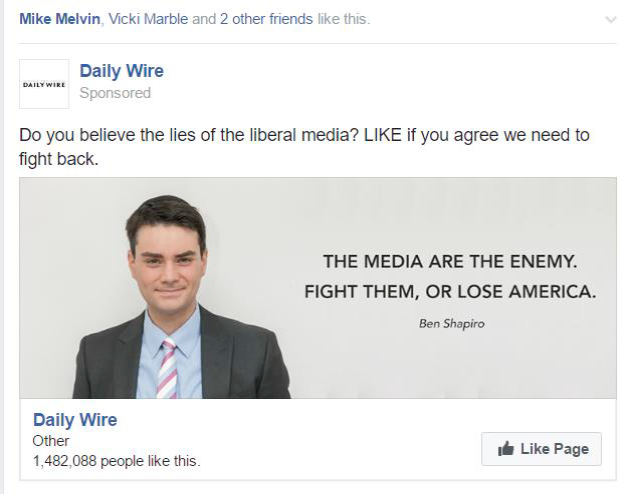
Maybe we can’t stop Trump from promoting fake news, but we can at least try to stop our own leaders from spreading it. That’s the BigMedia Blog’s goal in bestowing Colorado’s first annual Fake News Awards to lawmakers and public figures.
Crusader for a Fact-Free Colorado! Award — State Sen. Ray Scott
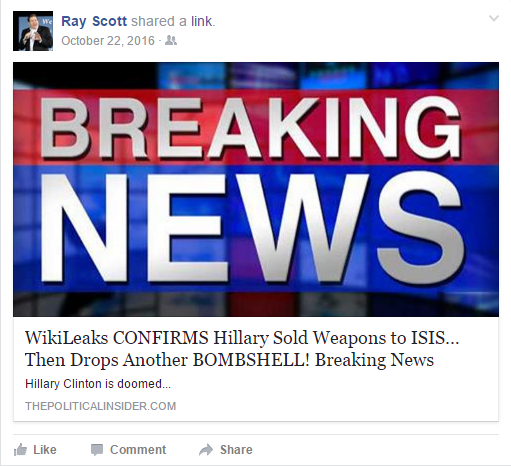
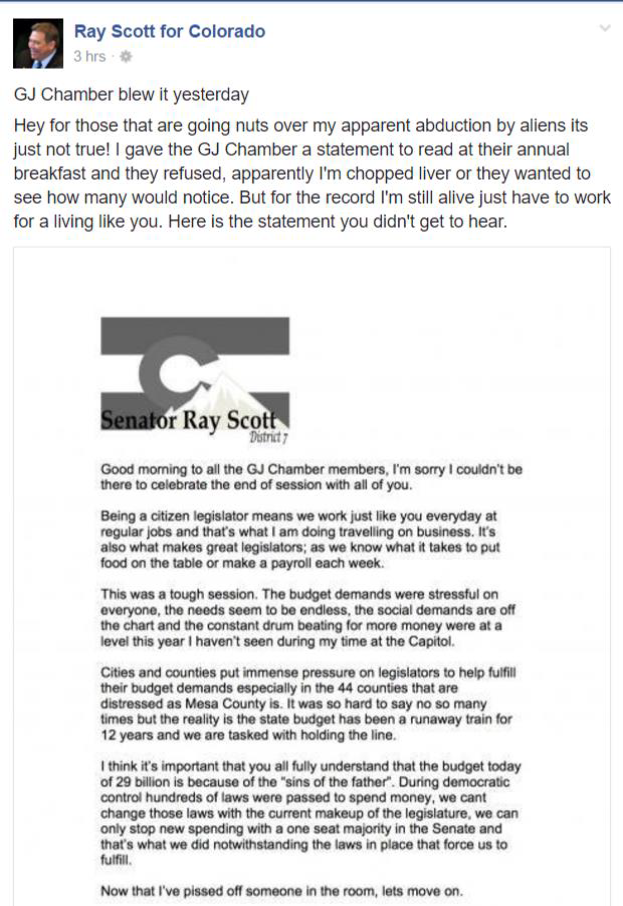
It’s bad enough that State Sen. Ray Scott (R-Grand Junction) called the Grand Junction Daily Sentinel “Fake News,” but doing so while 1) promoting Sentinel articles he agreed with and 2) refusing to remove actual fake news from his own Facebook page earns Scott the award of Crusader for a Fact-Free Colorado. Scott refused to remove from his Facebook page a fake news item titled, “WikiLeaks CONFIRMS Hillary Sold Weapons to ISIS…Then Drops Another BOMBSHELL! Breaking News.” He also refused to delete a tweet with this ridiculous (and fake) quote from Ronald Reagan about Trump: “For the life of me, and I’ll never know how to explain it, when I met that young man, I felt like I was the one shaking hands with a president.” And that’s not all! Just for good measure, Scott recently promoted an ad designed to look like news (sponsored content) from Grand Junction Sentinel.
Who the Fuck Cares about the Facts? Award — State Rep. Patrick Neville and Casper Stockham
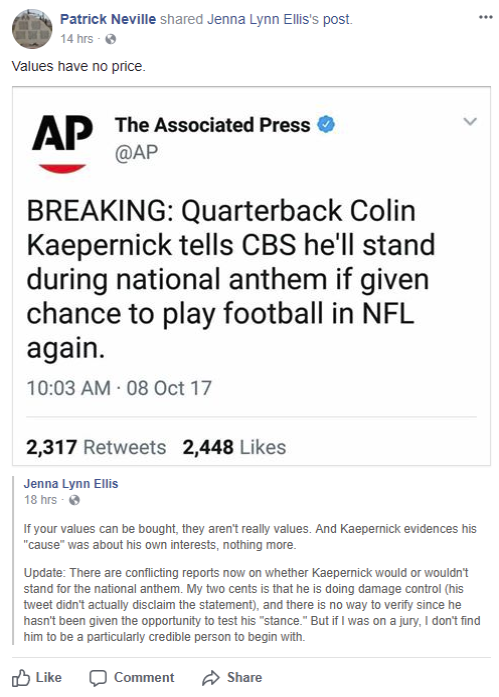
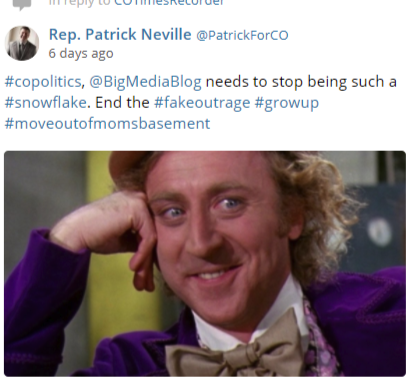
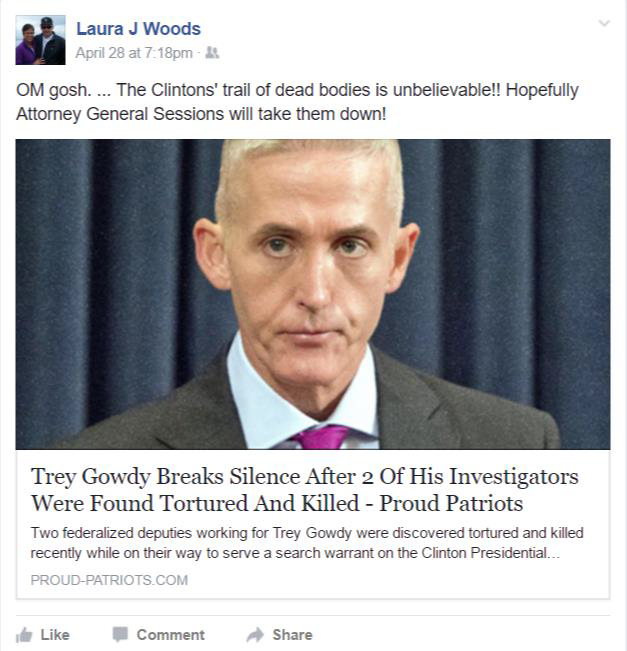
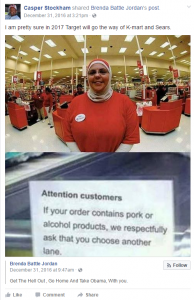 Sometimes we ask people to remove fake news, once determined to be false by outside fact checkers, and lawmakers ignore us (e.g., former State Rep. Shawn Mitchell, former State Sen. Laura Woods (R-Arvada). Other lawmakers talk about it with us in a civil manner and we agree to disagree (former GOP State Rep. Gordon Klingenschmitt of CO Springs, Republican State Sen. Tim Neville of Littleton) And still, others say, essentially, who cares if it’s false? Take, for example, Republican State House Minority Leader Patrick Neville. Told about a falsehood on his Facebook page, he tweeted that we should “stop being such a #snowflake. End the #fakeoutrage #growup #moveoutofmomsbasement.” Meanwhile, the fake news remains on his Facebook page. A similar who-the-fuck-cares attitude toward the facts was revealed by failed GOP congressional candidate Casper Stockham, who posted a falsehood about a Muslim Target cashier refusing to sell pork, even though Stockham himself wrote that the meme is “probably not true.” It wasn’t. But there it sits on his Facebook page to this day.
Warriors Against the Fake News Darkness Awards
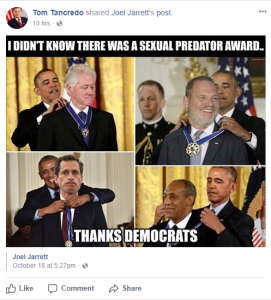 It’s been a depressing year on the fake news beat, but there’s hope on the home front. A growing number of Colorado officials are removing fake news, once they are alerted to the fact that it’s rotting on their social media feeds. Yay for these current and former lawmakers from both parties, who posted fake news and then removed it: State Rep. Polly Lawrence (R-Roxborough Park), State Rep. Susan Lontine (D-Denver), former State Rep. Marsha Looper (R-Calhan), U.S. Rep. Jared Polis (D-Denver), former State Rep. Kit Roupe (R-Calhan), Republican gubernatorial candidate Tom Tancredo, Former Democratic Mayor of Denver Wellington Webb, and Elbert County School Board Member Scott Wills. Joshua Hosler, Chair of the El Paso County Republican Party, also gets credit for removing fake news from his Facebook page, once he was alerted to it.
Let Me Deceive You — State Rep. Dave Williams
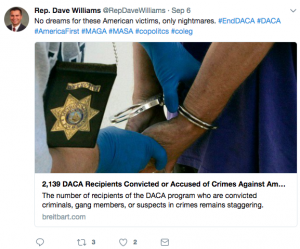 Despite the fact that immigrants are much less likely to commit crimes than the rest of the U.S. population, you’d think they were responsible for 83 percent of crimes committed on American soil if you only got your news from the Facebook timeline of state Rep. Dave Williams (R-Colo. Springs). Williams, who is a strong opponent of sanctuary city policies and even pushed a bill that would have punished politicians who enact them, almost exclusively highlights crime committed by immigrants. The only exceptions, making up 17 percent of crime-related posts on his timeline over the past 14 months, are an accusation that Hillary Clinton broke the law, a few posts expressing condolences after mass shootings, some promotion of his law to crack down on squatters, and an erroneous claim that an Antifa member stabbed an innocent man. Williams’ vastly disproportionate focus on immigrant crime deceives his Facebook followers into believing that undocumented immigrants are dangerous, when in reality, they’re more likely to be law-abiding citizens, and may actually cause crime to decline in their communities.
Mr. Congeniality Award — State House Candidate Raymond Garcia
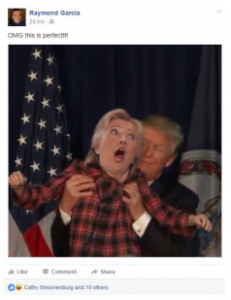 A failed GOP candidate for Colorado’s House of Representatives, Raymond Garcia’s offensive, inaccurate, and downright cringe-worthy Facebook timeline earns him the satirical title of Mr. Congeniality. His social media activity often reveals bigotry, like when he called Harvey Milk a pedophile and suggested that black people should feel guilty for slavery. He also repeatedly attacks Hillary Clinton, whom he refers to as “Hitlery”, and once even posted a poorly photoshopped image of her in which Donald Trump appears to grope her with the caption “OMG this is perfect!!!” What a charming fellow!
The “Earth Is Nearly in Its 21st Year Without Global Warming” Fake News Award — State Sen. Tim Neville
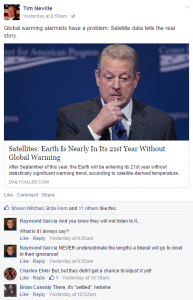 Global warming is a big priority for us fake news cops, so naturally we were alarmed when we saw State Sen. Tim Neville (R-Littleton) spreading fake news headlined, “Satellites: Earth Is Nearly in Its 21st Year Without Global Warming.” The linked article cites satellite data allegedly showing a “prolonged hiatus” in global warming. The mainstream scientific community, as reported by Factcheck.org, has found no hiatus in global warming on Earth. Yet, Neville has refused to remove the falsehood from his Facebook page.
Madeleine Schmidt contributed to this post.
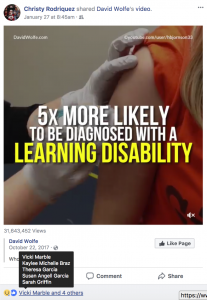 State Sen. Vicki Marble of Ft. Collins “liked” a recent Facebook meme last depicting a woman getting a shot along with the statement, “5x MORE LIKELY to be diagnosed with a LEARNING DISABILITY.”