More on the conservative talk-radio echo chamber and the damage done

December 16th, 2012

In a post Thursday, I discussed a conversation between two local talk-radio hosts and Colorado Springs Gazette Editorial Page Editor, Wayne Laugesen.

Unfortunately, the good folks at KLZ’s Grassroots Radio Colorado thought I unfairly presented their show as attacking every garden-variety environmentalist under the sun, not just the radical fringe.

So I’ve posted more of the exchange between Laugesen and the KLZ hosts below, including more insight into Laugesen’s thinking on whom he’s referring to when he talks about “radical” environmentalists. Warning: he’s pretty vague, as some suspected on ColoradoPols and elsewhere.

I’d love to meet the soccer-mom environmentalist from Jefferson County who feels good about the Republican Party after hearing this conversation on conservative talk radio.

If the KLZ radio hosts, and Laugesen for that matter, really cared about the toxic effect of talk radio on the Republican Party, here’s a suggestion on how they could begin to do something about it.

Have an actual debate! Bring a mainstream environmentalist on the show, for example, when you talk about radical environmentalists or environmentalism as religion. Refuse to be a guest unless more than shades of conservative gray are present. I’m not saying this never happens, but do it more often, please.

Chances are, when the echo chamber starts echoing on talk radio, it’s turning off most of the electorate. That’s when you need to bring in an opposing view.

In any event, here’s more of the discussion from last week:

Co-host Ken Clark: [chuckling after hearing audio of ] Wayne, what did you think about those whack jobs?

Laugesen: Oh, you know, it was just kind of funny…I couldn’t hear it through the phone, but–

Clark: Well, that was the one who said that I don’t want to be able to light my water faucet on fire.

Laugesen: Right. Yeah, lots of people can light their water on fire. It’s methane gas that you know, that often comes through a faucet. You know, it’s become a big symbol of fracking. You know, lots of people, where there’s no fracking anywhere near the water supply, can light their water. These are the same—. Honestly, I’ve been to a lot of protests in Colorado Springs. Believe it or not, there is a lot of left wing activism in this town. We are a majority Republican, conservative town. But that doesn’t mean that, you know, forty, forty-five percent of the town isn’t on the other side. And it’s a big town. I mean, there’s 600-plus thousand people in the metropolitan Colorado Springs area. So, several hundred thousand of those people are left of center. And of those several hundred thousand who are left of center, you know, a significant number are radical left-wing activists. So, you’ll find that in any large city. These are the same activists you see who will protest any form of human progress you can think of. They will – you know, if somebody finds a way to feed famished children in Africa through a new agricultural practice, they’re going to be there with – you know, they’re going to be on the streets with signs telling us how this is a bad thing….

[See excerpt from previous post.]

Worley: And my question is, “Where did we get this abundance of ignorance?”

Laugesen: You mentioned religion a minute ago. I don’t think — I’m not saying for a minute that we got if from religion. I’m saying that the same – you know, the people who lack religion, who have no religious belief, they need something. They need a cause. They need something outside of themselves that seems like a good thing, to worship, to work toward. And I think that’s what you – you know, we joke, some of us on our side of the equation, jokingly use the term “tree huggers” “Tree worshipers”. But I think there’s a lot to that. I really – I think that—I think these — that activists who – their activism is directed against progress, that it is serving the same – it is doing for them what religion has done for thousands of years for most people.

Clark: Well Wayne , it is also the ultimate feel-good philosophy because think about it, it is the biggest sales job that has ever been perpetuated on the world-wide public as a whole, and I’m talking about climate change, global warming, anti-fracking, anti-coal – the whole nine yards. Because think about it. You create this made-up travesty that is going to kill the planet – global warming. And then you’ve got all these people, “Oh, my God! Look what I can do! I can go out there and save the world!” And these people buy into it. They give them false propaganda, false junk science, on and on and on. And they read this stuff. They think they’re educated. But they’re reading the Sierra Club propaganda. They’re reading this Agenda 21 propaganda. And it is the ultimate in feel-good, left-wing, propaganda. And there – people succumb to it, and man, they think they are really doing something. And in fact –

Laugesen: They feel great! – about a cause like that–

Clark: Oh, yeah! Oh, that’s –

Laugesen: –and the protests themselves are kind of fun. Now, I was counter-protesting yesterday, but it was fun! I really enjoyed it. And I know the people who were there making a lot of noise and holding up signs—they were having fun. It was something to do….
Post’s policy on use of term “illegal immigrant” makes sense

December 14th, 2012

I posted The Denver Post’s policy regarding the use of the term “illegal immigrant” last week.

As you can see here, The Post favors the use of “illegal immigrant” over “undocumented immigrant” but accepts “undocumented immigrant” as less precise synonym.

That makes sense to me when it comes to describing the group of millions of people who entered this country illegally. I agree with the New York Times‘ reasoning on this.

But when it comes to an individual, I wouldn’t use any label (illegal or undocumented) unless there was actual factual evidence that the individual in question was, in fact, an illegal immigrant.

This approach would be in keeping with what Post City Editor Dana Coffield told me last year, that The Post only refers to someone’s immigration status “when it becomes part of and material to the public record.”

This seems really obvious, but it wasn’t spelled out in The Post’s published policy.

I asked Denver Post Politics Editor Chuck Plunkett about this, and he more-or-less affirmed the policy Coffield articulated:

Plunkett: If we are talking about an individual, then it would have to be a judgment call based on information that we have. If the person admits she is here illegally, or if police say that is the case, that’s pretty straightforward. Otherwise it gets murkier. My answer has to be that we would deal with the description on a case-by-case basis. Dana Coffield’s answer to you last year follows the same kind of logic that I would follow.

So I’m thinking it should be really rare for The Post to describe a person as an “illegal immigrant” or an “undocumented immigrant” unless that status is confirmed by an official source, on the record, or the person has stated this themselves. You can dream up exceptions, like an off-the-record source used in an unusual situation, but you wouldn’t expect to see this very often.

“Dwelling on the nuances does not win the favor of dittoheads”

December 13th, 2012

The Editorial Page Editor of the Colorado Springs Gazette, Wayne Laugesen, caught my attention last month when he pointed out that talk radio is “viewed, right or wrong, as part of the GOP, a big part of the GOP.”

This, he said, has hurt Republicans among Hispanics.

I asked Laugesen whether the damage caused by talk radio goes beyond Hispanics, to women or environmentalists, for example.

“I think a lot of good comes out of conservative talk radio,” he told me “But it can be a double-edged sword. That which gets ratings is not always in the best interest of those trying to win elections. Trying to find a niche on the radio is different from trying to put together a coalition of voters to win an election.”

I called Laugesen after listening to him on a talk radio show yesterday, where he had this exchange with radio host Jason Worley on KLZ’s Grassroots Radio Colorado yesterday:

Jason Worley: Environmentalism is a religion today. If you compare it to Judaism, Catholicism, Christianity, Hinduism, it has the same tenents, the same ideas. The problem is, the people who follow it, don’t have to actually ever suffer the effects of it. Go drop them off in Borneo in the middle of the rainforest with no mosquito protection repellent, no sunscreen…see how long they could last. They wouldn’t.

Laugesen: Right. If they ever got their way. If they were ever successful at stopping all this progress they intend to stop, they’d be miserable.

Worley: Wayne, you and I share a lot of beliefs. We’re right there on libertarian-leaning conservative beliefs.

Laugesen: Sure. I love progress. Almost 100% of the time, with some exceptions, when someone creates profit, which is really just the cost of capital, that person has improved the human condition. Because what are we willing to pay for? What makes us part with precious capital? An improvement to our lives. That’s the only thing that makes us part with capital. Human beings are not intuitively into destroying their lives, or the environment that supports their lives.

Lots of people, like swing-voting soccer moms, consider themselves environmentalists.

Could this conversation possibly make them feel good about the GOP?

To be fair, there was a lot more to the KLZ radio segment, including Laugesen’s audio of a group of anti-fracking protesters saying some silly stuff, but still, if you’re the kind of person who feels warmly toward environmentalism, and you listened to this show, you could easily have felt personally attacked.

But that wasn’t Laugesen’s intention.

I interpreted Laugesen’s 100% comment to mean he’s against most all regulations that might hinder profit. But he straightened me out, saying he believes that rules and regulations are necessary.

He also said he thinks “organized religion is far more legitimate than extreme environmental activism.”

In fact, throughout his radio appearance, Laugesen directed his critique at “radical” environmentalists, not all of them.

But, amid the extreme comments by a guy like Worley, do everyday environmentalists hear the distinction. Or do they just feel attacked, like Hispanics?

Laugesen and I agreed that amplification can overpower details on talk radio.

“Dwelling on the nuances does not win the favor of dittoheads,” he said.

Specifics needed in news coverage of immigration debate

December 12th, 2012

I blogged a few weeks ago about the need for media types to smoke out the views of state politicians on federal immigration reform.

So it was good to see extensive local coverage of a bipartisan initiative by Sen. Michael Bennet laying out the broadest of principles for immigration reform, like the humanitarian notion that U.S. immigration policy should “prioritize” keeping families together. That is, “where possible.”

The “where possible” caveat symbolizes the document, called the “Colorado Compact.” If the call to “prioritize” wasn’t sufficiently vague, it had to be clouded further with the phrase “where possible.” And there’s no comment on whether immigrant families should be kept together in the U.S. or deported juntos.

Top to bottom, the document is void of details, like how big a fence might be built, if a path to citizenship is essential, and if immigrant kids can get Pell grants, much less the same college-tuition rates offered to American-born kids.

The document calls for a “path forward for immigrants,” but not much in the rubber-hits-the-road category.

That’s fine for a broad community effort, like the Colorado Compact.

But journalists should be focused on specifics.

That’s what pissed me off about most of the news coverage of the Compact. (See a compilation of news coverage on the Colorado Compact’s website here.) It was gushing, mostly without any skeptical edge that you want from reporters.

The coverage barely hinted at stumbling blocks down the line, like Obama’s and other Democrats’ insistence on a path to citizenship and GOP opposition to this (e.g., Coffman, Gardner, Lamborn, Tipton). What about the Dream Act? What about the folks like Tom Tancredo who are saying it’s just wrong, period, to reward a person who’s entered the U.S. illegally with any form of legal status?

What about the folks like Helen Krieble, whose proposal for immigration reform has been floated by some Colorado Republicans like Rep. Ray Scott. Krieble reiterated her immigration proposal on Sunday to approving KNUS talk-radio host Krista Kafer, who’s a former aid to failed GOP Senate candidate Bob Schaffer:

Krieble: So, our recommendation [is to] have these employment agencies outside our borders. So, [illegal immigrants] don’t have to go home to their home countries. But they must go, by appointment, outside the borders, run through the security check, prove they have a job, or take a job, so they’re self-supporting, and return to the United States according to the rule of law. Which, could all be done in 48 hours. Because remember, you don’t have bureaucrats who have no incentives to do a hundred people a day versus two people a day. But a private business has every incentive in the world to do it and do it well and quickly. So, that would be our recommendation.

Krieble’s proposed policy solution is full of unanswered questions regarding its implementation and implications. But Kafer doesn’t venture to open those cans of worms.

We love reporters becasue they deal in the world of specificities, like data, numbers, concrete ideas, etc., and the ramifications of those specific things.

That’s what we want in news coverage of the immigration debate, even if politicians and policy makers don’t want to go there.

KNUS’ Kelley has moved to the right, but he still asks decent questions in interviews

December 11th, 2012

Sometimes KNUS’ Steve Kelley seems embarrassed by his own morning rants and rages against Obama and the nasty Democrats. The other day he asked, “Do you really want to hear a rant from middle-aged white guy?”

Kelley’s current behavior looks different from what you heard during of his 19 career at KOA, where he at least acted like he didn’t have the answers.

But Kelley’s more level-headed roots return when he conducts interviews, which usually feature straight-forward questions you’d want, but don’t expect, from someone seated behind a microphone.

This morning, for example, during his Kelley and Company show, he asked Rep. Cory Gardner this really good question:

Kelley: Why do you guys [Republicans] seem to be losing the PR battle [on the fiscal cliff]? I mean, it’s so easy to blame a Republican, but it seems to stick to you?

Gardner: Well, you know, it’s tough. We’ve got to do a better job of messaging and explaining to people who are in the middle class, people who are lower income earners, that people who will be affected by this tax increase are people like you, people who are working hard to make ends meet, people who are struggling to pay the mortgage, because their business are going to be hard hit. That’s going to result in lower take home pay because the businesses they work with are suffering and struggling to bear the burden of the tax increases. That’s the bottom line and so the President controls the bully pulpit, regardless of who it is in the White House, whether it is a Democrat or a Republican. They have a tremendous opportunity to shape the outlines of the message.

Listen to audio of Rep. Gardner talking fiscal cliff on Denver radio station KNUS 710 AM on 12-11-12

Kelley was on the right track, but to get to the heart of the GOP’s fiscal-cliff problem, Kelley should have contrasted Gardner’s head-spinning response with Obama’s crisp lines on the topic, which he delivered at a rally Monday:

Obama: “We can solve this problem. All Congress needs to do is pass a law that would prevent a tax hike on the first $250,000 of everybody’s income,” he said. “When you put it all together, what you need is a package that keeps taxes where they are for middle class families, we make some tough spending cuts on things that we don’t need, and then we ask the wealthiest Americans to pay a slightly higher tax rate.”

In another question, which Kelley didn’t acknowledge actually related to his previous question about the GOP’s PR problem, Kelley asked Gardner whether he’d compromise on a tax increase:

Gardner: “We cannot agree to a tax increase. That is not the solution. That is not going to solve our $16 trillion debt. That’s what I am urging our leaders, Speaker Boehner and others, to make sure they are adhering to…I think he knows that the [Republican] conference does not support a tax increase, that there is no will to increase taxes amongst the Republican Party and the House majority.”

That’s obviously part of the Republican PR problem on the fiscal cliff, but Kelley didn’t get into the fundamentals. Maybe he thinks it would be bad PR.

Journalists’ “likes,” “friends,” “retweets,” etc. on social media don’t reflect favoritism or bias

December 7th, 2012

On his profile on his Facebook page, Denver Post Politics Editor Chuck Plunkett writes:

Please note. As a journalist using social media, my following or friending or liking — and in some cases even retweeting or reposting — is not always meant as an endorsement.

This is a shorter version of a post Plunkett wrote shortly before the election on Facebook:

Friends. I’ve been asked about this a couple of times in recent days, as we are now fully in the final throes of the Election season. The question is whether as a journalist who covers politics it is correct for me to “like” the Obama page or the Romney page. (And I “like” them both.) The problem is that is how Facebook defines what you have to do to follow a page. That’s not — in most cases — how I would describe my interest. I might genuinely “like” a band, for example. But a politician? It’s not the same thing. I’d like to expand on what I have long indicated on my Facebook profile — which probably not everyone reads. For years now, since my earliest origins with Facebook, I have contained in my profile the disclaimer that as a journalist using social media I “friend” and “follow” and “subscribe” and “like” and “retweet” and etc. all manner of people, groups, media, politicians, movements, companies, nonprofits, etc. But my doing so is NOT meant as an endorsement. Rather, I do so in order to see their posts in order to watch for news and whatnot. Increasingly, politicians use social media in the place of the old-school press release or statement. To not follow risks missing something — not that I don’t miss things even when I follow, given what has become the enormous success of these kinds of sites. I hope this makes sense. Bottom line: I do not endorse any politician or political party and do not advocate for any of them either. I have much better things to do with my time.

To me, that’s common sense, but it’s good Plunkett spells it out for us.

You say, still, what if a guy like Plunkett “likes” or “friends” 100 right-wing groups and 25 lefty ones? What if he re-tweets Scott Gessler (as if Gessler doesn’t tweet his own horn often enough)? Does it mean he favors the right?

It means little or nothing. You don’t know what Plunkett is up to or where he’s getting information, unless you’re a mind reader, and mind readers are the worst kind of media critics–though they are a common kind.

Re-posting, retweeting, even “likes,” by other public figures, like politicians, invites questions, however.

The bottom line is, for journalists, if you think they lean one way or the other, evaluate their actual factual work. Is it fair? Is it accurate?

Post’s style guide on usage of phrase “illegal immigrant” raises questions

December 6th, 2012

As an addendum to a shrill column by Ruben Navarette arguing that the term “illegal immigrant” should not be replaced by a phrase like “undocumented worker,”  The Denver Post Perspective section published its own guidelines on how Post journalists should use the terms.

Unfortunately, the explanation apparantly only appeared in the print edition.

I was going to ask The Post to put it online, and I’m thinking its omission was just an oversight, but before I did, I thought I’d put it out there for people to see:

Newspaper usage     

The Denver Post: The Post uses the term “illegal immigrants” in referring to citizens of foreign countries who are in this country with no passport, visa or other document to show that they are entitled to visit, work or live in the United States. We do not use “illegal aliens” or “illegals” except in direct quotes or in rare cases when the official government term “illegal aliens” is unavoidable. We will not use the nouns “alien” and “illegal” in headlines. The term “undocumented immigrants” or “undocumented workers” is an acceptable synonym but is more vague.

The Associated Press: The AP also prefers the term “illegal immigrant.” Unless quoting someone, the news service does not use the terms “illegal alien,” “an illegal,” “illegals” or the term “undocumented.”

My question for The Post is, what constitutes sufficient proof that an individual doesn’t  have a “passport, visa or other document to show that they are entitled to visit, work or live in the United States.”

If someone admits not having proper documentation? If immigration officials or police make this determination? If someone can’t produce documentation immediately? What’s the evidentiary standard?

It’s one thing to label the group of people who are presumably in the United States illegally as “illegal immigrants,” but it’s another to presume any single individual is an “illegal immigrant.”

Last year, Post City Editor Dana Coffield told me that The Post only refers to someone’s immigration status “when it becomes part of and material to the public record”–unlike talk-radio host Peter Boyles who dehumanizes himself and all of us by implying or asserting that someone with a Spanish surname is an “illegal.”

In his column in The Post, Navarette argued in part:

• The wording is accurate. When you enter the United States without permission or overstay a visa, you break a law. Vargas notes that “being in a country without proper documents is a civil offense, not a criminal one.” True. But the word “illegal” simply means against the law, and civil laws can be broken just like criminal ones.

• The proposed change is, for the most part, about being politically correct. And this is not a good spot from which to practice journalism. My profession isn’t about making folks comfortable. That’s public relations. At its best, journalism is about making them uncomfortable.

• The word police simply want to sanitize the debate, so that immigration reformers don’t get their hands dirty by condoning illegal activity.

Anyway, I’ll ask The Post my question about its style guide next week, and I’ll include a few of the best questions from my readers, if you have any. Shoot them my way, if you do to tips@bigmedia.org.


Media omission: Tancredo says Metro lawsuit “probably going nowhere”

December 5th, 2012

Former Congressman Tom Tancredo told me this week that his idea to sue Metro State University for offering a reduced tuition rate to the children of illegal immigrants is “probably going nowhere.”

Tancredo said back in October that he was having trouble locating a student plaintiff, and he said he still can’t find an out-of-state student who’s willing to endure the “perceived retribution” that TAncredo says would result from filing the lawsuit, which would seek damages based on the notion that the illegal immigrant should not receive a lower tuition rate than that of an out-of-state student.

Asked what kind of retribution might be expected, Tancredo said that no one would get thrown out of school, but there could be “problems with professors and grades.”

Tancredo said he’s unlikely to pursue a legal strategy without a student plaintiff.

“It’s risky, at best,” he said. “I’m not in it for the grins of it. I want to succeed. Without a student, we just don’t have a good strategy to employ.”

Tancredo said the recent Republican election loss, resulting in part from the GOP’s unpopularity among Hispanics, was not a factor in his thinking about the Metro lawsuit.

“Believe me,” he said, “I would pursue this regardless of what happened in the election,” adding that Hispanics vote for Democrats because they like big government, not because vocal segments of the GOP, led by Tancredo, have called for a crackdown on illegal immigration.

Hispanics vote for Democrats for the same reason that other people vote for Democrats,” he said.

So is Tancredo pursuing another anti-immigration project?

He said he’d like to push a Colorado law like the one in Arizona targeting illegal immigrants, but he’s got “nothing on the front burner.”

And he’s not worried his high-profile activities alienate Hispanics from the Republican Party.

“My hope is that we can begin to make inroads with Hispanics who realize the problems that plague the countries they fled are the problems being created by Democrats in this country,” he said. “Unless they’re trying to replicate the economic basket cases that they came from, they should try to create different political allegiances.”

Where Are Those “More Tax Cuts for the Millionaires!” Protests?

December 4th, 2012

You may recall one of the most effective organizations supporting the re-election of George W. Bush was Billionaires for Bush!

The billionaires trailed Bush and Cheney around the country, with signs like “It’s a Class War and We’re Winning” and “Widen the Income Gap.” The billionaires liked to say they paid for eight years of Bush, and so throwing him out after four years was a rip-off.

I was thinking about Billionaires for Bush when I saw a roundup of news coverage from around the country of protests Saturday against extending tax cuts for the top two percent.

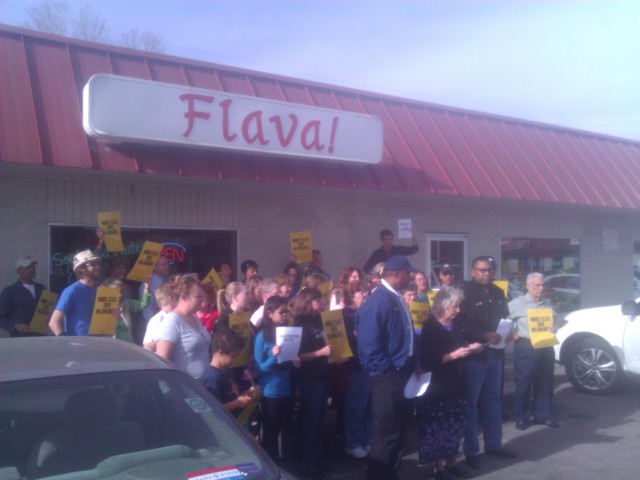
They weren’t giant demonstrations, but you had 25, 50, 100 people in dozens of venues. In Colorado, there were about 25 folks in Grand Junction and about 50 people in front of Fava’s restaurant in Aurora.

Whether this impresses you or not, you’d agree that what you do not see are the top two percent in the streets, with signs like, “More Tax Cuts for Millionaires Now!” “What’s Good for the Top 2% Is Good For YOU,” “Keep On Tricklin'”, “Another Yacht, for the Good of the People,” or “Why Own Just One House When You Can Have Five?”

The fact that you don’t see those folks demonstrating at all adds news value to the protests by the folks like Fair Share Colorado and Protect Your Care, who were among the organizers of the protest in Aurora. Yet, Saturday’s demonstration got zero news coverage in Denver, as far as I can tell.

Reporters should not only cover events like the one in Aurora but also point out that the super rich aren’t in the streets over this. What’s up with them? Too busy? Embarrassed to put their faces out there?

I’m serious. The Denver Post ran a piece on its Spot Blog yesterday about 50 business leaders who signed a letter to Colorado’s congressional delegation asking them to solve the fiscal-cliff problem. They didn’t even take a position on extending the Bush tax cuts for the super rich. Overall it was a mushy letter, its impact derived from the compiled signatures of wealthy, powerful elites, who call for resolution and compromise. With only vague platitudes, agreeing with overall public sentiment, the letter is more appropriate for a story on the Society Page.

Yet, the Post found the letter more newsworthy than 50 folks actually standing in Aurora, who called on Rep. Mike Coffman, specifically, to prioritize the “middle class over millionaires,” and to end tax cuts for the top 2 percent of income earners.

“Representative Coffman should not hold out for tax cuts for the richest among us,” said Aurora real estate agent Jeanne May, an Aurora real estate agent and member of Colorado Fair Share. “He needs to vote for middle class tax cuts for people like me not tax breaks for millionaires who don’t need them.”

So Jeanne May has thrown down the gauntlet to super rich out there–and reporters. Will there be a response? When will we see the luxury street protests, or somehow, the faces of the top two percent?

Where are those Billionaires for Bush now?

Small business owners and others ask Rep. Mike Coffman to end tax cuts to two percent of income earners

Small business owners, veterans, and others ask Rep. Mike Coffman to end tax cuts to two percent of income earners.

Post should have noted that CO House Republicans don’t favor citizenship path

December 3rd, 2012

The Denver Post’s Sunday editorial, “Immigration’s Time Has Come,” pointed out the “flaws” in not one but two GOP immigration bills, floated or introduced last week in Congress.

One proposal actually reduces visas for poor people from places like Africa, to make room for higher-achieving immigrants, favoring one group over the other. The other bill allows undocumented kids to attend college and get work visas.

But neither offers a path to citizenship, as The Post favors.

Why doesn’t The Post get local and offer some suggestions on how our favorite local Republicans will get on board?

The Post need look no further than its own website to find Rep. Mike Coffman saying:

Coffman: “I consider myself aligned with Congressman Tancredo in that he fundamentally believes that we need to secure our borders and that we should not grant either amnesty and a path to citizenship to those who have violated our laws.”

Rep. Scott Tipton also has opposed it on The Post’s pages, as did Rep. Doug Lamborn. Rep. Cory Gardner opposes it, too.

It’s great for The Post to favor comprehensive immigration reform and to criticize the GOP’s half-baked proposals.

But does it have any suggestions on how Colorado’s Republican Congressmen can buck off the hard-line anti-immigration activists and talk-radio hosts from their backs and support comprehensive immigration reform?