Other mistakes in Manzanares coverage

June 26th, 2007

In my column on Saturday, I argued that the dailies overplayed the allegation that former city attorney Larry Manzanares had porn on a stolen computer in his home.

One aburd front-page Denver Post headline read, “Indictment alleges sex videos viewed.” Big deal.

In response to criticism for hyping the porn, the dailies have said that the porn could explain Manzanares’ motive in the case. It’s true that Manzanares could have been embarrassed, even though the prosecution stated that no child porn or illegal porn has yet been identified. Maybe Manzanares took the computer to hide the porn he was viewing at work. Or to look at porn at home. Who knows? It’s all speculation, not worthy of front page headlines.

And besides, there are other possible motives: There were legal documents and jury instructions on the laptop. Maybe Manzanares, if he stole the computer, was a workaholic, not a sex addict, as the dailies speculated. Or you could speculate that he was a combination of the two. Seriously.

Or maybe he was just cheap. Just because he made a six-figure salary doesn’t mean he wouldn’t be motivated to save $300 bucks or $1,500 bucks. Lots of rich people are frugal beyond belief. Maybe he had financial pressure and struggled with a shopping addiction instead of a porn addiction.

Maybe that’s far-fetched. Maybe not. But my point is that the speculation about Manzanares’ motive rose too high on the news agenda, and if the operative motive hadn’t involved porn, you can bet it wouldn’t have been given the headlines it got.

Another mistake of journalists was failing to offer critiques of the prosecution’s tactics until after former Manzanares killed himself. You’d think that they would have done this, as they did on Sunday, just to balance out the focus on the porn. But this critical reporting came too late.

You have to respect the dailies for writing articles about the anger that’s currently directed at them for the Manzanares coverage, but you also have to wonder why they don’t cop to making any mistakes. How often does hindsight fail to illuminate mistakes? But the editors at the dailies are basically saying they were fair. Period.

I’m not blaming the media for Manzanares’ death at all. But journalists should be as honest as possible about their coverage, even if it means admitting a mistake or two.

Andrews’ again says he was duped

June 10th, 2007

Former Senate President John Andrews writes that I called him a liar in my column yesterday. In fact, I wrote that he’s either a liar or seriously confused. I didn’t suggest that he could be both, which may be closer to the truth. But there really could be some explanation.

We don’t know, because Andrews hasn’t explained how Sen. Norma Anderson used “sleight of hand” to trick the former Senate Prez and other Republicans into voting for the tax-rate freeze in 2004, when Republicans not only overwhelming supported it but also debated it. See post below.


2004 CO Senate Debate on Tax-Rate Freeze

June 8th, 2007

Dick Wadhams’ has proven himself to be a master at yucky campaigning. But Wadhams’ dream to be the next Karl Rove took a hit when the word “Maccaca” came out of the mouth of Virginia U.S, Senate candidate George Allen. Wadhams was Allen’s campaign manager, and Allen lost his Senate bid, thanks in part to his Maccaca line.

After the 2006 election, Wadhams came back to Colorado, where he became Chair of the State Republican Party. He’s been looking for slime to throw at Colorado Democrats. It seems that he believes he’s found some really good slime to nail them with.

He’s trying to use the Democrats’ efforts to clean up the state’s school finance mess against them in the next election. The Dems passed a law, signed by Gov. Bill Ritter on May 9, 2007, that freezes planned reductions in most property taxes statewide. If property taxes would have been reduced as planned, the state would have been forced by law (Amendment 23) to continue increasing funds for K-12 school funding, even though less and less money would have been collected from property taxes to pay for this. (The state school fund was projected to face a $100 million deficit by 2012.)

As a result, a larger and larger portion of K-12 school funding would have come from other state funds, depleting funding for other budget priorities, like higher education, healthcare, and more. Democrats have fixed this mess, for now, by freezing most property tax rates. But the Independence Institute says it will sue to stop the freeze, claiming that it must be approved by voters because it’s a tax increase. Dems counter that voters have already approved it. Now back to Wadhams. He’s licking his chops, according to a Rocky headline, because he’s planning to accuse the Dems in the next election of increasing taxes based on their support for the tax-rate freeze. Gov. Bill Ritter responded this way to the political heat. Denver’s news media has downplayed the fact that, in 2004, the Republican-controlled Senate approved the tax-rate freeze.

The Post reported that four current members of the Colorado Senate voted against the tax rate freeze this year, but voted for it in 2004. However, these Senators were not interviewed to explain their flip flop. Instead, the Post interviewed Sen. Andy McElhany, who explained the flip flop of his four Republican colleagues by saying that they were, at worst, confused. McElhany opposed the measure both in 2004 and this year.

Outside the Legislature, some high-profile Republicans support the tax-rate freeze. There’s this support, too. 

The News reported that former Sen. Norma Anderson was the Senate Republican who pushed the tax-rate freeze in 2004. Rep. Keith King was “instrumental,” according to the News, in removing the tax-rate freeze from the bill.

John Andrews was Senate President in 2004. He also voted for the tax-rate freeze in 2004. A Post editorial highlighted his flip flop. Today, Andrews blames Anderson for using “sleight of hand” to push the tax-rate freeze through the Senate. Andrews says that, thanks to Anderson, he cast an ill-informed vote for the freeze. This was reported here and here.

Anderson, who’s no longer in the Senate, told me that, in her experience, legislators pay attention when property taxes are under consideration by the Legislature.

And there’s evidence that, in fact, Senate Republicans were paying attention to the tax-rate freeze in 2004, despite Andrew’s claim that Anderson duped the Republicans.

The tax rate freeze was the subject of a raucous debate on April 7, 2004, in the Senate chamber featuring Sens. McElhany, Anderson, Ron Tupa, and Ron Teck.

Here’s the transcript:
 

April 7, 2004

9:15 amColorado SenatePresent …• 33Absent/Excused …• 2; Gordon, VeigaSenator Taylor is acting as Chairman. Sen. McElhany: Thank you, Mister Chairman. Yes, I would ask for a no vote on severed section 2. What’s happening here is that, and what you don’t have benefit of is the fiscal note from the Appropriations Committee [“They have it” is heard in background] Is it in this- It shows that the effect of this part of the amendment has the effect of freezing the mill levy where it is right now on property tax assessments across the state. And when-. What happens when that mill levy freezes then as -. The way it works now, as these assessments go up, in order to stay within the Constitutional limits, as assessments go up, the mill levy drops. And if you adopt this portion, it freezes the mill levy. And when you freeze the mill levy, then, if you look at your fiscal note, what that does it will cost property tax payers an additional $18 million dollars the first year. And then, after that, as property values increase that becomes more and more dramatic, amounting to potentially hundreds of millions of dollars over a five- to ten-year period.Sen. Anderson is saying that this is not an increase. It’s just eliminating a decrease. And it depends on the property tax classification and the property tax jurisdiction and what’s happening with the value of your own property, depending on what happens.

But if you freeze this, what it does is it saves the state money at the expense of people paying property taxes. Now that’s pure and simple. So that’s what you’re voting on if you vote in favor of this, and I’d ask for a no vote.

Chairman: Somehow, something tells me, Sen. Anderson has a different discussion on this.

Sen. Anderson: Sen. McElhany, you don’t understand it at all because you weren’t here in …94 when we put this in the statute. What we put in the statute, and one of the big reasons-. There’s two reasons that we’ve transferred costs from local government to the state, from the school district to the state. There’s two reasons. One is Gallaghar, which you love to talk about assessements, and that’s wonderful, and this has absolutely nothing to do with it, absolutely nothing. The other is, we put in 94 a constant reduction of mill levy into the statute, and if you stop reducing the mill levy, you stop shifting the cost of school finance to the state. So what we’ve done over the years, we’ve gone from 40 percent of funding from the state to 62 percent. And what I’m trying to do is stop at the 60 or 62 percent, thank you very much. And stop dropping that mill levy when it should be paid at the local level where they have the schools.

Sen. McElhany: Sen. Anderson, I think we agree on one thing. And what this amendment would do is it stops the mill levy from dropping. Then, as property values go up, you’re gonna pay more in taxes because your mill levy doesn’t drop any more.

Sen. Anderson: You’re going to pay more in taxes when the value goes up anyhow, whether this is here or not, Representative McElhany.

Chairman: (Corrects Sen. Anderson’s use of the word “Representative”) Senator McElhany.

(background laughing and “woooo.”)

Sen. McElhany: (laughing) Thank you, Representative Anderson.

(laughing in background)

Chairman: You’re both out of order. Sen. McEhlhany. [Because they referred to each other as “Representative,” not “Senator.”]

(more laughing in background)

Sen. McElhany: (laughing) I would just ask for a no vote.

(More laughter)

Sen. Ron Tupa: Thank you, Mr. Chairman, Sen. McElhany. That’s vintage dragon lady from the House, as you well know. I was going to ask, how does your back side feel?

Thank you, Mr. Chairman, I’m glad someone else is taking some heat from Sen. Anderson. It’s not just me. But on this one, Sen. McElhany, Sen. Anderson is correct. I think what she’s trying to do is stop that perpetual shifting of costs from the local share of school finance to the state share. And what she’s saying is it’s inherently inequitable what’s continuing to happen, that the entire state is paying more and more and the locals are paying less and less. And Sen. Anderson, I think, is trying to slow if not stop that from occurring. And so somebody’s going to end up paying for school finance. What you’re saying is that is should be and it’s appropriate for the state to pick up more of the tab. And what I think what a lot of us feel is it’s actually more appropriate for the locals to pay more of their costs to get their kids through school. So, I will be supporting the Anderson, I think it’s the Committee report on this. You’re asking for a no vote and I will be asking for a yes vote on that section that you’re striking.

Sen. Anderson: And Sen. McElhany, I apologize. I got carried away. I remember you in the House. We debated there.

Sen. McElhany: Thank you Senator Anderson. Apology is not necessary. I just enjoy re-living some of these experiences, although it would be just as enjoyable not reliving them. And anyway, I would say the shift from the local level to the state level is for all kinds of different reasons. The fact that the state has partly chosen and partly been forced to fund schools at a higher and higher level, whereas the local jurisdictions and school districts have been inhibited for a whole lot of different reasons from doing that, one reason being that at some point we take their property tax away from them and equalize it across the state. But that goes on and on, and what this simply does is the local property tax payer is going to end up paying more money if you vote for this part of the amendment, and I’d ask for a no vote and we can move on.

Sen. Anderson. And I ask for a yes vote because what it does is stop the cost shift and it also does not increase. It stops the decrease.

Sen. Teck. Mr. Chairman, I was a little concerned I was stepping in between Senators McElhany and Anderson there. I was afraid I might get hit. I just wanted to add my support to Sen. Anderson on this and ask for an aye vote on this issue.

Chairman: Further discussion on the severed section two. Seeing no further discussion. All those in favor say aye (ayes heard in background). Those opposed no. (one no heard in background.)

This debate ended in a voice vote, which is in accordance with the normal rules for a Second Reading.

In the end, the School Finance Bill (HB04-1397), which contained the tax-rate freeze amendment, passed the Senate by a recorded vote of 29-6, with overwhelming support from Republicans and Democrats. Andrews, as Senate President, voted for the bill. Those who voted against it were: Veiga, Tapia, McElhany, Lamborn, Grossman, Groff.


Stop Fox from taking over Dow Jones

June 7th, 2007

The journalism world is already in a depressing state. The last thing we need is Fox News taking over Dow Jones, Inc, which owns the Wall Street Journal and Bloomberg News, among other media holdings.

TrueMajority.org is circulating an online petition begging the Bancroft family, which owns Dow Jones and has resisted Rupert Murdoch’s $5 billion offer, to not sell out. The family may be wavering, having agreed to meet with Murdoch this week.

Click here to sign the petition.

Rosen wouldn’t fire Gunny

May 25th, 2007

I asked KOA’s Mike Rosen about his column in today’s Rocky.

I wrote: “You wrote in today’s Rocky that you’d have fired Churchill for what he said on and off campus, because his free speech rights are much broader in the Constitution than in his job. Would you also have fired Gunny Bob for his bigoted statement that Muslim immigrants, including naturalized citizens, should be tagged and stripped of their civil rights? This discrimination is apparently forbidden under Clear Channel’s employee code of conduct. Thanks for your views on this.”

Rosen replied: “No, I wouldn’t fire him. It would certainly be KOA’s prerogative to fire him, or me, if it chose.  But Gunny isn’t a college professor operating under a scholarly code of conduct at a taxpayer-funded institution.  He’s a talk show host with strong opinions employed by a private sector company. Have you listened to Keith Olberman or Air America lately? I disagree with your assertion that it violates Clear Channel’s employee code of conduct or FCC restrictions, for that matter.  Perhaps you could show me exactly what you’re referring to.  My understanding is that for on-air personalities, the policy relates more to language and off-color subject matter than to political opinions.  Gunny’s proposal was harsh, and goes farther than I would, but his language wasn’t obscene.”


Outsourcing reporters

May 11th, 2007

Check out this exceprt from a LA times areticle. A website is using Indian journalists to do basic local reporting.

LOCAL NEWS REPORTING OUTSOURCED TO INDIA

[SOURCE: Los Angeles Times, AUTHOR: Alex Pham] When is local journalism not really local? When it’s about Pasadena and written by someone in India. James Macpherson, editor and publisher of the Pasadena Now website, hired two reporters last weekend to cover the Pasadena City Council.

One lives in Mumbai and will be paid $12,000 a year. The other will work in Bangalore for $7,200. The council broadcasts its meetings on the Web. From nearly 9,000 miles away, the outsourced journalists plan to watch, then write their stories while their boss sleeps …- India is 12.5 hours ahead of Pacific Standard Time. “A lot of the routine stuff we do can be done by really talented people in another time zone at much lower wages,” said Macpherson, 51, who used to run a clothing business with manufacturing help from Vietnam and India. So, on the Indian version of Craigslist, he posted an ad that said in part, “We do not believe that geographic distance between California and India will present unsurmountable problems, and that working together with you will result in your development of a keen working knowledge of this city’s affairs.” Dozens replied. One of the two chosen had attended the UC Berkeley Graduate School of Journalism. Rob Gunnison, the director of school affairs there, is dismayed. “It just seems so fundamental to journalism to be there,” Gunnison said. “I still can’t quite believe it’s not a hoax.”http://www.latimes.com/business/printedition/la-fi-pasadena11may11,1,984491.story?coll=la-headlines-pe-business

(requires registration)

Early polling a disservice

April 26th, 2007

Fairness and Accuracy in Reporting (FAIR) did a smart thing and showed how useless early presidential polling in 2003 turned out to be in predicting the eventual Democratic nominee.

Yet another reason the mainstream media should refrain from early polling.

April 24th, 2007
I asked KOA talk show host Mike Rosen what thought of Jay Marvin’s response (See below.). This is what he emailed me yesterday:
I’ve had a parade of Denver mayors and Colorado governors on my 9-noon show once a month for almost 20 years.  It’s a tradition. It’s not always exciting radio, although sometimes it can be.  We do it mostly as a public service.  They come on my show because KOA is the blowtorch, heard statewide, and we have the biggest audience.  With all the demands on their time, it just isn’t practical to do many other radio appearances. While I’m an admitted partisan Republican, I usually take a back seat during these sessions so that they may communicate one on one with callers.  Of the mayors, Federico Pena gave the best radio; Hick is pretty good.  Wellington Webb was the most difficult to listen to, never giving a 300-word answer to a question if he could ramble on, deliberately, for 3,000.   Bill Owens was the most air-savvy of the governors; Roy Romer and Dick Lamm were good.  Bill Ritter is getting more comfortable. 

Dems favor Rosen

April 18th, 2007

Hick and Ritter both go on Mike Rosen’s talk radio show each month. Rosen is a loyal Republican–not to mention mean.

So why don’t these Democrats appear on a lefty show?

The Dems say that they’ve never been asked, but they’d consider it.

Unfortunately, there really aren’t many options. There’s KGNU (1390 am). It has a noon talk show called Metro. Then There’s Rick Barber on KOA in the middle of the night. That’s it for left-leaning talk radio.

Except Jay Marvin, on 760 am, which carries mostly Air America programs in addition to Marvin, who’s local.

But Marvin doesn’t want Dems on his show on a regular basis, he emailed me:

“No I have never asked either of them to be on monthly. I do not do that with anyone except for a select few like the folks from Media Matters and Christy Harvey. A morning drive show is not the same as a mid-day show. Things change too quickly. I saw Bill Ritter last week. I told him he can come on anytime he wants, but I never ask for him unless there is a story out there for him to comment on. As for the Mayor I’m not a big fan. I think he did a lousy job with the snow this winter and the roads are awful. So I’m not a big fan.”

I pointed out to Marvin that Rosen makes news by having these politicians scheduled to be on his show. Sometimes they’re in a crisis, and they make news on his show. Plus, having Colorado politicos on these shows would help give them more credibility–even though, it’s true, politicians can be boring on the radio. Still, if I were Marvin, I’d ask em.

Marvin replied:

“I like Bill Ritter a lot. And he always will come on with me if I ask. The same with Congressman Udall. Also the same with Congressman Pearlmutter. Colorado Democrats hardly ever say no. That goes for all of them. It’s the national ones I have trouble with. The Dems on a national level are not very smart when it comes to using talk radio, and progressive talk on a local level. Here in Colorado this is the best state party I have ever worked with. Pat Wakk is very smart and knows the media. So you should let folks know the Dems here never hide out on me. It’s the national Dems who have a problem.”

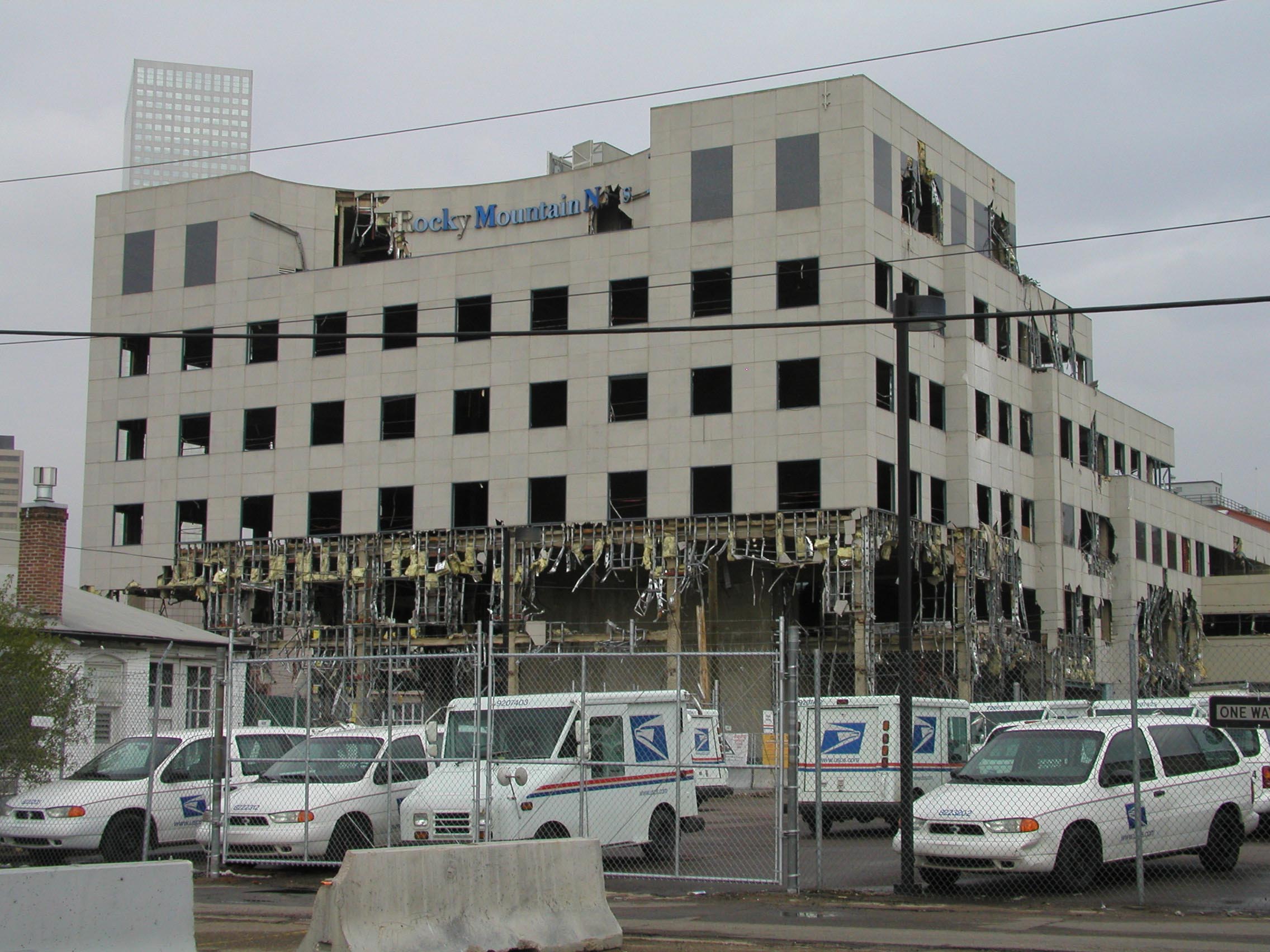
Assault on the Rocky?

April 9th, 2007


The Rocky
      

Is this the future of the Rocky?

Or its past?

Or is this what happens when conservatives attack the alleged liberal media?