How a Rocky Mountain News Endorsement Launched the Political Career of John Hickenlooper

October 29th, 2013

Around midnight on April 2, 2003, five weeks before John Hickenlooper won the first election of his political career, Hick campaign manager Paul Lhevine and other campaign staffers arrived at the Rocky Mountain News printing plant in industrial northeast Denver.

They asked workers for the early edition of next day’s Rocky, which was just coming off the press.

“The folks at the plant were pretty amused by us,” said Lindy Eichenbaum-Lent, who was Hick’s Communications Director. They had no problem with leading Eichenbaum-Lent and the others to the printing press, where Lhevine scooped up some newspapers off the conveyer belt.

Hickenlooper’s staff was hoping an endorsement from the conservative but quirky Rocky would add credibility to Hick’s off-beat campaign. A Rocky endorsement, it was hoped, would separate him from the pack of seven candidates vying to be Denver’s mayor in 2003.

Lhevine left the printing press and took a still-warm newspaper straight to Hick’s LoDo loft in the middle of the night.

“It was just stunning,” Hickenlooper told me of the Rocky’s endorsement. “It was like, all of a sudden, the junkyard dog that finally catches up to the trash truck, right? What am I doing now?”

The editorial endorsement turned out to be essential in Hick’s first election victory.

“Voters want something more from a candidate than demonstrated competence and imagination in tackling bread-and-butter maters such as jobs, bureaucracy, budgets and productivity,” the endorsement stated. “They want someone who possesses a larger vision for the city, a genuine love for its essential character, and a passion for the welfare of every resident. But as anyone who has spent time with Hickenlooper knows, he exudes all those qualities. He has long been committed to making Denver a better place—all of Denver, not only the lower downtown area that he helped resuscitate.”

After the election, Republican strategist Dick Wadhams told the Rocky’s Lynn Bartels that in ten years (i.e., now), people would still be talking about the impact of the Rocky endorsement. (They are.) Wadhams called it “stunning” and “one of the strongest-written editorials I’ve ever seen.”

“I could not have possibly won without that endorsement,” Hickenlooper told me last year, apparently speaking to a reporter about it for the first time.

The governor said the “glowing” endorsement legitimized his unlikely candidacy and pushed influential players and others into his corner. Helen Thorpe told me via email that it was a “game changer.”

That’s exactly what Rocky editor John Temple and editorial-page editor Vincent Carroll hoped they’d achieve by publishing the raving endorsement five weeks before the primary election.

“That was a deliberate decision to go early, in part to make a splash, I will admit, and to beat The Post, but in part because we thought, if we could provide a kick to the campaign, now was the time to do it,” said Carroll, who wrote the editorial. “It was best to do it early to focus his name in the minds of people who up to that point, perhaps, had not taken him seriously. So that was very deliberate to go early.”

“If we were going to endorse him,” said Temple, “we needed to do so in a way that was really going to bring attention to him.”


“We’re Worried that You Don’t Have a Shot”

But first, Temple and Carroll, like everybody else, had to be convinced to take Hickenlooper seriously.

“Initially, I couldn’t believe that a guy was going to build a campaign for mayor based on essentially a campaign against a stadium name,” Temple told me, referring to Hickenlooper’s earlier efforts to keep “Mile High Stadium” as the name of Denver’s football stadium. “And I didn’t take [Hickenlooper’s campaign] very seriously.”

But after “doing our homework” and meeting multiple times with Hick and his staff, Temple says he became convinced that Hick had more potential than another candidate Temple liked, Ari Zavaras.

“We thought that he had political skills, that he was clearly intelligent, that he seemed to have this curiosity that allowed him to propose one variation of an idea after another,” said Carroll. “He had a fertile mind. He talked seriously about public policy. He was not a Johnny-come-lately to civic affairs. And I don’t mean in terms of his sitting on boards to build up his resume, but he had actually done some things like try to save the Mile High name but also some things behind the scenes that were substantive.”

So Hickenlooper seemed serious and smart, but the question for the Rocky was, as a practical matter, did he have a decent chance of winning?

It looked like Hickenlooper could “raise significant money,” Carroll said. In fact, in the month prior to the Rocky’s endorsement, the brew pub owner though still behind in overall money-in-the-bank, was collecting about as much cash as the leading candidates.

But money aside, you don’t want to back somebody “if he’s going to make you look foolish, to be quite honest,” Carroll told me.

“I remember there was one concern expressed by Peter Blake, who was on the [editorial] board at the time, that we could look silly if he ended up with five percent of the vote and never took off, never gained any traction, like some of these guys who try to make the transition from business to politics,” Carroll said. “They just bomb.”

Temple informed the Hickenlooper campaign that the Rocky was serious about endorsing him but, according to Hick, Temple said: “We’re worried that you even have a shot.  You’re so far behind in the polls. You’re so unlikely a candidate.”

Hickenlooper asked campaign advisor Mike Dino to help make the case to the Rocky that he could win.


Rocky Had Big Influence on Previous Denver Mayoral Races

Dino was Wellington Webb’s campaign manager in 1991, and he’d seen how the Rocky’s endorsement of Webb (two weeks before the primary, on the same day The Post endorsed Norm Early) had given the underfunded Webb campaign a “huge boost” in credibility and momentum. Webb has been quoted as saying his Rocky endorsement was “the turn-around” for his campaign.

Dino was also aware that the Rocky’s track record on mayoral endorsements included not only picking Webb but Federico Peña in 1983. The Rocky’s Peña endorsement wasn’t as effusive as Hick’s (neither was Webb’s), but it, too, came out early (three weeks before the primary and two weeks ahead of The Post’s endorsement of Dale Tooley) and surprised many political types. It’s widely seen as having given Peña a serious boost.

“I certainly thought, from previous experience, that if then-candidate John Hickenlooper could get one of the newspaper endorsements, it would be a huge shot in the arm for what was already a promising candidate and campaign,” said Dino.


First Hick Campaign Ad Impresses Rocky

Hickenlooper recalls Dino laying out the case to Carroll at a breakfast meeting at Dixon’s restaurant in Lodo.

“Vince was saying, ‘Hickenlooper doesn’t have a discernible constituency that’s going to get behind him, like the Republican Party or the Democratic Party or the enviros or this or that,’” recalls Dino. “And I said, ‘That’s what’s so unique about [Hickenlooper]. He’s going to get realtors. He’s going to get business organizations. He’s going to get nonprofit associations. He’s a different type of political animal with a different constituency.”

Hickenlooper told me: “Dino did a brilliant job of saying, ‘Colorado loves underdogs. If you look at who’s supporting [Hickenlooper] and who cares, if there was credibility and people thought he’d win, things could change dramatically. And wait until you see the first TV ad.’

Hick’s debut ad, which political junkies still talk about, depicted an unpolished candidate trying on cheap suits. “Everybody says I need better clothes,” says Hick in the ad, and at the end, he zips away on a motor scooter. Its light humor and outsider tone appealed to multiple audiences, including the disheveled demographic.

According to Carroll, the ad closed the deal for Hick.

“The ad demonstrated that he could probably run a competent campaign,” Carroll told me. “And that’s important.”


Endorsement a Risk but Focused on “Stuff We Were Comfortable With”

During my interview with Hickenlooper, I handed him a copy of the endorsement. He read the first line aloud:

“John Hickenlooper is the only serious candidate for Denver mayor who has actually done what all the other candidates say they want to do as a top priority: create an impressive number of private sector jobs.”

Hick stopped reading and said: “Holy smoke! Look at how long the endorsement is. It doesn’t mention a single other candidate. When do you ever see that? And not at any moment do they say, well, he has problems here. He has this problem there or whatever… It’s cool to read this again. It’s actually the first time I’ve looked at it in years.”

Carroll told me that in the endorsement he focused on the “stuff we were comfortable with.”

“We actually mentioned the Chinook Fund [which Hickenlooper helped establish], although I referred to it as ‘edgy Chinook Fund,’” Carroll told me, reaching across the table and circling the word “edgy” on the copy of the Hick endorsement I’d shown him earlier in our conversation.  It was clearly a word he’d picked carefully ten years ago.

“I didn’t want to give it away,” Carroll said. “It’s actually a left-wing fund.” The editorial also states vaguely that Chinook “funnels grants to maverick activists.”

“I won’t deny; it gave me pause,” Carroll said. “Does this guy have an ulterior agenda that he’s not letting on to? But I don’t think he did, after all, at the end of the day. I think he pretty much wanted to do what he said he wanted to do. Fortunately, I was right.”

“Whatever his views on social issues, or issues we might have been more conservative on, didn’t matter, because that wasn’t the purview of the mayor,” said Temple. “It really mattered to us that he brought that business experience and when we met with him it was obvious that he had that.”


Hick Campaign Surges after Endorsement

The Rocky’s endorsement gave the beer guy the springboard that both Hickenlooper and the Rocky had hoped it would.

Hick took off.

Two long weeks after the endorsement, The Denver Post also picked Hick, complimenting other candidates but writing that Hickenlooper stands out as having an “exciting agenda of change for a city stalled in the economic doldrums.”

Three weeks after the Rocky endorsement, Hickenlooper had a 13-point lead over his opponents, after trailing by as many points about eight weeks before. (Unfortunately, more polling info isn’t available.)

“It was a big boost at an important time when people were wondering if they should take a risk with this guy,” said Dino. “It made it easy for a lot of people to say, ‘Oh, yeah, now I can get on board.’ [The Rocky endorsement] probably had a better effect than it did for Wellington.  People were ready for John. They needed a nudge.”

“The Rocky moved him from the guy with the quirky campaign to someone to be taken seriously,” said Penfield Tate, who ran for mayor that year, adding that he expected the Rocky to endorse Hick because it was the “conservative newspaper.”


Most Influential Newspaper Endorsement in Colorado History

Don Mares, who faced Hick in the mayoral runoff election in 2003, told me Hick’s creative ad campaign, not the Rocky endorsement, separated Hickenlooper from the other mayoral candidates. The ads were particularly effective with so many candidates in the race, he said. Dino also thinks Hick would have won without the endorsement.

But most people I spoke with, on and off the record,  agree that the Rocky editorial, coupled with the ads, was indispensable in the first election victory of the guy who’s gone on to become governor.

This leaves little doubt, and former Post journalist Fred Brown agrees with me on this, that it’s the most influential editorial endorsement in memory—if not in the state’s history.

As such, it’s distinct from most newspaper editorials, which, as former Post editorial writer of 32 years Bob Ewegen put it, “probably fit in the classic definition: Writing an editorial is like wetting your pants in a blue serge suit. You feel warm all over but nobody notices.”

But in this case, there’s substance behind the warm feeling Temple got after endorsing Hick.

“The day after the mayoral election, the mayor-elect and his wife, and Michael Bennet and his wife, invited Judith [Temple’s wife] and me to dinner at Hickenlooper’s loft in Lodo,” said Temple, who’d not met the brew pub owner prior to the election campaign. “We had a barbeque outside, and it was sort of in recognition of the role that the Rocky Mountain News, not me personally, but the Rocky Mountain News had played. They knew it was absolutely critical. He obviously had to win and to do it himself. But they knew that the editorial had been the key.”


Carroll Doesn’t Regret his Role in Launching Top Dem

Former Rocky cartoonist Ed Stein, who drew cartoons at the Rocky for over 30 years, told me that “Vince felt strongly that the Republican agenda was preferable to the Democratic one.”

Stein’s liberal bent doesn’t stop him from referring to Carroll as a “wonderful editor,” but Stein says Carroll generally “felt he should support any, even marginally acceptable, Republican candidate, even if he/she was a dim bulb or politically inept, so long as it represented a reliable vote for the good guys [the GOP].”

But the Denver mayoral election is nonpartisan, and as Stein put it, “It’s kind of pointless in the mayoral election here to support a Republican.”

So you might think Carroll, who’s a mix of social conservative and libertarian, might have regrets about his role in launching the career of Hickenlooper, who’s turned out to be such a successful Democrat, considered presidential material.

But even now, with Hickenlooper presiding not over the liberal city Denver but the centrist hotbed of Colorado, Carroll expresses no regrets about the editorial he wrote 10 years ago.

“I still like now-Gov. John Hickenlooper,” Carroll told me in December, before he became editorial-page editor of The Denver Post. “On the spectrum of politicians, I think he’s a good one, on the upper end of the spectrum. I don’t always agree with him on policy, and I don’t expect to. But, since he’s been governor, he has continued to be something of a maverick on some issues. And that’s good enough for me, for a state-wide Democrat. You don’t always know what he’s going to say on an issue. But some prominent Democrats in this state, I do. And I find that refreshing. I find it refreshing in any politician. It worked out. And as you recall, the alternatives in 2010 were Tom Tancredo and Dan Maes, neither of whom I voted for. Leave it at that.”

Jason Salzman was a freelance media critic at the Rocky. He now blogs at www.bigmedia.org. Contact him at Jason@bigmedia.org Twitter: @bigmediablog
Talk-radio host should remind State GOP Chair what he told Fox 31 about recall elections

October 28th, 2013

Three weeks ago, KDVR’s Eli Stokols reported that Ryan Call, Chair of the Colorado Republican Party, had some harsh words to say about the recall election of Democratic State Senator Evie Hudak:

Call: “This recall election would undermine our efforts in the governor’s race, the U.S. Senate race and to win a senate majority if voters perceive that Republicans are trying to win a majority through recalls.”

“The job of the Republican Party is to get Republicans elected when there are regular elections,” said Colorado GOP Chairman Ryan Call. “And there are already a lot of things competing for our time, attention and resources. [BigMedia emphasis]

In a different media environment Thursday, on conservative talk radio, Call reiterated that the State Party won’t back the petition-gathering effort to recall Hudak, but he said the State Party would be “all in” if  a recall election takes place, “just like we were in the recall elections in Colorado Springs and Pueblo.”

Call: “The principled purpose and objective of the Republican Party is to support Republicans in elections. So, as soon as there was an election, and as soon as there is a Republican candidate [in Colorado Springs and Pueblo recall elections], the State Party was all in to help support that effort, and we would do the same if enough citizens, again, Republican, Democrat, unaffiliated voters, sign recall petitions [for Hudak recall election]. We want to honor and respect the will of the citizens…. We’ll be all in just like we were in the recall elections in Colorado Springs and Pueblo.”

Call’s tone on KNUS’ Kelley and Company Oct. 24 had changed dramatically from three weeks ago when he was saying that the Hudak recall election would “undermine” (as in kill, destroy, stop, lose, end, flatten) Republican hopes for next year.  What happened to his view that it’s his job to support Republicans in “regular” elections?

Host Steve Kelley should have Call back on the show to find out what’s changed in the past three weeks or whether Call has one set of talking points for talk radio and another for news outlets where professional journalists live and work.

Partial Transcript of appearance of Ryan Call on KNUS Oct. 24:

Call: The State Party directed over $120,000 in support of those two Republican candidates in recalls in Colorado Springs and Pueblo.

Kelley: You were not behind that effort  personally either were you?

Call: That’s the point. The principled purpose and objective of the Republican Party is to support Republicans in elections. So, as soon as there was an election, and as soon as is a Republican candidate, the State Party was all in to help support that effort, and we would do the same if enough citizens, again, Republican, Democrat, unaffiliated voters sign recall petitions. We want to honor and respect the will of the citizens.

Kelley: Why wouldn’t you then offer financial support to the folks on the front end?

Call: Once a recall is ordered, once there is a demonstrated desire on the part of the citizens to have an election, the State Party will step in. That’s our role. Other outside groups can push for recall elections. We won’t stand in their way. What we need to be prepared, with resources and organizational help and support, to help elect a Republican candidate as a successor if a recall election is ordered. We’ll be all in just like we were in the recall elections in Colorado Springs and Pueblo.

Report the shock pastor’s bigotry but correct his facts

October 24th, 2013

You’ve heard of shock jocks, like the drive-time radio hosts who throw chickens out the radio station’s second-story window? If a shock jock is a right-wing pastor, then you’ve got a shock pastor, like Colorado Springs’ Kevin Swanson, who recently cited “decadent homosexual activity” as the cause of Colorado’s floods.

Swanson’s latest shocker: his campaign against Girl Scout cookies. Swanson’s anti-cookie crusade was first reported by Right Wing Watch, which spotlights this kind of stuff. It quoted Swanson on his weekly radio show saying that “the individualism of feminism has been devastating to this country.”

Swanson: “I’d say you ought to say no the Girl Scout cookies too. I don’t want to support lesbianism, I don’t want to support Planned Parenthood, and I don’t want to support abortion, and if that be the case I’m not buying Girl Scout cookies…”

“The vision of the Girl Scouts of America is antithetical to a biblical vision for womanhood, it’s antithetical to it… Guys just check it out at the Girl Scouts’ websites and you’re going to find that the people showing up are lesbians, lots and lots of lesbians. Dave, I didn’t realize there were this many lesbians leading this country but they certainly show up in Girl Scout conventions across America…

“In fact, if you want a communist in the White House in the year 2020 you have got to get more daughters raised with the worldview, the independent mindset, the worldview that is presented by the Girl Scouts of America.”

As Westword pointed out today, Swanson didn’t change his tune in a Channel 7 interview last night.

Channel 7 asked Swanson to back up his assertion that the Girl Scouts promotes Planned Parenthood, abortion, and lesbianism.

Channel 7 reporter Marc Stewart: How can you make those statements?

Swanson: I just take the data I see on the Internet. I take the associations I see on the Internet. I see the promotion of feminism and lesbianism.

Unfortunately, Channel 7 didn’t show us Swanson’s alleged internet proof—or state as a factual matter, that none exists.

Still, the TV station did report a denial from the Girl Scouts, as well as a counter view from a parent.

Girl Scout parent Susan Sabol: “The meetings have nothing to do with sexuality or reproduction, or reproductive rights. They’re really leaning to be good members of society and the community. It’s very much about being a good person.”

You can argue that, at some point, reporters should ignore shock pastors, who repeatedly blast out outrages on little-known internet radio shows.

But there’s actually a lot to be gained from seeing bigots being bigots, and asking them about it, as long as their misinformation is corrected and the facts are clear.

Radio hosts should have asked Brophy for more details on the undocumented valedictorian milking cows

October 23rd, 2013

Conservative talk-radio hosts agreed to disagree with State Sen. Greg Brohpy  last week on his support of a new Colorado law offering undocumented students, who were brought to our country illegally, in-state tuition.

Asked to explain the evolution of his thinking on the topic (from for it to against it), Brophy said in part:

There is a real problem that some kids in the state of Colorado are locked into permanent impoverishment when there is a better path for them.  So, you know the kids down here in Kersey, for instance, a kid named Everado who was the valedictorian of his class and a great football player and baseball player, had a scholarship to go to college but couldn’t get in-state tuition.  He is now milking cows instead of going to college.

Nicely put, but why won’t this kid be able to stop milking cows and go to college, now that the ASSET law has been passed? KFKA co-hosts Devon Lentz and Tom Lucero didn’t ask. Maybe Brophy himself can help this kid, and differentiate himself further from fellow gubernatorial candidate Tom Tancredo?

But the AM Radio Colorado Show hosts were apparently too upset about Brophy’s support for ASSET to sympathize with Everado. Instead, they pushed on, asking Brophy where he stands on the immigration bill passed by the U.S. Senate but being held up by the Republican-controlled House.

Brophy said he’d oppose the bill, explaining:

BROPHY:  I would oppose that bill.  I would say, you know, first and foremost, secure the borders.  Make sure that we stop, as much as possible, the inflow of people coming into the country illegally.  And then second, and almost immediately, put in place a two-track visa system where people that want to come here to become Americans have a path to do that, that they can actually see, that takes away the incentive to cheat.  And another path – a visa path – that let’s people come to this country to work.  And again, it’s a relatively easy path to see, to take away the incentive of coming here illegally.  I look at this like a problem to solve, a little bit like a police chief in a small town.  If you’re having a lot of trouble with kids late at night, you enforce the curfew.  The kids that are inclined to not cause problems, will be at home.  The ones that are going to be problematic, there won’t be nearly as many of them for you to watch.  So, if you have a visa system that actually works, that allows people a pretty clear path to get here, to become an American or to get here to work, then you don’t have to watch so many people trying to sneak in to the country illegally.   That solves that problem, and I would be pushing for that as governor.  I think that’s a—you know, that’s an American way of doing things.  We want people to come here.

Lentz and Lucero should have someone on the show to defend the immigration bill, since Brohpy won’t do so.


Raise your hand if you think Boyles objected when his guest called recall opponents Nazis

October 22nd, 2013

Speaking on a radio show yesterday, Mike McAlpine, one of the leaders of the effort to recall Democratic Sen. Evie Hudak, called Hudak supporters Nazis.

“I mean, these people – the Brownshirts — have been doing it for decades and decades,” McAlpine told KNUS’ Peter Boyles yesterday morning, referring to Hudak supporters he encountered over the weekend in the Westminster area. “You and I recognize it.” (Listen to McAlpine on Peter Boyles Oct. 21 @ 1:30)

Raise your hand if you think Boyles, who surely knows how the paramilitary “Brownshirt” Nazis helped Hitler gain power, objected.

Seeing no hands raised, I’ll tell you that Boyles chose to respond with a breathless: “Yeah! Yeah!”

Boyles offered to create a “goon squad” to support the Hudak-recall petitioners. He’ll post photos on the KNUS website to identify recall opponents and where they live, he said.

“Look, I’ve said this a thousand times: If the progressive gets his/her hands on the helm you can start to say goodbye to 1st amendment, 2nd amendment, the 4th amendment, the 5th amendment,” Boyles said on air.

As for evidence of Nazi activity in Westminster against Hudak opponents, there is none. Over the weekend, “Alan” on ColoradoPols posted a video of a discussion among activists and police during which recall supporters could cite no evidence of voter intimidation, much less Nazi brutality.

On Boyles’ show this morning, McAlpine again made accusations of voter intimidation but there was no documentation, other than an inconclusive photo on Boyles’ web page, which could be interpreted any which way.

McAlpine said that after his complaints on Boyles’ show Monday, and to the Secretary of State’s Office, police are responding more quickly to his complaints.

That’s good. Because Boyles spent a lot of air time today promoting his goon-squad idea. You wish you didn’t have to take Boyles seriously, but you do.

Gessler’s talk-radio salvo conflicts with his own office’s election rule that you have to live in a district in order to vote there

October 21st, 2013

Back in August, Secretary of State Scott Gessler’s office issued an election rule stating that voters must reside in the same district in which they vote, and, in case someone like Jon Caldara was wondering, Gessler’s rule stated that “intent to move, in and of itself, does not establish residence.”

This sounded sensible to people who believe in representative government.

But about a week later, the residency rule was rescinded by Gessler’s office for no apparent reason. It was part of a set of election rules, one of which was thrown out by a judge, but Gessler wasn’t required to dump the residency rule. But he did anyway.

About a month later, people who believe in representative government were surprised when Gessler stepped up to a talk-show microphone on KNUS radio and proclaimed that under Colorado’s new election law, “you don’t have to live in the district in order to be able to vote there, which I think is just absurd.”

Now, even people who don’t believe in representative government were puzzled, because in August Gessler’s office had arrived at the exact opposite conclusion about the new law.

The eternal question: What would Gessler say next?

Well, on Oct. 9, the residency rule was re-issued by Gessler’s office in almost the exact same words as before, stating that “intent to move to a new district or county, in and of itself, is not enough to establish residency.”

The rule also says: “An elector may not register to vote in a new district or county unless he or she has already moved and established his or her primary residence in the new district or county.”

Just like before, this makes sense to most everyone, except maybe Jon Caldara and…we don’t know if Gessler’s on board with it, even though it emanated from his office.

Will Gessler again be asked to step up to a talk-radio microphone and explain if he still thinks, like he said before, that Colorado’s new election law mandates that “you don’t have to live in the district in order to be able to vote there?”

How could he possibly think so, now that his office has twice concluded otherwise? I’ll be sitting by my radio, waiting for his answer on KOA, KNUS, KLZ, or wherever.

Actually, wouldn’t it be fun if Jon Caldara asked Gessler about it on his Sunday KHOW show?

In trying to defend Coffman, Mike Rosen proves enviros’ claim that Coffman has head in sand on global warming

October 16th, 2013

I try not to miss any of the fact-checks of political ads on local TV. But somehow 9News’ Aug. 21 “Truth Test” of an ad attacking Rep. Mike Coffman got by me. It was the ad showing photos of ostriches and claiming that Coffman has his head in the sand about global warming.

9News’ Brandon Rittiman concluded that, even though part of the ad is an “overstatement,” it’s “fair to say” Coffman questions whether “we can do much” about climate change, because he’s “said repeatedly that ‘climate change is naturally occurring’ and it’s still up for debate how much of an impact people are having.”

Rittiman reports:

“Despite saying on his website that he wants to reduce carbon emissions, Coffman does have a solid record of voting against controls for carbon.”

“Bottom line, if you want someone in office who will vote for more control of carbon emissions, Mike Coffman isn’t your guy.”

Rittiman’s analysis of the ad demonstrated basic integrity and attention to detail that was nowhere to be found in the work of Denver Post columnist Mike Rosen, who also critiqued the ad.

Rosen starts his Aug. 11 Denver Post column by writing that the ad, paid for by the League of Conservation Voters, “dishonestly attacked Rep. Mike Coffman,” and “absurdly calls Coffman an anti-science extremist.”

But where are the dishonest attacks on Coffman? Rosen never tells us. Instead, he just writes that “science is never settled,” and, it’s “highly speculative” whether humans are causing global warming.

Rosen doesn’t try to defend Coffman for being the climate-change denier that the ad accurately says he is. Instead, Rosen holds hands with Coffman and questions whether humans are causing climate change. Rosen asserts that the ad falsely claims that “97 percent of scientists agree that climate change is real.”

Rosen: The league charges that Coffman is out of step, claiming “97 percent of scientists agree that climate change is real.” Of course climate change is real. Coffman doesn’t deny that. The Earth’s climate perpetually changes. Ice ages and warm ages predated human existence. Yes, global temperatures have increased since 1800. That was the low point of what’s called the “little ice age.” And the increase was driven by solar radiation, not SUVs. But notice the League of Conservation Voters’ sneaky wording. It didn’t say that 97 percent of scientists agree that “human activity” is a primary cause of global warming, because the survey it cites made no such claim. And the impact of human activity is the key, disputed variable.

Actually, the survey cited in the ad says that 97 percent of scientists do, in fact, agree global warming is “very likely due to human activities.”  They didn’t assert that it’s absolutely positively the primary cause, but “very likely” sounds like agreement to me.

That’s probably why Rittiman also found the ad’s fact that 97% of scientists believe climate change is real “to be true, among climate scientists.”

Rittiman reported:

CLAIM: 97 percent of scientists agree climate change is happening and NASA says it’s worsening extreme weather. VERDICT: TRUE

The ad should have specified that the figure represents agreement specifically among climate scientists, but it is a well documented figure, backed up by reputable research.

You can also find articles from NASA discussing extreme weather as it relates to climate change and worsening fire conditions, too.

It turns out, surprise, Rosen denies climate-change science just like Coffman does.

So, ironically, in trying to defend Coffman, Rosen reinforces the basic facts in the ad, which were affirmed by Rittiman, that scientists agree humans are causing global warming and Coffman doesn’t believe mainstream scientific opinion on the topic.


USA Today Misleads with Hickenlooper Headline

October 15th, 2013

by Michael Lund

 
Reporter Susan Page, Washington Bureau Chief at USA Today, and her editors apparently need our help.

So, here is a challenge I pose to readers: Please watch Page’s interview with John Hickenlooper and suggest a headline which fairly represents the content of our Colorado Governor’s remarks, while highlighting the most newsworthy and attention grabbing aspects.

My guess is that your best amateur efforts will exceed the misleading and misrepresentative headline waving over the video interview posted Monday morning on the USA Today’s online “Washington Download” program. I mean, did Hickenlooper actually give the NRA and gun-rights groups an endorsement for unilateral and uncontested access to Colorado voters, as the USA Today headline suggests?

The interview covered a range of timely topics, including the roll-out of the Colorado Health Care Exchanges, the government shutdown and its effects on Colorado’s flood recovery, and Hickenlooper’s prospects for re-election to the governor’s office and ambitions for higher office. Any of those topics could produce a worthy headline.

But, for the sake of argument, let’s accept that Colorado’s gun laws passed during the last legislative session and the resulting recall elections in El Paso and Pueblo Counties, along with the latest recall attempt initiated in Senate District 19, are prime topics to highlight in an attention grabbing and timely headline. A month after the recalls, they are still relevant and reverberating across our local media landscape and beyond. News from the recalls convey the controversy which the competitive, market driven media industry and consumers of news love.

So, in constructing our salacious headline, let’s focus on that section of the interview.

Just over half the interview deals with the topics around gun legislation and the Colorado recalls. Mention of the Aurora theater and Newtown, Connecticut shootings provide the context behind intitiating the gun safety bills. Visuals are edited into the interview provide a balanced depiction of the public demonstrations of support for both sides of the issue. Hickenlooper candidly and concisely speculates on the political challenges behind passing the common sense legislation, despite initial support from polls. Probing, difficult questions, answered directly, articulately and concisely by the interviewee. No softballs. That’s what we like to see.

It’s all good until Susan Page asks about outside money in the recalls, and it is this section of the interview that the sources the misrepresentative headline for the interview. I’ve transcribed the relevant portion below:

PAGE: And in the previous two recalls, there was a lot of money that came into Colorado from supporters of gun laws

HICKENLOOPER: And opponents.

PAGE: And opponents. But from people like Michael Bloomberg and others on behalf of the two senators who were recalled. That became a little bit of an issue in Colorado. Would it be smart if there’s this third recall effort, to try and limit the outside money and make it a Colorado effort?

HICKENLOOPER: Probably. I mean, Colorado is a state that people like to be resourceful themselves, and solve their own problems. They don’t really like outside organizations meddling in their affairs. And maybe the NRA gets a pass on that. But, probably not a bad idea. I do think that, again, getting the real facts out on some of these issues and making sure that – I mean, universal background checks is not the ogre, it’s not the evil, demonic taking of guns that it has been presented as.

When I listen to the interview, when I see the transcription, I don’t take away that “Colorado Governor suggests gun-control groups stay away.” I hear a much softer hypothesis– speculative dreaming, really, considering that limiting any groups participation in the recalls isn’t realistic or even constitutional, whatever the Governor might suggest. I hear speculation about an ideal of self-determination for Coloradoans, and getting facts to voters without distractions of political firefights, hyperbole, and loud well-funded special interests.

And most importantly, I hear our Governor correct the bias of the reporter’s leading question, by pointing out that both outside opponents and outside supporters of gun-control legislation were represented in the recall fight. Instead of exclusively calling out gun-control groups’ participation in Colorado, I hear Hickenlooper directly say, “And maybe the NRA gets a pass on that.”

Now there’s an accurate, attention grabbing headline that writes itself.

It’s bad enough that an otherwise decent interview with Hickenlooper is marred by the misleading headline, but it’s worse when our local journalists repeat and amplify the mistake. On Monday, the Denver Business Journal constructed a short article, apparently around the USA Today headline alone, and repeating the misrepresentation in three of the four paragraphs.

Then, to make bad journalism worse still, Kurtis Lee repeats the mischaracterization in his blog post headline for “The Spot” in The Denver Post, even after noting the same quotes from Hickenlooper I quoted above, and a statement from Hick’s spokesman, Eric Brown, which clarifies the Governor’s remarks. The headline is a stark misrepresentation of what the Governor said.

Let’s hope that accuracy prevails in future headlines regarding our on-going gun-safety debate in Colorado.


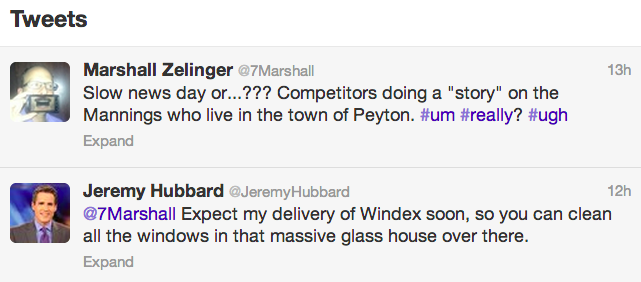
Messenger Shoots Messenger

October 11th, 2013

With the growing influence of alternative media platforms like Twitter, is this kind of “peer review” a growing trend?

Good thing?  Bad thing?

We’ll be looking for data points to track this trend.  Please feel free to contribute!  Send us your entries.

If journos are going to take CO secession seriously, they should report Gardner’s position on it

October 11th, 2013

In college, I led a petition drive to put an question on the student-council election ballot asking students if they wanted the university to stock suicide pills for optional use by students in the event of nuclear war.

The media had to take this seriously, because kids were actually voting on it, and it had its own internal logic, given the Cold War nuclear craziness around us at the time. But what college would stock suicide pills? Obviously, our core goal, even if we were also serious, was to promote our anti-nuclear agenda.

Same with the secession “movement.” At it’s heart, given the impossible odds of it happening, it’s, duh, a media stunt, offering right-wing conservatives the chance to bash moderate Democratic legislation.

But, it’s true that 11 counties will be voting to secede from Colorado, and so you can’t blame reporters for feeling as though they have to take the stunt sort of seriously, without overdoing it like The Denver Post has done.

But taking it seriously means finding out if serious conservatives actually support it. This week, the New York Times covered the secessionists, quoting county-level GOP organizers and Democratic Gov. John Hickenlooper as saying he takes it seriously. But, really, what else can the Democratic governor say?

More interesting is what serious Republicans like Rep. Cory Gardner would do on election day. As a resident of secessionist-hotbed Yuma County, he’ll be voting on it next month. And if you take secession seriously, Gardner would eventually be voting on it in Congress, too, if it’s gong to pass. Plus Gardner has long-standing ties to secession-organizer Sean Conway.

Will Gardner vote yes? (So far he’s been vague.) What about the GOP gubernatorial candidates? Where do they stand?

When something smells like a crazy media stunt, and reporters still have to take it seriously, they should at least give readers enough opinions on the matter so they can try to understand what’s really going on. In this case, getting the specific positions of Republicans, whose audiences goes beyond the way-right crowd in the secessionist counties, is key to offering a fair and accurate picture.