Statesman gets credit for trying to find out if Coffman, Gardner, and Tipton still support personhood

November 28th, 2011

UPDATE 8-7-2012: This blog post was corrected to reflect the fact, incorrectly reported previously, that Rep. Scott Tipton is not on record supporting the personhood amendment in 2010.

————————-

The Colorado Statesman went where no other media outlet dared go last week and asked Colorado’s congressional delegation whether they support the personhood initiative, born again last week at a Denver press conference.

One could argue that the 2012 personhood initiative isn’t actually “born,” or alive in any way, really, until it makes the ballot, but for our purposes, a personhood amendment is considered alive when the proposed wording of the personhood petition has been officially submitted, and this occurred last week.

The Statesman reports:

Colorado’s Republican congressional delegation was mostly silent on the measure this week. U.S. Rep. Doug Lamborn is “a supporter of personhood,” according to an email sent by his spokeswoman, but press aides for U.S. Reps. Cory Gardner and Scott Tipton didn’t respond to inquiries from The Statesman and a spokesman for U.S. Rep. Mike Coffman said his boss was out of the country and unavailable for comment.

The Statesman failed to note that Coffman and Gardner are former supporters of Colorado’s 2010 personhood initiative, and former Colorado Personhood poster child, now grown up, Kristi Brown, said Gardner was, in fact, “one of our main supporters” in Colorado in 2008.

Nor did the Statesman report that, despite endorsing personhood in Colorado and Coffman have yet to endorse bills in Congress, backed by GOP lawmakers, aimed at making personhood the law of the land. Lamborn hasn’t endorsed federal personhood bills either, despite telling the Statesman last week that he supports personhood.

But the Statesman did quote Colorado GOP Chair Ryan Call as saying that “there is often a difference of opinion within our party on how best to advance that cause.”

Also, the Statesman briefly told the strange tale of failed Colorado Senate candidate Ken Buck’s relationship with personhood, consumated with a full endorsement of the measure. But Buck later admitted to having prematurely endorsed personhood, without understanding it fully, so he un-endorsed it.

Still, Buck didn’t shed his personhood-like position on abortion, and it is widely believed to have played a key, if not decisive, factor in his loss to Sen. Michael Bennet.

Video of personhood press conference shows often-overlooked value of bloggers

November 22nd, 2011

I’m a blogger, so I’m in a good unbiased position to write that bloggers make more contributions to the public debate than they are often given credit for.

No matter where you are on the political spectrum, you have to appreciate the blogger who posts unedited video of public events, like Free Colorado’s Ari Armstrong did yesterday.

Armstrong posted video of a press conference staged by backers of Colorado’s personhood on the occasion of submission of wording for a 2012 personhood amendment.

It’s excellent material, airing out good information, along with Armstrong’s interviews and written analysis, about the initiative.

Here’s his video:

Upset about pizza comment, KENN talk-show host calls Democratic strategist a “stupid female dog,” an “ignorant slut,” a “stupid retard” and more

November 22nd, 2011

Skip this if you’re one of those people who won’t read blog posts about the latest outrageous comments on right-wing talk radio, because they’re just the latest outrageous comments on right-wing talk radio.

But read on if you want a window into what hate looks like, and you want to call it out.

You may remember my post in October about  KENN radio host Sean Jeremy Osborn’s suggestion that the entire population of Iran is like a cancer and should be killed.

Now Osborn is angry at Democratic strategist Donna Brazile. My guess is that Osborne has some underlying issues here, because you’d never think Brazile’s comment about the meaning of vegetables on pizza would set off a explosion of rage from Osborne.

You can speculate for yourself about what’s really bothering Osborn after I explain what happened.

On CNN’s “The Situation Room” Nov. 14, host Wolf Blitzer read to Brazile the following comment by GOP presidential candidate Herman Cain, and Blitzer asked Brazile if she had a “problem” with it:

“The more toppings a man has on his pizza, I believe, the more manly he is…. A manly man don’t want it piled high with vegetables…. He would call that a sissy pizza.”

Brazile’s response to Blitzer:

“Herman Cain clearly has a ‘women’s problem.’ He doesn’t know how to address women. He doesn’t know how to respect women, and now he’s making this comment about, bring on more toppings.”

Osborn played this exchange on his “Painful Truth” radio show and started screaming.

“Seriously, Donna, you’re going to go there? It’s an advertising-marketing thing designed to reach men. Men like meat on their pizza, you stupid female dog…It doesn’t mean Herman Cain is insensitive to women… It means men like meat on their damn pizza….I am ready to start busting walls in this room. Donna Brazile…you are a magnificently ignorant slut. There, how’s that for disparaging to women, you dumb female dog…you stupid retard.”

There’s more, and you can listen to below. Osborn starts off by saying that the exchange reflects hypocrisy in journalism. hmmm?

You’re thinking, who cares what an apparent right-wing nut says on a small radio station in the four corners area.

I do because, hey, KENN may be small, but it still reaches the good people in multiple cities like Durango and Cortez. It’s also owned by American General Media, which appears to have at least one other station in California.

So Osborn, who hasn’t returned past emails, because, he says I’ll  take his comments out of context, as if this were possible, should explain his behavior to his bosses and the people of these communities. Contact KENN here.

Listen to Osborn here:

Politics should be focus of personhood coverage

November 21st, 2011

UPDATE: This blog post was corrected on 8-7-2-12. Scott Tipton did not support the personhood measure in 2010, as previously reported here.

———–

Another attempt at passing a personhood amendment, defining zygotes as people, would almost certainly fail if it makes the Colorado ballot next year, given that it’s gone down decisively twice in a row.

So journalists covering the announcement today by personhood backers that they are petitioning  to put the measure on the ballot shouldn’t get bogged down in the old questions of which forms of the Pill this amendment would ban. It’s well-known to Coloradans that common forms of birth control would be banned.

The focus for reporters should be the politics of having a personhood measure on the ballot in 2012, in a swing state like Colorado.

So I attended today’s news conference announcing the personhood petition drive to make sure these issues were raised by reporters, and since they were not, I filled in the journalistic gap.

I asked Kristi Brown, who’s changed her name from Kristi Burton since she sponsored the first personhood amendment with her father in 2008, if she expected to get the same support from major candidates that her measure had gotten previously.

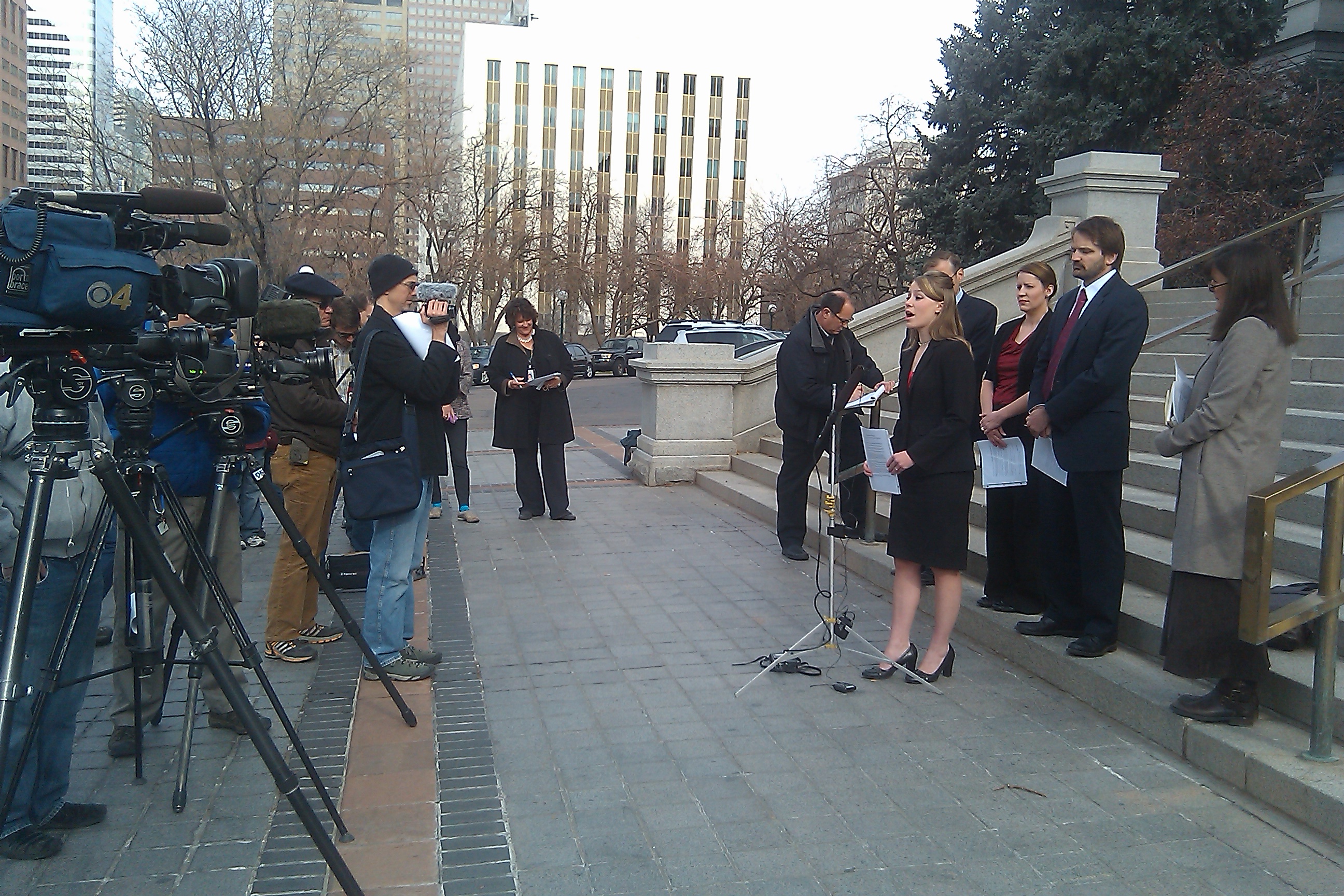
Kristi Brown announces effort to put personhood on 2012 ballot

I mean, you can argue that without a Republican primary, GOP candidates like Mike Coffman and Cory Gardner might not endorse the 2012 measure, given its apparent unpopularity with voters, especially women.

“I haven’t personally talked to [Coffman and Gardner],” Brown told me.

“I know Cory Gardner is very conservative, has really good stands. I talked to him on the 2008 amendment. He was very, very supportive. He was one of our main supporters. So I would guess that he would.”

When she says a main supporter what does she mean?

“Very supportive,” she said. “He would come to events for us. He talked about it.”

Here’s Gardner at one personhood event.

Colorado Right to Life’s website lists Mike Coffman as a supporter of personhood 2010 as well, with the statement: “Incumbent Republican Mike Coffman is on record supporting Personhood and is on record as Pro-Life with no exceptions. However, he does not appear to have co-sponsored the Personhood legislation introduced in Congress. We hope that he would vote to support such legislation if he had the opportunity, as he has pledged.”

I asked Gualberto GarciaJones, who wrote this year’s amendment, which has more expansive and precise language than last year’s, if he thought presidential candidate Mitt Romney would support his amendment this time, given that he’s changed his position over the years. Garcia Jones said Romney is known as a flip flopper and that his group would persevere regardless of the positions of Democratic or Republican politicians. (No major Democrats support the effort, as far as I know, but Michele Bachman, Herman Cain, and Newt Gingrich back personhood, and it’s endorsed in a plank of the national GOP platform.

Asked if he thought he’d get Gardner on board for personhood this time, former gubernatorial candidate and “Generations Radio” host Kevin Swanson, said, “I think so,” adding that he hopes to get Democrats as well. (In his prepared remarks, Swanson repeated his view that said Dr. Suess summed up the amendment best when he wrote, “A person’s a person no matter how small.”)

“I think it’s real possible we could get some strong Republican support,” but he said he hadn’t been in touch with Tipton or Gardner.

In response to the personhood petition drive, Planned Parenthood of the Rocky Mountains’ President Vicki Cowart said in a statement: “Colorado voters spoke loud and clear in the 2008 and 2010 elections when they voted down the so called “personhood” amendments by a 3-to-1 margin each time. No means no, yet Personhood USA and Personhood Colorado continue to ignore the wishes of Colorado voters. Planned Parenthood of the Rocky Mountains will for the third time since 2008, work with our over 90 coalition partners to educate Colorado voters about this initiative which aims to ban abortion in all circumstances.”Historically, Colorado has been a state that votes in favor of trusting women and doctors. At the end of the day, Coloradans trust women to make personal, private decisions about their own body with their doctor, their family, their faith and without interference from the courts or lawyers.”

Media omission: Gessler promised to produce evidence of election “fraud,” but hasn’t delivered any

November 21st, 2011

Secretary of State Scott Gessler said a lot of interesting things during his speech at Colorado Christian University last week, but reporters should circle back and ask about a story Gessler told about the last legislative session.

We know that Gessler made a lot of references to voter fraud during the last session, implying that there could be thousands of illegal voters.

At one point, he said he that he did “believe” there were instances of fraud in Colorado that a photo-identification pill would have prevented.

But during his speech Monday, Gessler said he had made a promis to show proof of fraud.

Gessler said he was making a presentation to the Senate State Affairs Committee, and one Senator told him he’d agree with Gessler on a photo-identification bill if there were evidence vote fraud in Colorado. Gessler said he responded to the senator by promising to produce evidence of such fraud.

“Well, you know, we’re going to provide some evidence of that,” Gessler recalled that he told the senator.

The senator responded by saying the evidence would have to be “widespread,” Gessler recounted.

Gessler doesn’t have “high hopes” that a photo-identification bill will get through the State Senate next session, but he plans to try anyway, he said.

He will “assemble the evidence from states like Indiana, assemble the evidence from states like Georgia; there’s been eleven other states where this has passed in the last two years and look at their experiences and be able to make the case that this is a good thing for the state Colorado, just as it’s been a good thing for many other states.”

So this gives journalists a clue about where Gessler may be going with his accusations of voter fraud. With no proof of election fraud here in Colorado, he may trot out evidence, sparse as it may be, from other states, and claim it applies here.

If he does this, journalists should report that Gessler promised to provide evidence of Colorado fraud.

And if he manages to come up with proof of fraud in Colorado, it should be taken seriously, but it would be legitimate for reporters to evaluate the seriousness of evidence based, in part, on how widespread it is. For example, The Denver Post reported earlier this year that national studies show that election fraud by noncitizens is “not an issue.”

Gessler told the audience at Colorado Christian University that opponents to bills requiring voters to present photo-identification take a “see-no-evil, hear-no-evil speak-no-evil approach.”

But reporters should point out that, in fact, when it comes to elections in Colorado, there’s essentially no evil to see or hear, despite much searching. The problem comes when you have a secretary of state who takes a promise-evil, see-evil, and hear-evil approach, and delivers nothing.

Media should report that Romney once supported Personhood, then flipped, and then possibly flipped again

November 18th, 2011

As Mississippi debated then defeated a “personhood” amendment that would have granted legal rights to fertilized human eggs, multiple media outlets reported that GOP presidential contender Mitt Romney refused to clarify whether he supported the measure, which would ban not only abortions but also common forms of birth control.

But no media outlet that I could find reported that four years ago Romney said he supported the federal equivalent of the Mississippi personhood measure.

The federal version would expand the definition of a “person” under the 14th Amendment of the U.S. Constitution to include the “unborn.”

And if you’re Mitt Romney, and you aren’t shy about your position that life begins at conception, then your support of legislation granting legal rights to the “unborn” is an endorsement of personhood at the national level.

On August 6, 2007, Romney was asked on ABC’s “Good Morning America” about the following plank of the Republican platform, which, incidentally, remains in the national GOP platform to this day:

“We support a Human Life Amendment to the Constitution, and we endorse legislation to make it clear that the 14th Amendment’s protections apply to unborn children.”

Romney was asked, “Do you support that part of the Republican platform?”

“You know, I do support the Republican platform, and I support that being part of the Republican platform, and I’m pro-life,” Romney told ABC.

So, for almost 4 years, you had to assume Romney supported federal personhood.

But things changed in September of this year, at a GOP presidential forum in South Carolina. When Princeton Professor Robert George asked Romney specifically about the federal personhood measure, Romney flipped, saying he’d oppose it.

George asked Romney and other GOP candidates:

Section Five of the 14th Amendment expressly authorizes the Congress by appropriate legislation to enforce the guarantees of due process and equal protection contained in the amendment’s first section. Now, as someone who believes in the inherent and equal dignity of all members of the human family including the child in the womb, would you as president propose to Congress appropriate legislation pursuant to the 14th Amendment to protect human life in all stages and conditions?

Michele Bachmann, Herman Cain, and Newt Gingrich all said they would do so. But Romeny replied:

That would create obviously a constitutional crisis. Could that happen in this country? Could there be circumstances where that might occur? I think it’s reasonable that something of that nature might happen someday. That’s not something I would precipitate.

Two months later, in October, Romney told Fox News’ Mike Huckabee that he “absolutely” would have signed an amendment to the Massachussets constitution establishing that life begins a conception.

Journalists (from The New York Times, The New Yorker, and others) tried to get Romney to clarify whether his response to Huckabee meant that he supported Mississippi’s personhood amendment, but his campaign did not issue a clear statement.

For example, asked about personhood last week, Romney’s spokesperson Gail Gitcho told Politico’s Ben Smith, that Romney believes that life begins at conception and favors a “Human Life Amendment that overturns Roe vs. Wade and sends the issue back to the states,” but she stopped short of saying Romney opposes a state personhood measure. (A “human life amendment” would overturn Roe v. Wade, without giving legal protections to a fertilized egg as a person.)

Gitcho’s statement to Politico above, and her additional comments that Romney is “supportive of efforts to ensure recognition that life begins at conception” and that “these matters should be left up to states to decide,” leaves open the possibility for support of a Mississippi-style personhood amendment. In fact, that would be consistent with support for “efforts to ensure recognition that life begins at conception,” wouldn’t it?

Similarly, Romney’s own statement last month to a voter in Iowa, who asked if he wants to ban birth control, sheds no light on his view of the personhood issue: “I don’t,” Romney replied. “I’m sorry, life begins at conception; birth control prevents conception.” This is meaningless because, as you know if you follow the complexities of this issue, personhood supporters don’t oppose “birth control,” like condoms that don’t wipe out fertilized eggs. And they don’t use the term “birth control” for IUDs and some forms of the pill that do destroy fertilized eggs, or have the potential to do so. Those are called abortifacients. So Romney’s statement that birth control prevents conception is perfectly acceptable to the personhood crowd, and he used the same logic to veto a bill allowing the use of the morning-after pill in Massachusetts in 2005.

Romney’s changing position on the personhood issue, which may reflect his campaign’s concerns about polling on the issue as well as the experience of failed GOP Colorado Senate Candidate Ken Buck, has frustrated the folks at Personhood USA, which has backed state-based initiatives like the one in Mississippi.

“Romney made positive comments on Mike Huckabee’s show, but we’ve heard mixed messages,” Jennifer Mason, Communications Director for Personhood USA told me, adding that at one point in the past she viewed Romney a Personhood backer. “We would like to know if he does support Personhood. America wants to know specifically how he falls on the pro-life issues. We haven’t heard anything since the Huckabee show about his position on Personhood. We’re still waiting.”

Asked if appropriate changes with respect to the definition of a person in the 14th Amendment to the U.S. Constitution would constitute “personhood” at the federal level, Mason said:

A federal personhood amendment is our ultimate goal, but it really depends on the language.  If it protects every human being , no matter of stage of development, size, location, gender or race, then we would support it. In fact that is what we are hoping for.

What if someone like Romney believes “life begins at conception” and also supports 14th Amendment protection of the “unborn?” Does that combination do the trick for Mason?

“I believe so,” she replied.

Like Personhood USA, Planned Parenthood also views changes to the 14th Amendment as the federal approach to personhood.

“Yes, it is fair to say that Planned Parenthood believes the effort to change the 14th amendment is a federal version of ‘personhood’ measures we’ve seen in the states,” said Monica McCafferty, Director of Marketing and Communications for Planned Parenthood of the Rocky Mountains. “They are all seeking to provide constitutional protection to fertilized eggs, embryos, and fetuses at all stages of development, regardless of viability.”

So, until Romney stops hiding from journalists, and announces where he stands on personhood, reporters should no longer state, as as the Las Vegas Sun did Thursday that “he has never voiced explicit support for it.” or even, as Politco stated Nov. 9, that it’s unclear “he supports the Mississippi law or others like it.”

Instead, the most fair and accurate way for journalists to describe Romney’s position on personhood is to write that he’s flip flopped on the issue over the years, first for personhood on the federal level (in 2007), then against it (in Sept. 2011), and finally maybe in favor a state version (last month).
Gessler suggests people influence journalists by writing letters-to-the-editor and blogging

November 17th, 2011

Colorado Secretary of State Scott Gessler said last month that he thinks  “a lot of the mainstream media” get upset when Republicans “make waves,” but these hostile feelings toward the media didn’t stop him Monday from suggesting people can influence newspaper editors by writing letters to the editor and online comments.

“When they write a story, and they see a large number of comments one way or the other, that means something,” said Gessler. “We do a terrible job on our ideological side of the fence. We do a terrible job of this.”

Gessler’s comments came in response to a question from the audience at his lecture Monday evening at Colorado Christian University’s Centennial Institute.

The unidentified questioner asked speakers Gessler and Colorado State Treasurer Walker Stapleton what ordinary citizens can do.

In addition to influencing journalists, by writing letters-to-the-editor and blogging, Gessler suggested people volunteer as election judges, sign up to receive e-mails from his office, and attend rulemaking hearings or submit comments on proposed rules.

“So, sign up for our e-newsletters, sign up for our notifications, write an email, write an email to us so you know what’s going on,” Gessler said. “Come to our rulemaking hearings. Once every two months, write a letter-to-the-editor. Twenty minutes a week, do a blog. I won’t ask anyone to contribute money to a campaign. And serve as an election judge. Those are the things you can do.”

Gessler said testifying during the rulemaking process is important but did not have an impact in the recent challenge of his rule to increase the amount of money a group of people can raise for an political issue before their group is subject to campaign finance laws.

“Now, this particular court [in the issue-committee-threshold case] didn’t read any of that [citizen testimony], so he [the judge] wasn’t quite prepared, which he admitted, which is unfortunate, but I’m sure the Court of Appeals will be far more prepared than he was, and those comments are just critical for helping me out,” said Gessler.

Here’s an excerpt of Gessler’s comments on this topic:

Look, if you can spend time, two or three hours, once every two months, to write a letter-to-the editor, that makes a difference. Writing a letter-to-the-editor once every two months really makes a difference.  It only takes three or four hours, about as much time as you’ll spend driving here, listening, and driving home. That makes a difference.

It doesn’t just have to be The Denver Post.; particularly local papers as well helps. When you see something in a local paper online, I’m assuming most people go online., instead of merely raging at the machine, I love raging at the machine, don’t get me wrong, instead of merely raging at the machine, write a post to that story. Because let me tell you something, newspaper editors pay attention to that stuff. And actually a lot of readers pay attention to that stuff too. When they write a story and they see a large number of comments one way or the other, that means something. We do a terrible job on our ideological side of the fence. We do a terrible job of this. I’ll go online, and my wife is watching, and she’ll say, ‘Don’t read those. Don’t read ‘em.’ And I’ll read them nonetheless. And look, people on our side don’t take the time to do that. You don’t have to put your name. You can be anonymous. You have sign up and register with your real name, but it can be absolutely anonymous.  I would challenge everyone to do this, 20 minutes, once a week. That’s what I would challenge you to do for 20 minutes, maybe 30 minutes once a week.

The other thing is, come to my website…and sign up for our e-newsletters….

So my office engages in rulemaking a lot. I just said, I’m re-doing all the campaign finance rules to make them clear. Okay. What helps me a lot, is when you come in to my office during rulemaking. You can come in person, is the best and testify. You can write us an email and that becomes part of our record. You can write us a regular letter and that becomes part of our record. The reason this is so important is, if I say, for example, I want to raise the threshold, and I did this. I held a rulemaking hearing, saying I want to raise the threshold to $5,000.  Well, what happened is people came in, and I see Matt Arnold with his hand up the entire time, and he’s one of the people who came in. I’m teasing Matt. And he said look, and other people did, this is why it’s so hard, this is the burden we face. And when I get that evidence and testimony, and I can take that evidence and testimony and use it in court to defend myself. So if you can bring your personal experiences in, that’s just so critical. Now, this particular court didn’t read any of that, so he wasn’t quite prepared, which he admitted, which is unfortunate, but I’m sure the Court of Appeals will be far more prepared than he was, and those comments are just critical for helping me out.

So, sign up for our e-newsletters, sign up for our notifications, write an email, write an email to us so you know what’s going on. Come to our rulemaking hearings. Once every two months, write a letter-to-the-editor. Twenty minutes a week, do a blog. I won’t ask anyone to contribute money to a campaign. And serve as an election judge. Those are the things you can do.

And let me tell you. If everyone in this room did those things on a consistent basis, it would make a huge impact here in the state of Colorado. It would have an impact people rarely ever see. Just the people in this room, if everyone did that on a consistent basis.

Gessler promises to appeal issue-committe-threshold lawsuit, if he loses

November 15th, 2011

If Secretary of State Scott Gessler loses a lawsuit claiming he overstepped his legal authority by increasing the amount of money a group of people can raise before being subject to state campaign finace regulations, he will appeal the case, Gessler said Monday during a lecture at Colorado Christian University’s Centennial Institute.

No decision has been handed down yet by a state court in the case, but Gessler told the audience last night that he “does not expect [the judge’s] opinion to be positive,” and if he loses the case, he will appeal.

GESSLER: The question is, since I have got two different court opinions on the issue committee threshold issue, how am I going to resolve that? Here is what is going to happen. We don’t have an opinion from the Denver District Court. The court just decided he wanted to say nasty things about me in the newspaper. Frankly, I have never in ten years of litigation on very controversial issues, never seen a judge behave that way in the entire state of Colorado. I was very surprised by his comments and I did not support those….

UNIDENTIFIED AUDIENCE MEMBER: What is his name and when is he up for retention?

GESSLER: He is up for retention in a year. Anyway, so I don’t have an opinion from him yet. I don’t expect that opinion to be positive based on his comments. So this I think is what is going to happen. First of all, we are going to appeal it. And I do believe that we will be able to point out, assuming the court comes out against us, the error of the courts ways. The second thing is, and I am pretty confident about this, is if we lose, the State of Colorado is going to be sued yet again on this issue. And again. Frankly, I fully expect that we will lose on this issue. And the claims board will have the opportunity to pay attorney fees yet again on this issue. It is an unfortunate state of affairs. I am hopeful I can prevail on this, to provide guidance on this upcoming election. But if I don’t, I have no doubt that the federal circuit court will step in and provide guidance here for the state of Colorado.

Gessler won’t say there’s fraud in Denver elections, as he did previously, but there “very well may be”

November 15th, 2011

My search for an explanation from Scott Gessler about why he’s been telling the media there’s actual “fraud” in Colorado elections bore a bite of fruit last night, when I asked him about his allegations.

I respect Gessler for answering my question, even though a crowd of people was waiting in line to speak with him after his lecture at Colorado Christian University’s Centennial Institute.

I identified myself as a “liberal blogger,” and he hesitated but still responded.

I asked him about his statement, on a radio show in September, that there was actual fraud among mail ballots returned by inactive voters in Denver.

He said he was “not quite sure” he made this statement about the last election. He didn’t. He was referring to the 2009 municipal election, but the same question applies: Was there actual fraud, like he said?

In the radio interview, Gessler said there was a “pretty high incidence of fraud” in Denver’s 2009 election among ballots returned by inactive voters. Listen to Gessler’s Sept. 30 radio statement here.

Regarding 2009, Gessler told me last night:

Gessler: I think if you look at Denver, though, you’ll see in 2009, for a large number of folks, the signatures didn’t match. I think that’s an indicium of fraud, right there, when the signatures don’t match.

Jason: It’s an indication of fraud, but you wouldn’t say that it’s fraud, would you?

Gessler: I said it’s an indicium of fraud. It very well may be. It’s not been fully investigated, to my knowledge.

After Gessler alleged fraud in Denver elections in September, Denver’s Clerk and Recorder denied the accusation, and the head of the Secretary of State’s election division later testified that he was not aware of any fraud relating to ballots mailed to inactive voters.

No talk show host or reporter that I know of asked Gessler what actual factual fraud he was talking about, so I tried to fill in the gap and ask his office, but I got no comment. Until last night.

Last week, Gessler made another vague statement to a reporter in Pueblo that some mail-in ballots are fraudulent. And during his election campaign in 2010, Gessler implied illegal behavior on the part of Denver election officials.

I’d liked to have asked Gessler more questions about his allegations, but he didn’t want to discuss it further, as you can see from the transcript of my interview here.

The biggest question in my mind is, but why in the world would a Secretary of State, who’s gotta respect America’s democratic ideals even more than the rest of us, play fast and loose with the F word?

I’m sorry if this sounds all high-minded, but does Gessler understand the damage he’s potentially doing by making people think their election system, upon which we base our imperfect but respectable system of self government, is rotting around the edges, sprinkled with fraud, if not laced with it?

I can’t think of a more serious accusation a Secretary of State could make, and I’m hoping to talk more with him about why he does this, with nothing but speculation to back him up.

Transcript of interview with Scott Gessler at Colorado Christian University, Nov. 14, 2011

November 15th, 2011

Jason Salzman: I’m a blogger in town.

Scott Gessler: Nice to meet you.

Jason: I’ve been trying to talk to your spokespeople, I’m a liberal blogger, about a question. I’m hoping I could ask you directly.

Gessler: Probably not.

Jason: Probably not?

Gessler: Probably not.

Jason: But hear what it is.

Gessler: I’m going to chat with some of these folks.

Jason: On the radio you said there was fraud, actual fraud, among the inactive returned ballots in the Denver election.

Gessler: I’m not quite sure that’s what I said for this particular election. I think if you look at Denver, though, you’ll see in 2009, a large number of folks, the signatures didn’t match. I think that’s an indicium of fraud, right there, when the signatures don’t match.

Jason: It’s an indication of fraud, but you wouldn’t say that it’s fraud, would you?

Gessler: I said it’s an indicium of fraud. It very well may be. It’s not been fully investigated, to my knowledge.

Jason: And statewide, any instance of fraud that you can point to?  Any single instance?

Gessler: I’ve given you my stand.

Jason: I appreciate the answer.

Gessler: Sure.