In TV interview, Gessler ignores evidence that minorities would be disproportionately affected by decision not to send ballots to inactive voters

December 13th, 2011

For months, I’ve been begging reporters to ask Secretary of State Scott Gessler for evidence when he claims there’s actual, real-life, happening-now election fraud in Colorado.

But reporters should not only ask Gessler for evidence, but also show it to him, when he makes claims that contradict facts that are admittedly obscure but should be known inside and out by the Secretary of State.

One such fact is that a larger percentage of racial and ethnic minorities than whites, at least in Denver, would not receive election ballots in the mail if ballots were not sent to “inactive voters,” defined as voters who’ve missed at least one general election and not responded to postcards.

Yet, on CBS 4 earlier this week, in a story about Rep. Diana DeGette’s warning of voter suppression in Colorado, Gessler said:

“When it comes to mail ballots, I don’t know who and I don’t know if there is any evidence of what racial minority uses them versus Causcasians. There’s just no evidence along those lines.”

Back in October, Rachel Maddow poduced maps showing, with graghic devastation, how minorities, particularly Hispanics, would be affected compared to whites if mail ballots were not sent to inactive voters.

As you can see here at the two-and-a-half minute mark, one map shows where ethnic and racial minorities live in Denver. The next map shows where inactive voters live.

It’s clear that a greater concentration of inactive voters are Hispanic and would not receive mail-in ballots under Gessler’s proposal not to send such ballots to inactive voters. ColoradoPols has a good analysis of this here.

Maybe Gessler didn’t see these maps? Or maybe when he was talking about mail-in ballots generally, not spcifically from inactive voters–even though the context of the quote makes it appear as if he’s talking about mail ballots from inactive voters?

In any case, when it comes to Gessler, reporters have to be ready to produce evidence, and ask for it, to keep the facts straight and accurate.

Columnist should explain why it’s a “cheap left-wing talking point” to point out that Coffman calls Social Security a “ponzi scheme”

December 12th, 2011

Denver Post columnist Vincent Carroll wrote last week that it’s a “cheap left-wing talking” point for Denver Rep. Joe Miklosi to point out that Rep. Mike Coffman called Social Security a “ponzi scheme.”

Carroll usually expresses himself as clearly as any columnist out there, but here he should have given us a few more details.

As it is, Carroll sounds like he’s using the “cheap left-wing-talking-point” line as a cheap right-wing talking point against Miklosi.

I mean, Carroll might have a point if Coffman had burped out the “ponzi-scheme” comment, and then said something like, “Excuse me. I didn’t mean it.”  Or even if Coffman said it just once.

But Coffman has embraced the ponzi-ssheme concept not once but twice with his trademark intellectual air of certainty, first calling it “obviously” a “ponzi scheme” and then confirming his view in a second interview.

What Coffman is saying here, unless you believe Bernie Madoff is innocent, is that Social Security is a big piece of fraud, designed by the Madoffs in Washington to rip us all off.

Actually, Social Security is a government program that’s completely above board and transparent, about as different from a ponzi scheme as you can imagine. It’s been tweaked a number of times during its existence, but it remains hugely successful. It will remain solvent for 25 more years with no changes at all, and minor changes will keep it going much longer. It’s no ponzi scheme, as explained here.

Now, to be fair to Coffman, he goes on to say in interviews that he wants to reform Social Security because unless changes are made, it won’t be there for the under-55 set.

But how does this square with his view that it’s a ponzi scheme? If it’s a ponzi scheme, you’d want to get rid of it and put the perpetrators in jail.

It’s a question someone should ask Coffman, why he wants to save a ponzi scheme, because his repeated use of the phrase seems to show that part of him must really hate the program or, in the bigger picture, government itself, because Social Security represents a successful effort by the federal government to collect taxes and design programs to improve our lives.

Coffman wants to have it both ways, allegedly believing in Social Security, yet calling it–and by implication government itself–criminal.

So, it’s not a left-wing talking point for Miklosi to highlight the fact that Coffman has repeatedly called Social Security a ponzi scheme.

It’s a legitimate statement about Coffman, and it should make columnists like Carroll wonder where Coffman really stands not just on Social Security but the basic functions of government.

Zappolo mixes light touch with tough questions in interview with Coffman about Social Security, flat tax

December 8th, 2011

In late September, on KNUS’ Kelley and Company, Rep. Mike Coffman said Social Security was “obviously” a ponzi scheme.

Kelley let it fly by, but I thought this should have been picked up by journalists, since it came from Coffman, especially given that Rick Perry, who was surging at the time, had just called Social Security a ponzi scheme.

After I posted it on my blog, Coffman’s comment was reported by national blogs and, later, by a Post columnist, but not a single reporter asked Coffman to comment further.

Or so I thought.

Unfortunately, I missed an subsequent interview in October with Coffman on Fox 31’s Zappolo’s People, a weekly interview program that airs Sundays at 10 p.m. on Channel 31.

Fox 31 anchor Ron Zappolo usually asks his guests tough questions, so the show has an underlying edge, but his questions are often sufficiently surrounded with light chatty stuff that his interviewees don’t get defensive; they answer with more honesty than they otherwise might, like on a lot of talk radio.

In this segment of the Coffman interview, Zappolo begins by shaking his finger at Coffman and smiling to Coffman and into the camera, as if Coffman were an old friend:

Zappolo: You are never afraid to say controversial things.

Coffman: It’s true.

Zappolo: I’ll give you just a couple. You went on somewhere the other day and said that Social Security is a ponzi scheme. You’ve also talked about how all ballots should be in English. Correct?

Coffman: Right.

Zappolo: Do you ever think about, as a politician, some of these things, I might be better off steering away from?

Coffman: You know, no. [smiles] My staff wishes I would. [laughs]

Zappolo: The honesty comes out. [laughs]

Coffman: But I don’t. The thing with Social Security. I think it is, although I agreed with ponzi.

Zappolo: You scared people in your district who are 65 and over.

Coffman: I think a lot of people, and I made my best effort to get them to understand. Quite frankly, the program is going to be there for them. It’s just the younger generation that it’s not going to be there for. And so the sooner we can reform it, and I think if we reformed it it now, I think there are analyses that say for people 55 and older, we can leave it the same. For 55 and younger we are going to have to phase up the age up to age 70 to make it work. And so I think we can certainly make it work.

Zappolo also gently raised the question of whether Coffman supports a flat tax, another controversial topic:

Zappolo: What do you think of the candidates who believe in a flat tax?

Coffman: I think the flat tax has tremendous value.

Zappolo: You don’t think it hurts the lower income—

Coffman: No, I don’t think it does because I think there are, the way that it’s defined, or there’s a provision in there that has to be defined, and that is where is there an exception on it, in terms of lower income people. So you can easily do that. But I think we are at a point now where about half of Americans have an income  tax liability, and then it’s very progressive from that point forward.

Zappolo’s show isn’t always political, which makes for a great change for a person like me who takes in too much politics. As a general newsmaker show, his program stands out locally among TV interview show, most of which are focus more narrowly on politics or sports.

Mike Coffman talks about Social Security with Zappolo:

Mike Coffman talks about the flat tax with Zappolo:

Talk show host says progressives are lying evil doers, so I’ve invited him to coffee

December 7th, 2011

Read (or listen here) how 560-AM KLZ’s Ken Clark said good bye to his listeners, including me, last night:

You know ladies and gentlemen, it’s been a great show. It’s been a lot of fun. It’s been very, very interesting. But I cannot stress enough that we need to get involved. We all need to get involved…. We need to become evangelical about this. We are in the fight of our lives. The Democrats, the liberals, the progressives, they lie. They are lying to you. It’s going to get a lot worse. You have got to study the issues. You have got to get involved. There are a ton places to go do that…They cannot win in a battle of ideas, because we always have the right ideas. On a national level, they cannot beat us in a battle of ideas. So they are going to lie. They are going to spend over a billion dollars in the next year, lying to you, making you believe that they are the good guys. They are not. Pure unadulterated evil. They are progressives. They are socialists. They have got to be defeated at all costs. This is Ken Clark, as always, good night, Colorado.

I sent the following email to Clark this morning. I’ll post any reply I get in its entirety.

Dear Ken:

You’ve make a big deal out of Rep. Amy Stephens calling you Tea Party people “anarchists.” I don’t blame you on that. It’s rude.

But now look what you’re doing, basically one upping her, calling people like me lying evil doers. I’m not evil, Ken. Ask my kids (on good days). Ask my friends. Ask people who’ve worked with me, conservatives even. Ask my Republican mother-in-law.

Maybe I’ve done an evil thing or two, but I’m a lot like you insofar as I try to figure out what’s right, and then do stuff, make things happen.

And you know what; I actually admire you for your activism. I’m not lying. I wish more people got involved, even if they join the Tea Party. Apathy is killing your side and mine.

And you can’t blame apathetic people for being apathetic if they stumble on your show and hear you  say you “always have the right ideas.” Are you kidding? I admire your passion, truly. I felt that way too when I was a kid. But please, do you really believe that? I don’t think you do.

You Tea Party people are losing ground because the word leaks out, from Congress down to your show, that you think you’re always right and you think those who disagree with you represent “unadulterated evil.”

How about we have a cup of coffee? I promise I won’t poison you. I’ll buy it, as a tiny sign of my non-evilness. Let me know if you’re up for it.

Jason

Post Columnist scoops news department and reports Gessler allegation of actual election fraud in Colorado

December 6th, 2011

If you’ve been reading The Denver Post over the past year, you know Secretary of State Scott Gessler likes to talk about possible fraud in Denver elections, as he did when he filed a lawsuit trying to stop counties from mailing ballots to inactive voters, and as he did when he was waving lists of possible illegal voters.

(My mistake, he didn’t wave these lists; he just talked about them and refused to make them public.)

But, if you’ve been reading The Post, you may not know that Gessler has alleged real-life, actual, happening-now fraud. That’s of course a far more serious allegation, but not a word of it has graced the pages of The Post.

That is, until Saturday, in an opinion column by Fred Brown, who scooped the entire news department.

Brown’s column was the first piece of any kind, news or opinion in The Post, stating Scott Gessler’s view that there is actual election fraud in Colorado.

Brown wrote:

“He [Gessler] rode into office in 2010 on a wave of Tea Party insurgence and immediately began warning everyone, from Coloradans to congressional committees, about election fraud, which he says is widespread but most others, including Meyer, say is a minor problem.”

In an email exchange with me, Brown wrote that he didn’t talk to Gessler directly about this. 

Brown wrote that he relied on other sources, including Gessler’s congressional testimony, which was quoted in The Post but does not quite allege fraud. Gessler testified,  “We know we have a problem with possible noncitizens on the voter rolls.”

But Gessler said on the radio: “So we know fraud exists. The question is, what’s the extent and what’s the proper balance.”

And to the Pueblo Chieftain: “Signatures vary a lot, and sometimes people’s signatures don’t match what’s on file. Some are fraud, some are innocent mistakes.”

Because Brown didn’t talk with Gessler directly, a door is wide open for a Post reporter to get out in front of the commentary section, track down Scott Gessler, and ask him, “Where’s his evidence for fraud in Colorado elections?”

And if he has none, why does a laywer like him, much less a man who’s got the title of Secretary of State, play fast and loose with the F word?

Talk-radio hosts shouldn’t simply nod as Ramirez accuses Carrera of drawing legislative maps out of spite and retribution

December 5th, 2011

We all know the process of hammering out new state legislative districts is difficult for everyone involved: the governor, legislators, judges, and regular people, as well as the journalists reporting on it.

So even conservative talk-show hosts, like Jason Worley and Ken Clark on KLZ’s Grassroots Radio Colorado, should at least make a pass at presenting the issue with some measure of decency and fairness.

I know, it’s talk radio, but still.

This should start with Worley and Clark mentioning, however briefly when they discuss this issue, the fact that Democrats and Republicans agree that competitive districts are good for Colorado, because competition makes politicians on both sides of the aisle more responsive to their constituents, so they’ll do the things they want them to do, like create jobs, boost education, and listen to each other at least as well as my 14-year-old listens to my 11-year-old.

As has been reported previously, it’s not just the Democrats who recognize that competitive districts are desirable, but it’s also former GOP Chairs Dick Wadhams and Bo Callaway. Also, in December, then GOP Senate Minority Leader Mike Kopp told the Colorado Statesman, “Citizens want a fair and open process with competitive districts.” The Fort Collins Coloradoan reported that Rep. Amy Stephens wants competitive districts, as does Sen. Steve Ward, R-Littleton, who told the Associated Press (April 24, 2008),“It’s the lack of competitive districts that have led to the polarization of politics.”

And both Republicans and Democrats can find aspects of the new legislative maps, currently under review by the Colorado Supreme Court, that increase competitiveness. So key elements of both parties would agree that this is a good thing, though, obviously, many leading Republicans believe that the latest set of maps give Democrats an unfair advantage overall.

But, as The Denver Post reported Sunday, not all Democrats are happy with the new districts either, and hearing their fellow Democrats say that the maps were drawn to meet the Supreme Court’s requirements to keep more counties whole doesn’t seem to satisfy them either.

But Worley and Clark failed to tilt their rhetoric anywhere near fairness and decency during a broadcast Tuesday.

Regardless of where they stand on this issue, Worley and Clark do no one any good when they nod, like Soviet generals, as Rep. Robert Ramirez, with no evidence, accuses reapportionment committee chairman Mario Carrera Tuesday of approving maps that would allegedly hurt Ramirez’s chances of re-election because of their old dispute over whether to allow undocumented children of illegal immigrants to qualify for in-state college tuition.

Retribution and spite, that’s what was motivating Carrera on the maps, Ramirez told told Grassroots Radio Colorado.

I mean, no matter where you sit on the political spectrum, you have to hope that a baseline level of evidence and facts are required before talk show hosts engage in a conversation like this one, which occurred on Grassroots Radio Colorado Nov. 29:

RAMIREZ: You know, its funny because the one vote this year that you guys actually praised me on, and we have seen different eye to eye on a couple things, was the ASSET vote. The in-state tuition for undocumented…. or illegals.  And he [Carrera] actually came to visit me the morning before that vote, brought me a letter and basically said please vote for this. It’s really important and I really want it. And I think we need to do this. It’s good for the Hispanic people. Blah blah blah blah. And really I went into that vote open-minded, thinking okay let’s see if there is something constitutionally we can do here. And they never found that. It was never there. Well then I hear…I overheard a Democrat [sic] commissioner talking to another commissioner hearing that while they were working on the maps, Carrera was discussing with people that he was upset with my vote on ASSET. And then I heard from a couple commissioners that he directly told them that he was mad about my vote on ASSET. So when I got my first map drawn, the primarily adopted, I am like wow ok so this is true, it’s working. But the new map with Carrera, and they dumped a 70 percent Democrat [sic] voting margin group in and took out my highest Republican voting margin. It was very obvious that he was playing the partisan game.

CLARK: So not to put words in your mouth. I’ll let you finish this Rep. Ramirez, but in your opinion you believe that pretty much everything he has been doing has been from a I’m mad at you for this, I’m mad at you for that, how dare you question me on this, and moving towards vindictiveness. And he is using the maps to get back at people he’s mad at.

RAMIREZ: Well, if you look, Ken Summers originally the only people that were really badly damaged that he could do anything with on the original maps were Republicans who had voted against the ASSET bill. And now it’s just, how dare you go against my word, so I’m really going to mess with you. I think it is. I think his pride has got in the way. And it’s unfortunate because I truly thought that he was a man of integrity. And he is proving that not so.

WORLEY: So now we can use M for Vendetta. M for Vendetta, we’ll have a new movie title going. Mario for Vendetta.

RAMIREZ: The main thing I wanted to say was, I wanted to thank Mario Nicolais. I wanted to thank the people who were actually trying to do their job. The Republicans that are on there. And it’s not a just a partisan thing. I’ve watched them, I’ve listened to them. And when you go to one of these meetings and you see the eye rolling of Atencio, Web, Matt…oh gosh…Matt Jones and Carroll. I mean literally, whenever a Republican or a conservative or a non-Democrat would say anything at these meetings they just [sign noise], roll their eyes, and really disrespect them. You never saw that from the people on the Republican side. They would get back at them.

WORLEY: I have heard Ms. Atencio is kind of nasty.

RAMIREZ: Oh absolutely. Without saying. I want to say that I appreciate the commissioners that are in there really trying to really be honest and hold true to the Constitution. Because the original map they gave me wasn’t a better map. It was a little worse than when I ran last year. But it was an honest map. And it followed the rules like you guys were saying earlier. We follow the rules. We go out there and try to do what’s right and then every time the Democrats…and we know they are going to do it, sweep in the last minute with lies.
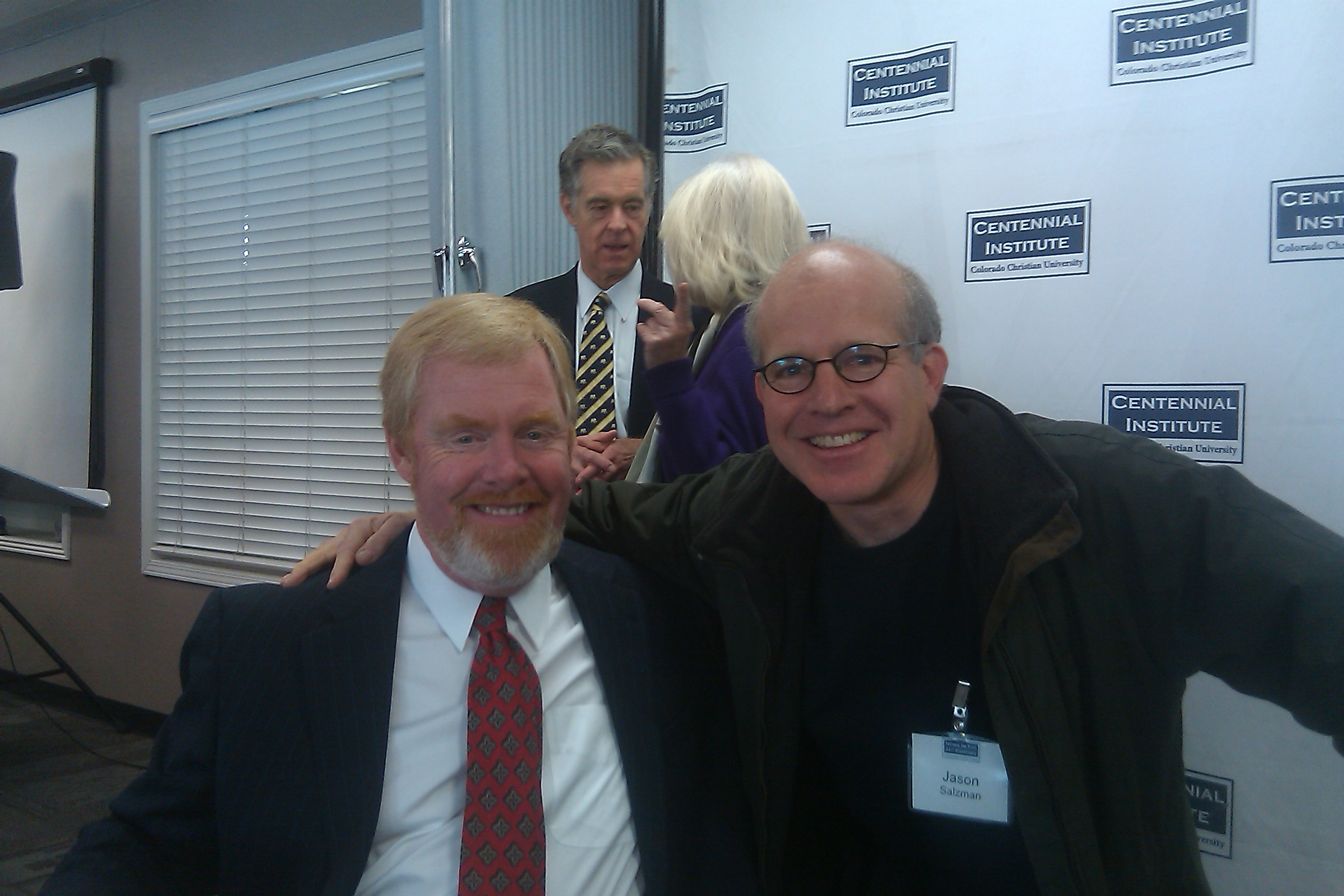
Your blogger with arm around Brent Bozell

December 2nd, 2011

I discussed media bias today on a panel with Jason Bane, Dan Caplis, Stephen Keating, and Dave Kopel at a forum organized bvy the Centennial Institute as part of its “News in the 21st Century” project.

Last time I went to a Centennial Institute event, the views were narrow, with speakers Walker Stapleton and Scott Gessler on a predictable war path against progressives and Democrats like John Hickenlooper, with lots of heads nodding.

Today’s event, in contrast, had views from people like Mike Littwin, who was on a panel addressing whether the “media is simply giving the public what they want,” to Brent Bozell, who gave they keynote talk.

Some students thanked me for coming out and said they don’t hear different opinions all that often. (Maybe they need more liberal professors out there?)

I hear opinions different from my own most often on talk radio, and in print. But I had a good time talking to conservatives in the flesh today.

And I even got my picture taken with Brent Bozell, with John Andrews in the background. What more could you want from a visit to Colorado Christian University?

Jason Salzman and Brent Bozell at Colorado Christian University Dec. 2

Will Tea Party radio play a role in promoting Coffman’s and Bachmann’s idea that China, with no safety net, is economic model for all?

December 1st, 2011

I like watching how Tea Party radio plays a role in the care and feeding of radical ideas. Here’s a small example.

This summer, I had a good honest conversation with Ken Clark, co-host of Grassroots Radio Colorado (KLZ 560AM), about what would happen to kids if the state of Colorado required their parents to pay more for their children’s government health insurance.

Clark agreed with me that there’s a risk that some kids’ health would suffer, but he said there are risks with running up more government debt too. (Sen. Greg Brophy has said the same thing.)

Then my on-air conversation with Clark moved to the bigger picture. He talked about how individual generosity, not government, should replace the safety net in America. That’s a theme you hear a lot on conservative talk radio, and often Ayn Rand’s name gets tossed in the mix.

Around the same time I had my conversation with Clark, Rep. Mike Coffman published an op-ed in the Littleton Independent taking a similar stand, but pointing to a place, a model, where the economy is booming in the absence of the economy-killing safety net.

Coffman refers to the China, which he presents as a model free-market economy, saddled unfortunately with political repression.

Here’s what he wrote in the Independent May 22 about a trip he took to China:

Coffman: “No doubt, it felt strange to travel to a country that is the largest holder of U.S. debt, continues to expand its industrial base at the expense of ours, and has enjoyed sustained economic growth based on the free market principles that we have long abandoned in favor of the redistributionist policies of a welfare state. The ruling elite of China are communists in name only but cling to power based solely on an ideology of economic growth that most of the population accepts in exchange for a complete lack of political freedom. The government knows that if they are unable to sustain economic growth then the Chinese people will question their authoritarian rule and unrest will follow. The Chinese are nationalistic in their pride; in only three decades this economic experiment has already lifted a third of their nation out of abject poverty.

Coffman voted for the Ryan budget, which, among other things, phases out Medicare, but this sounds like Coffman wants to go further, to the Grassroots-Radio-Colorado zone, where freedom means the poor and sick and lowly folks rely on donations.

And, lo, who picked up on Coffman’s point in early November? Michele Bachmann! For those of you who haven’t been paying attention to her lately, here’s what she said:

Bachmann: “The ‘Great Society’ has not worked, and it’s put us into the modern welfare state. If you look at China, they don’t have food stamps. If you look at China, they’re in a very different situation. They save for their own retirement security…They don’t have the modern welfare state and China’s growing. And so what I would do is look at the programs that LBJ gave us with the Great Society and they’d be gone.”

Bachmann puts more meat on Coffman’s China concept. No Social Security. No food stamps. No pesky Great Society programs to sink the economy and hold back the poor from thriving.

Now I’m expecting Grassroots Radio Colorado to start talking about the beauty of economic freedom in China, to bring things full circle in the Tea Party echo chamber.

No decent reporter would let federal candidates get away with saying abortion issues don’t matter

November 30th, 2011

You wonder how anyone could read former Colorado Senator Hank Brown’s recent comments to Republicans, that a federal candidate’s position on abortion really doesn’t matter, and not think of failed Colorado Senate candidate Ken Buck, Rep. Cory Gardner, and others who made similar statements, even though a quick Google search shows just how incredibly important abortion issues are in politics at the federal level.

Here’s what Brown said Thursday, as quoted by the Colorado Statesman:

Noting that he suspected most of the Republicans in the room disagreed with him about that — and adding that “Colorado, as you know, is the second-most pro-choice in the nation” — he argued that the [abortion] issue shouldn’t take center stage in elections because it’s out of the hands of politicians in Washington and just divides voters.

“The reality is, that’s a constitutional interpretation. The people you elect on that issue don’t have anything to do with that. You don’t vote on allowing or not allowing abortion in the U.S. Senate or the U.S. Congress. It’s never even an issue,” he said, adding that most Republicans agree the federal government shouldn’t subsidize abortions.

“So for Republican candidates, there isn’t any aspect of that pro-life, pro-choice issue that ever results in a vote in Congress,” he said, noting that in rare cases Senators can weigh in on the fitness of Supreme Court nominees and influence longer-term policy on abortion.

Thank goodness reporters in Colorado didn’t let Ken Buck get away with it when he said essentially the same thing last year.

Here’s a fine example of a reporter holding Buck’s feet to the fire in one televised debate, if you want to take a trip down memory lane. That’s just one case of Colorado journalists doing their jobs and mapping out the steps of the abortion buckpedal for citizens. The Ft. Collins Coloradoan didn’t let Gardner forget his stances on abortion either.

If you look at what happens in Congress, you can see that reporters are obviously right that these issues are not just abstract theoretical distractions, like Hank Brown would have you believe.

They make a big difference in politics as practiced in the Beltway, where you can’t predict what votes will be taken for what reason and when.

Remember that Obamacare almost fell apart over abortion wedge issues, with Democrats and Republicans falling on both sides.

And in March, abortion issues, including a dispute over funding for Planned Parenthood, nearly shut down the federal government, as negotiations stalled, with Gardner and Tipton among those digging in their feet on abortion. Also on the disputed chopping block were federal funds for international organizations that provide women’s health care in the world’s most impoverished countries, where the absence of these services translates into hundreds of thousands of deaths each year.

Maybe some people don’t want to take it seriously that the national GOP platform calls not only for an anti-abortion amendment to the U.S. Constitution, but also for legislation changing the definition of a person under the 14th Amendment to include fertilized eggs, or zygotes. But how can you not take this seriously, given the strange unpredictability of abortion politics and that the GOP has a shot at controlling both houses of Congress and the White House in about a year?

Herman Cain, Newt Gingrich, Cory Gardner, Mike Coffman, Doug Lamborn, Scott Tipton, or any other federal candidate, can’t say they favor personhood and then expect it to mean nothing to reporters. Sorry.

Reporters know that one of their most basic functions is to air out issues so citizens can understand where the candidates stand and what they’ll do if elected.

And so, Hank Brown, with due respect, journalists were right in 2010 not to accept the GOP post-primary cries that abortion issues mattered so little compared to jobs that they need not be discussed. And they should continue to matter a lot to journalists today and every day.

Suthers tells radio host he wants “everybody to have health insurance” but host doesn’t ask how he’d achieve it

November 29th, 2011

You learn lots of little things when you listen to talk radio, and many of them you could do without knowing, like lawyer Dan Caplis’ assessment of Tim Tebow’s football skills.

But other small stuff catches your attention, like the fact that Colorado Attorney General John Suthers wants everyone to have health insurance.

You might think Suthers is the last person in Colorado who wants universal coverage, given that he’s pushing a lawsuit to stop Obamacare.

But that’s what he told KNUS morning host Steve Kelley Nov. 18:

SUTHERS: The founders never envisioned the federal government would be in the healthcare business. The individual mandate requiring every individual to buy insurance is premised, Congress said, on their Commerce Power, their power to regulate commerce among several states. In fact, the Commerce Power has been broadly construed to allow Congress to essentially regulate any economic activity that impacts interstate commerce. But therein lies the rub: this would be the first time in history that Congress will be reaching out to every individual American and saying we are going to punish you for your economic inactivity. For not engaging in commerce because your failure to do so impacts the marketplace by imposing burdens on other people who do buy insurance.

KELLEY: But aren’t they assuming [Obamacare] is for our own good though? Really, the betterment of everyone.

SUTHERS: Well, that’s right and that is kind of the typical liberal response. And that is what I get most. Gee, this is a good thing. And indeed it is. We want everybody to have insurance. [BigMedia emphasis]

So, how do we get everyone covered, like Suthers wants?

Why Steve Kelley didn’t ask him is beyond me, because it’s the most basic follow up question you can think of for anyone who trashes Obamacare in one breath and says they want the 44 million uninsured Americans to have health insurance in the next.

Now back to the little things you learn on talk radio.

Back in February, Suthers told KOA’s Mike Rosen that the states can require citizens to buy health insurance, not the feds:

SUTHERS: The state can exercise any power that the citizens don’t deprive them of in the Constitution. So unless you put a provision in the state constitution saying the state couldn’t force you to buy auto insurance or health insurance…that was one that we just voted on that in November, that’s what that was all about. Then the state can force you to do that.

You might wonder if I was mistakengly quoting Mitt Romney not John Suthers, because he’s been saying Romneycare is well and good for Massachusetts, but Obamacare is sick and bad for America.

And if you’re thinking that Suthers must have been talking to Romney, you might be right, because Suthers backed Romney in 2008 and remains on the Romney train to this day. Suthers didn’t endorse Romneycare, as far as I know, but he seems open to it, and it’s a question Kelley should keep in mind for next time.