Coffman’s rational appeal to cut miltary spending

October 7th, 2011

I may disagree with Rep. Mike Coffman about some things, but he has a lot of guts to call for Pentagon cuts, like he’s been doing, especially since he represents a district near Colorado Springs.

It’s a truism that most politicians who represent communities anywhere near a military facility won’t suggest defense cuts, even if the cuts are unrelated to the military activities in their districts. It’s one for all and all for one, even if a tiny slice of the defense budget could change the world for millions and millions of people.

Pentagon spending now accounts for about half of the federal discretionary budget, which is the portion of the budget that’s the focus of most beltway debate.

Current Pentagon spending is $696 billion, with $118 billion going to the Iraq and Afghan wars (our closest “enemy” China, spends about $120 billion, Russia $70 billion, Iran $7 billion).

Contrast this, if you feel like getting really depressed, with federal spending on clean energy development ($4 billion), Head Start ($8 billion), humanitarian foreign aid ($27 billion), and k-12 education ($43 billion). The entire EPA budget is about $10 billion, give or take a few billion.

The lives of millions of starving kids could be saved by spending $10 billion a year on basic health needs. Amory Lovins had written that we could rid ourselves of our dependence on oil in 10 years with a $20 billion per year investment. About $10 billion more would cover poor kids in America who are eligible for Head Start but don’t get it. The list goes on.

Against this backdrop, even the briefest look at the federal budget shows that Pentagon spending, even without the Iran and Aftghan wars, is way out of control.

Up steps Coffman, with the Tea Party mostly looking the other way, and suggests cuts in overseas bases, reductions in the active-duty force, and other idea, some of which have serious value.

He points out:

In early 2004, Osama bin Laden said one of his goals was to “bleed America to the point of bankruptcy.” In some ways, our strategy of counterinsurgency has played into his hands. Our current doctrine is a high-cost nation-building strategy that has worn out our military.

Coffman might derive his inspiration on this issue from the fact that he served in Iraq.

And by the sound of it, you have to think he believes the war wasn’t worth it, and he wants to spend tax dollars differently so America is less likely to repeat the mistake.
It’s a good time for all of you who are sponging off the Denver Post’s website to subscribe

October 7th, 2011

Ironically, when you go to The Denver Post’s website and look for a way to pay for the content, instead of lapping it up for free, you have to get out your microscope and look in the upper right hand corner (and the way bottom of the page) to find the word “subscribe.”

I’ll make it easy by providing the subscription link here.

The Post should enlarge its “subscribe” button so its squinting aged readers don’t have another excuse, as if they need one, not to subscribe to the newspaper, which  is downsizing its newsroom once again.

Obviously The Post, like other outfits that try to practice serious journalism, is hurting. You might think it’s their own fault. You might think they’re doomed. You might think they don’t add as much to civic debate as they used to. And you might be right, but please think about subscribing anyway, especially if you use the content, to try to help keep the state’s best journalistic organ alive.

It may already be in the death spiral, but there’s still hope that if the newspaper industry can make it through the recession and, at the same time, get better at making money online, it can maintain the expertise and staff needed to inform us idiots out here.

The people who say that The Denver Post is useless at this point can’t be reading the newspaper.

If everyone in Colorado actaully read The Post, we’d have the most informed and educated state in history. I know the newspaper sucks compared to what it was, but think about how bad it could be, and how much worse the state would be without it.

The newspaper still covers the grind of politics and civic life, entertainment, business, even sports, unlike anything we’ve got and will probably ever have.

So do us all a favor and subscribe.

“Oh, I’m sorry I’m laughing. Laughing makes many people nervous on this radio show”

October 6th, 2011

If you’ve been following my blog, you know I’ve been trying to get Jimmy Lakey, who’s a Colorado Springs talk-radio host, to explain why he laughed like a mad man when a caller compared Michelle Obama to a character in the Planet of the Apes. (Listen here to the audio.)

On his show Sunday, September 25, Lakey offered up a response of sorts.

He was laughing about something, and he cut off his laughter abruptly and said:

“Oh, I’m sorry I’m laughing. Laughing makes many people nervous on this radio show.”

I’d been looking forward to hearing what Lakey had to say, but I never expected to agree with him, especially when he was mocking all the people who were legitimately upset by his behavior.

But he’s right. He laughs and I’m nervous.  That’s not my usual reaction to laughter, but in this case, it’s true.

Now I’m hoping he explains himself some more.

September 25, Jimmy Lakey show on KVOR-740 AM, owned by Cumulus Media, Inc.

Dick Armey’s appearance on Mike Rosen show illustrates effectiveness of “Wall Street Greed” Protests

October 5th, 2011

Former House Majority Leader Dick Armey, who’s a creator and promoter of the Tea Party, was on the Mike Rosen Show yesterday, and he and Rosen spent a couple minutes discussing the Wall Street Greed protest.

Armey’s rambling about the demonstration shows why the simple message of Wall Street Greed is so effective.

The conservatives try to say, Wall Street is not greedy because…. and they immediately start to sound really out of touch.

Here’s Dick Armey, who’s not a stupid guy:

Armey: …Goofballs that are walking around now protesting what they call, Wall Street greed is just ridiculous. I don’t know how you even respond to people like that.

Rosen: You’re talking about the, Occupy Wall Street, demonstration here.

Armey: Right, right. These folks first of all, the first thing the left does, progressives, there’s a documented history of this is a design by them, is distort the language. Basically what they argue is that people who have gone out and worked hard and earned their living and want to keep the money they earned through their legal, honest effort, these people are greedy…. To me, greed was wanting something from someone else that you hadn’t earned. That’s what I always thought greed was. But to these folks, greed is wanting to keep what you worked very hard to earn. I mean, I don’t get it. I don’t get their line of thinking. You know, I think they’ve got a distorted sense of truth. I don’t know, it’s very frustrating to me because it’s hard to know how anybody can be that misguided and that arrogant.

Rosen might have been alone, even among his audience, in not wanting to ask: Ok, about that Wall Street Greed that is self evident in America?

In 2010 radio Interview, Gessler implied that inactive voter lists mismanaged to favor Democrats

October 4th, 2011

Colorado Secretary of State Scott Gessler has been denying that partisanship played any role in his decision to file a lawsuit to stop Denver from mailing election ballots to inactive voters, who last voted in the 2008 general election.

Gessler’s latest public denial of partisan-taint came on KHOW’s Caplis and Silverman Show last week, in response to a direct question from Silverman at 33 minutes in the podcast Sept. 28 show, 5 p.m. hour:

Silverman: Isn’t this just partisan on your part? Isn’t it because you’re thinking this will favor the Democrats?

Gessler: Absolutely not. Denver can’t do what it wants to do. It can do what it wants to do in a municipal election.

But in October, as he was running for office, Gessler said on a radio show that the large number of Democratic voters on the inactive voter lists concerned him, specifically because more Democrats than Republicans were on the inactive voter lists.

In fact, it concerned him so much that he implied that election officials in Democratic counties, which would include Denver, were managing their inactive voter lists in such a way as to favor the Democratic Party.

Gessler framed the issue in partisan terms, saying at the time that in counties with large numbers of Democrats, election officials are slow to clean up their lists of inactive voters.

“You have some heavily democratic counties that are less focused on cleaning up their databases than other counties,” Gessler told KOA’s Mike Rosen, Oct. 6, 2010, at 10:15 seconds in the podcast:

Rosen: I’ve got a report in front of me from the Secretary of State’s office, and it’s an official report. You can see  it online. And it has total registered voters by party affiliation and status. Among Republicans, we have 869,000 active voters and 199,000 inactive voters. Among Democrats, 825,000 active voters and 242,000 inactive voters….

Gessler: If they have not voted in the last general election they become inactive. And I think what you are seeing there, especially because of the heavy skew towards the large number Democrat inactive voters. I think that indicates variances in the counties and how focused they are. You have some heavily democratic counties that are less focused on cleaning up their databases than other counties. What you always look for to find out if there is a problem with the database is statistical anomalies. When there is something that pops out that seems a little unusual. Here there is something unusual there. You have two times, twice as many inactive Democrat voters as you do Republican voters. That is something that needs investigation. I am not saying there is massive fraud or anything there but that is very unusual to have those statistical anomalies.

I contacted Gessler’s office for a clarification. When he said, “less focused,” did he mean that clerks were deliberately putting less of a priority on cleaning up the inactive voter lists in order to promote Democrats?

Does he believe there’s a little bit of fraud going on here, even if there’s not the “massive” variety? Did his concern about the inactive voter lists play a role in his decision to file the lawsuit against Denver?

I’ll update this post when I get an answer.

Radio host: If I say Chewbacca, what do you think of? Michele Obama?

October 3rd, 2011

UPDATE: Talking Points Memo picks up on the post below, adding, among other things, the quote from Lakey that it’s cruel to criticize Michelle Obama’s clothes, but “”It’s cruel for her to talk about my hamburgers that I want to eat all the time.”

————————-

Colorado Springs talk-radio host Jimmy Lakey was sitting at a cigar club at some point, he didn’t say when, and he heard someone refer to Michelle Obama as “Chewbacca.”

He’d never used the word himself, he told his radio audience Aug. 14, but “at the cigar club, someone used the phrase Chewbacca, and everyone knew or assumed who this person was talking about.”

“I’ve tested it,” Lakey said on 740 KVOR, laughing. “I’ve done group testing, and I’ve said, if I say Chewbacca, what do you think? And, I’m telling you. I’m in so much trouble right now.”

In trouble, he said, with his wife, whom he told about the Chewbacca talk at the cigar club.

“She lectured me, and told me that was wrong, and that was crossing the line, and how rude that was,” Lakey said into his microphone for the world to hear.

But then one day Lakey showed his wife some photos from Facebook of Michelle Obama dressed in different outfits.

His wife, the “nice one,” he said,  told him she looked like a halfback.

“If you’re the First Lady, you shouldn’t wear things that make you look like a halfback,” she said to him.

Lakey replied to his wife: “What’s the difference between you saying she looks like a halfback and someone else saying the name Chewbacca? I don’t get the difference. I just don’t get the difference.” [Editor’s note: A halfback is a football player. Chewbacca is an ape-like character in Star Wars films.]

After he started telling this story on the radio, Lakey said he got a Facebook message from a listener. The caller claimed to be the guy from the cigar club, Lakey said, the person Lakey first heard using the name Chewbacca. The guy who started this whole thing.

It turns out, this guy’s wife gets mad at him, too, for referring to Michelle Obama as Chewbacca.

“I had a guy just post on my Facebook fan page,” Lakey told anyone who hadn’t turned off the radio yet. Then he read the Facebook post:

Hey Jimmy, I smoke cigars, and I referred to Michele Obama as Chewbacca since 2009 (laughs). I wonder if I’m the guy you heard call her that. …My wife has told me not to call her that in front of my kids. But my boys, got bless them, have picked up on it and they have marched forward with it…. I wanted to identify myself and state that I cannot stand the Obamas. I took my boys out of school to attend the Tea Party rallies, and they were magnificent.

Along the way, Lakey had told his audience that he thought calling Michelle Obama Chewbacca was “crass and a little bit much.”

But that didn’t stop him from saying everything he said, plus Lakey offered up this:

Chewbacca! I didn’t say it! (laughs) No! I will not take the heat on this. I did not call her Chewbacca.  No. I get in trouble. My wife, when I told her this, she yelled at me. I thought it was kind of funny.

After I listened to a recording of Lakey’s story last week, I sent him an email with this question:

You said on the radio Aug. 14 you thought it was “kind of funny” for Michele Obama to be called Chewbacca. You also said the comment was “crass and a little bit much,” but you went on to repeat the phrase and laugh repeatedly. Do you really think that using “Chewbacca” to describe Michele Obama is kind of funny?

I didn’t hear back from him.

Neither did he tell me a couple weeks ago why he laughed hysterically and grotesquely when a caller compared Michele Obama to a character in the Planet of the Apes.

And, as I explain here, Lakey deleted questions about his on-air behavior that I posted on his Facebook fan page, where he describes himself as “humanitarian & entrepreneur, and a former candidate for U.S. Congress in Colorado’s CD7 and…a frequent guest host for radio talk shows across the USA.”

I don’t take his brush-off personally, because he didn’t respond to the Colorado Springs Gazette either.

So that’s where the story ends for now.

If you want to ask him what the @?!!!** he’s thinking and why, here’s his email address: jimmy.lakey@cumulus.com. Lakey’s station, KVOR, was just recently bought by Cumulus Media, Inc, one of the biggest radio conglomerates in the U.S.

—-
Below are the segments of the show during which Lakey tells his Chewbacca story.

If you thought the written version above was scary or offensive, you’ll find the radio-show clips below even worse, because his laughter adds a creepy dimension that could not convey.

Lakey: “Chewbacca! I didn’t say it,” Part 1:

Lakey “Chewbacca! I didn’t say it,” Part 2 (later in the show):

Caplis and Silverman rush Gessler off the air after he alleges election fraud in Denver

September 30th, 2011

Under normal circumstances, I’d slam KHOW’s Caplis and Silverman for letting Colorado’s Secretary of State breeze onto their show Wednesday, assert that there’s a “pretty high incidence of fraud” among one type of Denver voters, and then depart without being forced to explain what in the world he was talking about and what evidence he had to back it up.

But maybe Caplis and Silverman have heard Secretary of State Scott Gessler make so many unsubstantiated accusations of election fraud by now that it sounds normal, so normal that they think there’s no need for boring follow-up questions.

Whatever they were thinking, KHOW talk-show hosts Dan Caplis and Craig Silverman listened in silence Wednesday as Scott Gessler made the startling assertion that “Denver itself admitted” that sending election ballots to inactive voters has resulted in a “pretty high incidence of fraud.”

The issue arose last week when Gessler’s office sued to block Denver from mailing ballots for the Nov. 1 election to voters who haven’t cast a ballot since 2008 and did not respond to a letter asking if they wanted a ballot.

Gessler took the action partially to “reduce the potential for fraud,” according to the lawsuit.

But on the radio, Gessler sharpened his accusation, saying he was fighting fraud itself, not just theoretical fraud.

Gessler said [at the 37 minute point in the podcast]: But Denver itself admitted, there’s a pretty high incidence of fraud in inactive-voters returned ballots. They rejected in their municipal election well over 200. So we know fraud exists. The question is, what’s the extent and what’s the proper balance. The Legislature struck that balance. I’m going to respect it.

Denver has not admitted that there was any fraud resulting from ballots submitted by inactive voters, much less a “pretty high incidence” of it.

“I’m not sure what he [Gessler] is saying is fraud,” Denver Clerk and Recorder Debra Johnson told me. “He’s using the word fraud loosely.”

She said about 200 ballots in the 2011 Denver municipal election were found to have “signature discrepancies,” meaning the voter’s signature on the paper ballot was determined not to match the voter’s signature in Denver’s database. If a signature discrepancy is found, a voter is sent a letter and given eight days to clear up the matter.

“Every one of those is sent to the District Attorney,” Johnson told me. “And none of those has been identified as fraudulent by the DA.”

Johnson pointed out that it’s not just the inactive voters who have signature discrepancies, it’s also the active voters. ‘We pulled our numbers from the last election, and they were the same, in terms of the percentage of ballots returned,” she said.

The history of election fraud in Denver, it turns out, is deadly dull, even to a political junkie. And you’d have to think even Gessler, who seems to get excited about fraud even when it’s not really fraud, would find it dull as well.

The last case of election fraud in Denver that was actually prosecuted occurred in 2005 and involved a single voter, according to Amber McReynolds, Director of Elections for Denver. She added that, in 2009, a circulator of a petition was found to be fraudulently signing names, and turned over to the DA, and in 2010, the state of Arizona asked Denver for information about a person who voted in Denver and also attempted to vote in Arizona.

Gessler’s interview on Caplis and Silverman stands in stark contrast to comments he made Aug. 31, 2010, on KFKA’s Amy Oliver Show.

At the time candidate Gessler was attacking then Colorado Secretary of State Bernie Buesher for allegedly failing to ensure that Colorado complied with a federal law requiring overseas military personnel be sent election ballots 45 days before the 2010 election. In the end, Buescher found a way for Colorado to comply.

Radio-host Oliver laughed it up with Gessler, who said something that Caplis and Silverman should play back to Gessler next time he’s on their show:

Gessler said: “You’re the Secretary of State. What the heck is your job? Your job is to make sure people can vote. That’s one of your jobs!”

On Caplis and Silverman Wed., about a year after his appearance on KFKA, Gessler hadn’t completely forgotten this notion of trying to make sure people can vote.

Asked by Caplis what he thought Denver was trying to accomplish by sending ballots to inactive voters, Gessler said, “I’m guessing they are trying to increase the number of people who vote in the turnout from inactive voters.”

Silverman then asked Gessler why it “isn’t a good thing, if more people vote.”

“It’s good if you don’t have fraud,” he replied.

And since there apparently is no fraud, where does that leave Gessler?

I’m hoping Caplis will ask him next time he’s on the show. Letting him depart with a”keep-up-the-good-work” slap on the back is pretty hard to listen to.

Media should provide perspective on how previous Colorado Secretaries of State have handled conflicts of interest

September 28th, 2011

With the partisan glow emanating ever more brightly from Colorado Secretary of State Scott Gessler, it’s worth taking a moment to think back on another SOS conflict-of-interest brouhaha that spilled out of the Secretary of State’s office in Colorado in recent years.

The local media hasn’t done much of this, so I’ll fill in the journalistic gap a bit here.

You may recall that a few months after Mike Coffman became Secretary of State in 2007, it was revealed that one of his new hires, Dan Kopelman, was running a partisan consulting business on the side. Kopelman was accused of selling SOS voter lists to Republican candidates. 

Kopelman was promoting his business on his website by highlighting his day job at the Secretary of State’s office.

Coffman admitted at the time that hiring GOP election consultant Kopelman to help oversee elections was a mistake, because of the appearance of conflict of interest, but he said he did not know Kopelman continued running the side business, illegal under state law, after he was hired. Kopelman was demoted and re-assigned. (Later, Colorado Ethics Watch filed a complaint against Coffman before the Colorado Independent Ethics Commission, alleging that he knew about Kopelman’s moonlighting biz. This was dismissed.)

Against the backdrop of secretary-of-state fiascos in Florida and Ohio, Coffman was quoted at the time as saying the Kopelman incident represented a “failure of leadership” on his own part. This is an expression of contrition that we haven’t yet heard from Gessler, even though Gessler has been acting as if conflict of interest is to be expected from the SOS, and he articulated this categorically when he told the Greeley Tribune in March that he hopes to use the SOS office to “further the conservative viewpoint.”

A couple weeks after Kopelman was accused of selling voter data (an allegation that was never proven), Coffman instituted personnel rules banning SOS staffers who worked on election matters from engaging in partisan political activities, including attending caucuses or conventions.

Coffman also told The Denver Post that he, personally, would not endorse or contribute to candidates or initiatives.

A BigMedia review of Coffman’s subsequent political donations from June 2007 to November 2008 shows that he did not contribute to candidates during his SOS service, but his wife did, and he, his wife, and his political groups gave a total of $2,625 to GOP political entities, according to state and federal databases

This includes $300 that his wife, Cynthia Coffman, gave directly to “Bob Schaffer for US Senate,” about month after her husband promised to stop donating to partisan candidates.

It also includes $1,629 given to GOP groups by Coffman himself, including $420 Coffman gave to the Jefferson County Republican Central Committee, $350 to the Arapahoe County Republican Party, and $300 he gave to the Douglas County Republican Central Committee. 

Coffman had to have known that groups like these collect money and, in turn, give much of it directly to candidates.

The rest of the $2,625 was donated to Republican groups by Cynthia Coffman ($312 to GOP groups plus the $300 for Schaffer) or by Coffman for Congress ($384).

Coffman gave an additional $2,216 to his own congressional campaign in 2008, which you’d have to count as a violation of his promise not to give to partisan candidates, unless he doesn’t count himself as partisan.

Apparently Coffman kept his promise about not making partisan candidate endorsements, though his office would not return my calls to confirm this or, for that matter, to comment for this post at all.

Gessler, on the other hand, has yet to donate to GOP candidates or groups, but he has taken endorsements to a new height, the presidential level, having thrown his weight behind Mitt Romney

Colorado’s last Secretary of State, Bernie Buescher, endorsed Cary Kennedy for Treasurer, and some other Colorado candidates.

Gigi Dennis, CO Secretary of State before Coffman, endorsed Bob Beauprez in 2006 and possibly others, she told me, adding, “I was always very careful about any endorsements, and I did not put my name on fundraising letters and invitations, that sort of thing.”

I didn’t ask her what she thought of Gessler’s dunk tank fundraiser.

“Secretary Gessler has an important role as the state’s chief elections officer,”  Jenny Flanagan, Executive Director of Common Cause, emailed me. “For voters to have confidence in our elections, they need to believe that the Secretary’s decisions are in the best interest of the state and not for the benefit of a particular candidate or political party.  To hold the public’s trust, the Secretary should refrain from partisan activities, whether it is endorsing candidates or fundraising for political parties.”

Some people thought Coffman’s post-Kopelman reforms didn’t go far enough, or were developed for self-serving reasons and ignored as Coffman ran for Congress, but a Post editorial at the time called the reforms “sound policy and should be a permanent rule in the secretary of state ‘s office, even after Coffman is gone.”

CO Springs radio host cleanses his Facebook fan page of BigMedia questions; maybe you’ll have better luck if you try

September 27th, 2011

Maybe you saw my post a couple weeks ago about a Colorado Springs talk-radio host who laughs hysterically (and grotesquely) when a caller tells him that Michele Obama reminds her of a main character in the Planet of the Apes. You have to hear it to believe it.

In response to my questions about this, one of Lakey’s supervisors at KVOR emailed me that Lakey did not know “whether his laughter following her Michelle Obama observation was out of humor or simply discomfort.”

I’ve been trying to get a response from Lakey himself but to no avail.

Is he sorry? How could he not figure out if he was feeling uncomfortable or elated?

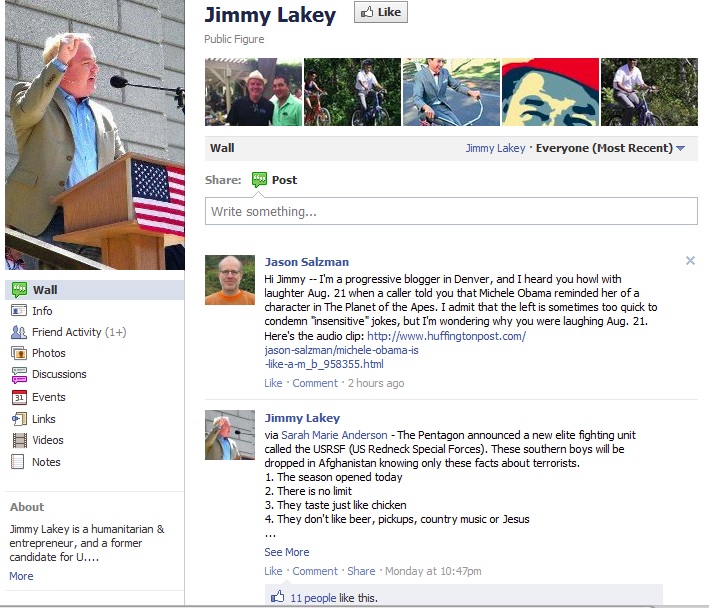
So I posted a question on Lakey’s fan page on Facebook Sept. 21:

Hi Jimmy — I’m a progressive blogger in Denver, and I heard you howl with laughter Aug. 21 when a caller told you that Michele Obama reminded you of a character in The Planet of the Apes. I admit that the left is sometimes too quick to condemn “insensitive” jokes, but I’m wondering why you were laughing Aug. 21. Here’s the audio clip.

Lakey didn’t respond, so I posted a second message the next day:

I’d like to conduct a poll of readers of Jimmy Lakey’s Facebook page. Do you think he should respond to my question below, posted on Sept. 21?

Within a couple days, my posts were deleted, and I was banned from posting further comments.

If you want to try to get an answer from Lakey to my questions or any others, please post them on Lakey’s fan page here. We’ll see if he deletes your questions, too, or answers them.

I had a feeling Lakey would expunge my queries from his page, so I made a screen grab of his Facebook page before he deleted my questions.

Here's BigMedia's post on Jimmy Lakey's fan page on Facebook before it was deleted.

Coloradoan and Colorado are losers with departure of Exec. Editor Moore

September 22nd, 2011

Colorado journalism is taking yet another sad blow Sept. 30 when Bob Moore departs for a job in, I’m sorry to say, Texas. He’ll be Executive Editor at the El Paso Times. Moore is clearly one of the state’s leading journalists thanks to his fair-minded and detail-oriented reporting, as well as his sincere concern for the community. He has the respect of all types media figures. Even bloggers like him. And he’s president of the Colorado Press Association.

Moore started his journalism career as an intern at the Pueblo Chieftain in 1983. He landed his first job in 1984 at the Fountain Valley News in El Paso County, CO. After a few months, he went to the Colorado Springs Sun. When it closed in 1986, he moved to the El Paso Times, where he was, among other things, executive editor. He left there in 2005 to become Executive Editor at the Coloradoan.

Q: Why are you leaving the Ft. Collins Coloradoan?

A: The opportunity to return to El Paso is a great professional and personal opportunity. I spent almost 20 years there before returning to Colorado in 2005. The Mexican border is one of the most interesting places in the world from a journalistic viewpoint. El Paso is a city going through a unique transformation as the violence in Mexico drives middle class Juarenses to El Paso, where they are setting up businesses and setting down roots. This current exodus is reshaping the U.S.- Mexico border like no event since the Mexican Revolution. I’ll also get the opportunity to work with seven newspapers in New Mexico. Finally, my wife and I have family in El Paso.


Q: You were the Executive Editor of the El Paso Times previously. Do you hope to be a better journalist at the El Paso Times? If so, how so?

A: As executive editor, I was the No. 2 in the newsroom. In my new role, I’ll be the top editor. I think my six years in Fort Collins has definitely made me a better journalist. I’ve had to reimagine approaches to news coverage, utilize new technologies, and be more creative in deploying resources.

Q: Do you see a dim future for your style of serious journalism at the Coloradoan [owned by Gannett] or Gannett newspapers generally? Does MediaNews [owner of the El Paso Times, The Denver Post, and many other newspapers] look like a better or more stable company to work for?


A: I think both Gannett and MediaNews are committed to journalism that aggressively informs communities and acts in the greatest traditions of the First Amendment.  I have very much enjoyed my 25 years with Gannett.  I’ve known Dean Singleton for about eight years, and very much respect him. Obviously, MediaNews is going through significant changes as John Paton moves in as CEO. Gannett’s also undergoing significant changes, as is the entire industry.

Q: As a long-time journalist in Fort Collins and as President of the Colorado Press Association, you have a good perspective on Colorado journalism, as you head out the door. What do you think are its biggest strengths and weaknesses?


A: The biggest strength in Colorado journalism is the journalists. We’ve got a lot of really good people plying their trade. Obviously, the numbers are down significantly from when I returned to Colorado in 2005. But there’s a lot of remarkable work being done. My biggest concern is how thin we are in the ranks of younger newspaper journalists. We’ve got some good ones working in Fort Collins, and there are others throughout the state. A few years ago I hired a great young reporter named Jason Kosena. He did a lot of good work in the political realm, but he’s now out of the business because he felt he needed something more stable.

Q: What would you say to a young person who wants to be a political journalist?


A: I still think it’s a good and important career, though I doubt there’ll be many people spending 25 years with the same company like I did. You’ll need to be entrepreneurial, flexible, and curious.

Q: Do you think political reporting in El Paso could possibly be as interesting as it is in Ft. Collins?

A: I don’t think Texas politics takes a back seat to politics anywhere. And sitting on the Mexican border, we’ll actually get to cover two presidential elections next year. And here’s my favorite piece of meaningless political trivia. No Republican since 1988 has been elected president without first appearing in a debate I moderated. The only candidate who fits that bill this year? Rick Perry.

Q: Do you have a couple favorite moments during your career here in Colorado?

A: The 2008 4th Congressional District campaign between Marilyn Musgrave and Betsy Markey would have to top the list. It was one of the more important House races nationally, and it had interesting dynamics. Even though I was covering it part-time in addition to my editor duties, I think we were able to bring a lot of depth to our coverage that you didn’t see in House races across the country. Covering the recent problems with the Larimer County Republican Party was also interesting.


Then there was Balloon Boy.


The most important impact the Coloradoan has had during my tenure is the consistent reporting we’ve done since 2007 looking at rising poverty rates in Fort Collins and Larimer County. This had been going on since the early part of the decade, but policy makers and the general public really didn’t notice it. Beginning with a seven-day series in August and September 2007, and continuing since, the Coloradoan has documented how rising poverty and declining incomes have altered our community. Our reporting managed to awaken the community to the problems, and spurred the creation of a program called Pathways Past Poverty, which is working to address a number of the root causes of rising poverty. This work constantly reminds me of the impact that newspapers can have on a community when we focus our storytelling.


Two stories from last year also come to mind. The Coloradoan documented that a negligent Department of Human Services bureaucracy had failed to complete 10 of 11 required child fatality reviews in the deaths of children who died while under state supervision. The purpose of these reviews is to identify systemic problems, and fix them. The Coloradoan’s stories were a huge embarrassment to the state and prompted a number of reforms. It was an example of how a small newspaper can have statewide impact.


The other story was our discovery, using open records laws, that the Poudre School District had decided not to notify parents when employees were charged with felonies involving student victims. Our reporting prompted change at both the state and local level.

Q: How will you live without the Colorado Rockies? [Moore’s followers know he’s a big sports fan.]

A: One of my great personal memories of my time back in Colorado was being able to go to every Rockies playoff game in 2007, including the play-in game against San Diego. That was a thrill. And I had tickets to Game 5 of the World Series. Of course, that never happened. I’ve now had tickets to two World Series games — Game 3 in 1989, which was the earthquake game, and Game 5 in 2007. Still haven’t seen a World Series game. And thanks to Josh McDaniels thinning out the waiting list for Broncos season tickets, I finally got season tickets this year. It’s hard to give those up.