A never-ending news story for good reason: McInnis regrets apologizing for plagiarism

September 26th, 2014

Fortunately for someone like me, who will never get enough of the 2010 election cycle, failed gubernatorial candidate Scott McInnis will never stop talking about it.

A great article today in the Grand Junction Sentinel states that McInnis has a big regret about how he handled the plagiarism scandal that torpedoed his gubernatorial campaign: apologizing for it, since he says he did nothing wrong at all.

McInnis, who’s running for a Mesa County Commissioner, told the Sentinel he “should have dug [his] heels in” and “brought up more about the Hasan family.”

The Sentinel’s Emily Shockley reports:

“I didn’t plagiarize, period,” [McInnis] said. But, at the behest of political advisers, he did make apologies for the situation ever happening. That situation involved a researcher ghost-writing the articles in question, which turned out to have several sections lifted from an old work by current Colorado Supreme Court Justice Gregory J. Hobbs Jr.

“I would have dug my heels in and I would have brought up more about the Hasan family,” McInnis said.

“I’ve used ghost writers my whole career. I would have said I didn’t make the mistake. I wasn’t dishonest then and I’m not dishonest now.”

If he’d done that, maybe we’d have heard more from McInnis’ ghost writer, Rolly Fischer, who spoke so eloquently to Channel 7’s John Ferrugia at the time, before he went into hiding.

If McInnis had thrown his researcher even deeper under the bus, and dug in deeper, it would have made an already great news story even better.

Media omission: Would Beauprez sign Gardner’s personhood bill?

September 26th, 2014

In the wake of this week’s revelation that Bob Beauprez once said he’d sign a bill outlawing abortion in Colorado, even for a 16-year-old who was raped, you have no choice but to ask yourself this bizarre question:

If Beauprez were governor, and Rep. Cory Gardner’s federal persohood bill successfully overturned Roe v. Wade, as it’s intended to do, freeing up the Colorado legislature to send an abortion-ban bill to Beauprez’s desk, would he follow through on his promise to sign it?

Yup, there are numerous hypothetical leaps there, and the leaps are significant, but they are smaller than you might think, and outlawing all abortion, even for rape and incest, is actually factually what both these candidates (Beauprez and Gardner) have pushed for throughout their political careers.

So I’ll quickly explain the steps involved in the question.

First, the federal personhood bill, co-sponsored by Gardner last year, would have to clear Congress, which is not so far-fetched when you consider that Republicans could take over the U.S. Senate this year. Then the Supreme Court, whose pro-choice majority is already questionable, would have to overturn Roe, based on the new legislation and other factors. Then, and possibly the biggest hurdle, Colorado Republicans would have to get their act together and take power under the dome. (This is already a reality in numerous other states, where Republican majorities would quickly ban abortion if Garnder’s bill had it’s intended effect.)

Do me a favor and don’t roll your eyes at this blog post, because all you have to do is think of Texas and look at all the places in America where abortion rights are already restricted or threatened. Here’s a great summary. It could even happen in Colorado. This is an issue that matters.

Bottom line: Along with their anti-abortion allies across the country, gubernatorial candidate Bob Beauprez and senatorial candidate Cory Gardner could theoretically work together to ban abortion in Colorado and/or in other states. Gardner could push for the federal legislation allowing Beauprez to sign a state bill making personhood a reality.

Post story misleads readers about Gardner’s 2007 stance on “contraception”

September 25th, 2014

In a piece on Colorado’s Senate race today, veteran Denver Post political reporter Lynn Bartels misleads readers into thinking a 2007 state personhood bill, sponsored by senatorial candidate Cory Gardner, wouldn’t have banned “contraception” when, in fact, the bill would have prohibited the use of common forms of birth control—as well as all abortion, including for rape and incest.

Bartels wrote:

The Udall campaign didn’t mention another part of that bill, an omission that bolsters Gardner’s argument that he’s not opposed to contraceptives. It reads: “Nothing in this section shall be construed to prohibit the sale, use, prescription, or administration of a contraceptive measure. … “

But Bartels didn’t point out that other language elsewhere in Gardner’s bill mandates that contraception would have to be used “prior to the time that pregnancy could be determined through conventional medical testing.”

The definition of “pregnancy” in the bill is “the human female reproductive condition of having a living unborn human being within her body throughout the entire embryonic and fetal ages of the unborn child from fertilization to full gestation and childbirth” [BigMedia emphasis].

So, under Garnder’s bill, some forms of “contraception,” like a condom or diaphragm, are ok, because they unequivocally don’t threaten or destroy fertilized eggs (zygotes) or any fetal stage of pregnancy.

But other forms of contraception, like the copper IUD or some forms of the pill, would not be allowed because they are considered abortifacients by the religious right. They are seen to threaten or destroy fertilized eggs. (In 2007, when the bill was drafted by Gardner, more types of hormonal birth control were widely seen as blocking zygotes from reaching the uterus and causing them, even if they got there, to be unable to implant in the uterine wall.)

Hence Gardner’s 2007 bill was carefully written to ban both abortion and certain forms of abortifacient contraception, while freeing women to use non-abortifacient methods to their hearts’ content.

In 2009, making his position against the use of certain forms of contraception clear, Gardner voted against the Birth Control Protection Act, which simply defined “contraception,” without exceptions, as a medically acceptable drug to prevent pregnancy. And Gardner has a clear record of opposing Plan B, also considered an abortifacient by hardline anti-abortion activists.

The Hobby Lobby decision spotlighted the fact that anti-abortion activists still say they’re in favor of “contraception,” as long as some forms are excluded.

In Bartels’ piece, Personhood USA director Keith Mason said the federal personhood bill, which Gardner cosponsored last year, could be interpreted to ban birth control.

Here’s the entire section of Gardner’s bill referenced by Bartels:

(4) NOTHING IN THIS SECTION SHALL BE CONSTRUED TO PROHIBIT THE SALE, USE, PRESCRIPTION, OR ADMINISTRATION OF A CONTRACEPTIVE MEASURE, DEVICE, DRUG, OR CHEMICAL, IF IT IS ADMINISTERED PRIOR TO THE TIME WHEN A PREGNANCY COULD BE DETERMINED THROUGH CONVENTIONAL MEDICAL TESTING AND IF THE CONTRACEPTIVE MEASURE, DEVICE, DRUG, OR CHEMICAL IS SOLD, USED, PRESCRIBED, OR ADMINISTERED IN ACCORDANCE WITH MANUFACTURER INSTRUCTIONS. [BigMedia emphasis]

Here’s the section defining pregnancy and other terms:

(1) “FERTILIZATION” MEANS THAT POINT IN TIME WHEN A MALEHUMAN SPERM PENETRATES THE ZONA PELLUCIDA OF A FEMALE HUMAN OVUM.

(2) “PREGNANT” OR “PREGNANCY” MEANS THE HUMAN FEMALE REPRODUCTIVE CONDITION OF HAVING A LIVING UNBORN HUMAN BEING WITHIN HER BODY THROUGHOUT THE ENTIRE EMBRYONIC AND FETAL AGES OF THE UNBORN CHILD FROM FERTILIZATION TO FULL GESTATION AND CHILDBIRTH. (3) “UNBORN HUMAN BEING” OR “UNBORN CHILD” MEANS AN INDIVIDUAL LIVING MEMBER OF THE SPECIES HOMO SAPIENS, THROUGHOUT THE ENTIRE EMBRYONIC AND FETAL AGES OF THE UNBORN CHILD FROM FERTILIZATION TO FULL GESTATION AND CHILDBIRTH.

(3) “UNBORN HUMAN BEING” OR “UNBORN CHILD” MEANS AN INDIVIDUAL LIVING MEMBER OF THE SPECIES HOMO SAPIENS, THROUGHOUT THE ENTIRE EMBRYONIC AND FETAL AGES OF THE UNBORN CHILD FROM FERTILIZATION TO FULL GESTATION AND CHILDBIRTH.

18-6-902. Abortion prohibition. (1) A PERSON SHALL NOT KNOWINGLY ADMINISTER TO, PRESCRIBE FOR, PROCURE FOR, OR SELL TO A PREGNANT MOTHER ANY MEDICINE, DRUG, OR OTHER SUBSTANCE WITH THE SPECIFIC INTENT OF CAUSING OR ABETTING THE TERMINATION OF THE LIFE OF AN UNBORN HUMAN BEING. A PERSON SHALL NOT KNOWINGLY USE OR EMPLOY ANY INSTRUMENT OR PROCEDURE UPON A PREGNANT MOTHER WITH THE SPECIFIC INTENT OF CAUSING OR ABETTING THE TERMINATION
OF THE LIFE OF AN UNBORN HUMAN BEING.
Proving Post’s Carroll even more right, Beauprez says, in newly discovered audio, that citizens stock guns to protect themselves from own government

September 24th, 2014

Over the weekend, Denver Post Editorial Page Editor Vincent Carroll pointed out that gubernatorial candidate Bob Beauprez has shown a “tendency in recent years to voice support for the fringe issue du jour on the right, whether it’s northern Colorado secession or repeal of the 17th Amendment permitting the direct election of senators.”

I just found yet another instance of Beauprez voicing “support for the fringe issue du jour on the right.” This time, Beauprez was on a right-wing radio show Dec.21 2012, a week after the Sandy Hook massacre. And the hot topic was the stockpiling of guns and ammo.

Host Chuck Wilder asked Beauprez, who’s running against Gov. John Hickenlooper, if he thought people were buying guns and ammo to protect yourself against the bad guys or to protect yourself against the government which might say, ‘Only the government is going to have guns?'”

Beauprez responded by saying there’s a “growing sentiment” that America might be on the “verge of something very, very bad,” and “folks realize they may need to protect themselves against the government that was supposed to be instituted to protect us.” 

Listen to Beauprez say Americans are stockpiling guns for possible use against the government

Beauprez’s use of the word “realize” indicates his agreement with the sentiment, I’d say.

Beauprez’s comments extend the theme, expressed by the Republican candidate previously, of impending civil war in America. On the Internet show “Christian Today,” Beauprez once said:

Beauprez: I hope and pray that, that we don’t see another revolution in this country, I hope and pray we don’t see another civil war, but this administration is pushing the boundaries like none I think we’ve ever, ever seen.

For more of the objectively fringy comments, like the ones Carroll mentioned, read Susan Greene’s recent piece in the Colorado Independent.

Partial transcrirpt of the  “Talkback with Chuck Wilder Show”, Dec. 21, 2012, on the digital Cable Radio Network.

Beauprez: I don’t mean to minimized this tragedy. It is a horrible tragedy. But the rush of politicians to somehow blame the gun when there is a whole lot going on than the weapon. If you are going to ban guns, you’re going to have to ban a whole lot of other things, baseball bats, kitchen skillets. 

Chuck Wilder: Some people, you know, they will look for a giant conspiracy. And that’s why, you know, all the K-Mart stores have already sold out of their assault weapons that they sell. That’s why, right now, what was it, 6,000 or 8,000 a day are joining the NRA since last Friday.

Baeuprez: We’ve got that going on in Colorado, the rush to apply for concealed-weapon permits, the gun training businesses are overwhelmed with people.

Chuck: You’ve got to ask yourself, Bob, and I’ll ask you. Do you think it’s to protect yourself against the bad guys or to protect yourself against the government which might say, ‘Only the government is going to have guns?’ You know what I’m saying?

Beauprez: I think a lot of the rush right now for people to get what firearms they want or need, to load up on ammunition, to get better trained, because, at a minimum, they think it’s going to be much harder to do very soon. You’re absolutely correct, there is a growing sentiment within this country that we might be on the verge of something very, very bad. And folks realize they may need to protect themselves against the government that was supposed to be instituted to protect us.”

Reporters who don’t think Beauprez’s abortion position is important should read this

September 22nd, 2014

I wrote last week about gubernatorial candidate Bob Beauprez’s comment, unchallenged by reporters, that he believes a governor has “very limited impact” on a woman’s right to choose–even though he told Colorado Public Radio back in 2006 that he’d sign a bill outlawing abortion, if such a bill landed on his desk.

If you’re a reporter, and you’re inclined to sluff this off, because Beauprez isn’t thumping his chest about banning abortion nowadays, you need to know more of what he said during that interview with CPR’s Ryan Warner back in 2006.

You can read his exact words below, but, to summarize, he dismisses the notion of making abortion exceptions for rape an incest with, “No. No. I don’t make exceptions for that.”

He also said, specifically, that he’d support a law preventing a raped 16-year-old girl from having the right to choose abortion, saying pregnancies resulting from rape are “relatively few” and the “child” conceived by the rape should not be punished.

Here’s a partial transcript of the interview:

HOST RYAN WARNER: Let’s start with abortion. As governor, if Roe v. Wade is overturned, would you sign a bill banning all abortions in Colorado?
BOB BEAUPREZ: As long as it protected the life of the mother, I would.
WARNER: Rape? Incest? Anything like that?
BEAUPREZ: No. No, I don’t make exceptions for that.
WARNER: Would you seek such a bill?
BEAUPREZ: Uhh, —
WARNER: Or would you sign it if it came to your desk.
BEAUPREZ: I believe that what happened up in — I believe it was North Dakota, or South Dakota –North, if I remember right.
WARNER: South Dakota
BEAUPREZ: South Dakota, excuse me. I thought that was a legitimate question to put in front of the people again. And I thought that’s what South Dakota did. If there was a move mood within the legislature, I’d, uh — I would applaud that.
WARNER: Let me give you what is admittedly an extreme hypothetical. A sixteen-year-old girl is raped. She and her parents want to get an abortion for her. They would pay for it, it wouldn’t be state dollars. You would support a law preventing her from getting an abortion under those circumstances?
BEAUPREZ: Yes, and I’ll tell you very simply why.
WARNER: Please.
BEAUPREZ: I don’t think it’s the child’s fault. And I think we either protect life — all life, especially the most innocent of life — or we don’t. The situations of rape or incest. and pregnancies resulting from, are relatively few. And I think, unfortunately, what we have done, sometimes, is use rather what we think of as extreme exceptions, to justify a carte blanche abortion policy that has resulted in– well in excess, as I understand it, of a million abortions a year in our nation. Tragically, I think, in some of our ethnic communities we’re seeing very, very high percentages of babies, children, pregnancies, end in abortion. And I think it’s time that we have an out in the open discussion about what that means.
WARNER: Do you know which ethnic communities, in particular?
BEAUPREZ: I’ve seen numbers as high as 70% –maybe even more– in the African American community, that I think is just appalling. And I’m not saying that it’s appalling on them. I’m saying it’s appalling that something is happening to encourage that. Frankly, it raises another question, you know? Do we think it is okay that that many African American babies aren’t allowed to be born and live an otherwise normal life and reach the blessings, the fullness of the American Dream. I think those are very serious, very intense, very personal questions that a society such as ours ought to ponder. [BigMedia Note, After being called out by MediaMatters of Colorado, Beauprez later admitted that his 70% figure was incorrect.]
WARNER: Do you believe the state has a role in preventing unwanted pregnancies?
BEAUPREZ: Yes. Yeah, and I’ve supported abstinence training, for example, which is very consistent with my belief and my background. I think that’s a very appropriate role. Some, certainly, their beliefs embrace birth control and the use of condoms. I think that kind of awareness is fine. I’ve got, you know, my own personal beliefs. But I think we need to — certainly need to provide that kind of education to people.
WARNER: Just to briefly–
BEAUPREZ: –especially to young people, I might add.
WARNER: On your personal beliefs, where do you stand on birth control and prophylactics?
BEAUPREZ: We don’t use them. I’m Catholic. And I’m Catholic by choice, and I embrace the teachings of my church, and so we’ve used what our church calls — and I think is widely recognized as ‘natural family planning’ It served me and my wife very, very well.

This interview is proof positive that reporters should ask Bob Beauprez to clarify, precisely, what kind of abortion restrictions (counseling, MRI’s, hospital requirements, etc.) he’d impose in Colorado, if legislation, for example, requiring a woman to view an MRI of her fetus before being allowed to have an abortion, as passed in other states, is presented to him for his signature.

Why did Gardner miss his chance to un-endorse fed personhood bill?

September 19th, 2014

The House of Representatives adjourned at noon today, meaning Colorado senatorial candidate Cory Gardner has officially missed his chance to withdraw his name from the Life at Conception Act, a federal personhood bill, prior to the Nov. election.

To uncosponsor the bill, Gardner would have had to make a statement from the House floor, and now the House is out of session until Nov. 12.

In March, Gardner reversed his longstanding support of state personhood amendments.

But in an endlessly puzzling move, the congressman did not also remove his name from the federal personhood bill, saying instead that the federal bill is a toothless symbol–even though numerous fact checkers, like Factcheck.org, think otherwise.

The mystery of why Gardner thinks the Life at Conception Act is symbolic remains unanswered because, well, Gardner won’t answer it, saying stuff like, “There is no federal personhood bill.”

I guess, if you’re a reporter, all you can do is ask the question again and see if a factual explanation emerges.

Fact check: Beauprez’s support for personhood isn’t irrelevant at state level

September 19th, 2014

I don’t envy reporters who are trying to uncover the logic in gubernatorial candidate Bob Beauprez’s decision to withdraw his support for personhood at the state level but to continue backing federal personhood legislation, even though state and federal personhood laws would do the exact same thing: ban all abortion, even for rape and incest.

In a post yesterday, Denver Post reporter John Frank tried to unravel Beauprez’s logic, and he made some headway, reporting that Beauprez apparently believes his abortion stance is irrelevant, because federal law is all that matters regarding abortion, and Beauprez won’t “deny what the law provides you.”

Beauprez: “The governor has very limited impact on what is really the federal law. Democrats always bring it up because they don’t want to talk about the economy or education or about transportation,” he said. “I don’t know where it is an issue in this campaign.”

Tell that to women and others in Texas, where a state law, under review now by federal judges, could reduce the number of abortion clinics statewide from 41 to just seven or eight–and Texas has over 5 million women of reproductive age.

In the more friendly territory of Colorado, a personhood abortion-ban bill was introduced just last year. What if control of the legislature changed, the bill were passed, and it landed on Beauprez’s desk? What about a bill requiring counseling prior to having an abortion or multiple trips to a clinic?

The Guttmacher Institute has a depressing chart that reporters covering Beauprez might want to take a look at, summarizing the 9 categories of state laws restricting abortion.

One category of state laws is “State-Mandated Counseling:”

17 states mandate that women be given counseling before an abortion that includes
information on at least one of the following: the purported link between abortion and breast cancer (5 states), the
ability of a fetus to feel pain (12 states) or long-term mental health consequences for the woman (8 states).

Waiting periods in ten states effectively require women to make two trips to a clinic prior to having an abortion. Some states mandate abortions to be performed by a licensed doctor at a hospital or at a clinic with full surgical capabilities.

Colorado is obviously less restrictive than many states when it comes to abortion, allowing it throughout pregnancy, and the state Leg is controlled by pro-choice Democrats. But it’s not crazy to point out that this could change. It’s fair to say it’s not likely, but it could happen.

So reporters should correct Beauprez when he says, when it comes to abortion, a governor has “very limited impact on what really is the federal law” and a women’s right to choose is the “law.”

Beauprez: “Some like me are personally pro-life, but I’m not going to deny what the law provides you.”

But Governors change laws. What laws on the Guttmacher chart would he sign? What wouldn’t he?

Media omission: With House adjourning, Gardner faces last chance to withdraw his name from federal personhood bill

September 17th, 2014

It’s a big week for senatorial candidate Cory Gardner, as the clock ticks down on his opportunity to withdraw his co-sponsorship from a federal personhood bill, which aims to ban all abortion, even for rape and incest.

To get his name off the legislation, Gardner is required to make a speech from the floor of the U.S. House of Representatives, which is expected to adjourn as early as this week. And it would not meet again prior to the election. So this is Gardner’s last chance.

Fact checkers in Colorado (here and here plus yours truly) and nationally have concluded that the Life at Conception Act, which Gardner cosponsored just last year, is substantive legislation, written and promoted by its sponsors to end a women’s right to choose.

But, inexplicably, both Gardner and his spokespeople, like Owen Loftus,  have told reporters that the bill is symbolic. Most recently, Gardner told 9News’ Brandon Rittiman, “There is no federal personhood bill.” The bill he cosponsored “says life begins at conception,” Gardner told Rittiman. Loftus once said, “The Democrats like to say that it is personhood but it’s not.”

Given these statements by Gardner, who’s challenging pro-choice Democrat Sen. Mark Udall, you wouldn’t expect Gardner to withdraw his name at this point, because he’d have a mouthful of explaining to do–like why he thinks his legislation is symbolic when no one else does.

Reporters should put that question to Gardner regardless of whether he removes his name form the bill in the coming weeks.  Why is he repeating the documented falsehood that the Life at Conception Act is symbolic, given the text of the legislation and the fact checks. With the deadline approaching, now would be a really great time to ask him.

Republican talk-radio host deserves credit for revealing his troubles booking Gardner

September 16th, 2014

KNUS radio host Dan Caplis said this morning that during 21 years on air, he’s “never had trouble booking Cory Gardner.”

But he said, “we have had, on a regular basis, trouble booking Cory Gardner for the last three-or-four months,” even though his show has the “friendliest audience you could ever hope for.”

“My concern is whether [the Gardner] campaign, and this is where I get back to tactics, has allowed Cory to be Cory, and whether they’ve had him out there enough. And whether it’s been a play-not-to-lose strategy. That’s my concern, because I think Cory is magnificent. I know even on this show, which is about the friendliest audience you could ever hope for, we have had on a regular basis trouble booking Cory Gardner for the last three or four months. And I’ve been on air 21 years, and I never had trouble booking Cory before.”

Listen to Dan Caplis discuss his troubles booking Gardner for his friendly show.

You gotta give credit to Caplis, who sounds on air like he runs in elite Republican circles, for coming clean with his criticism of Gardner’s media dodge.

Deleted Denver Post article stubbornly remains in Post digital archive

September 15th, 2014

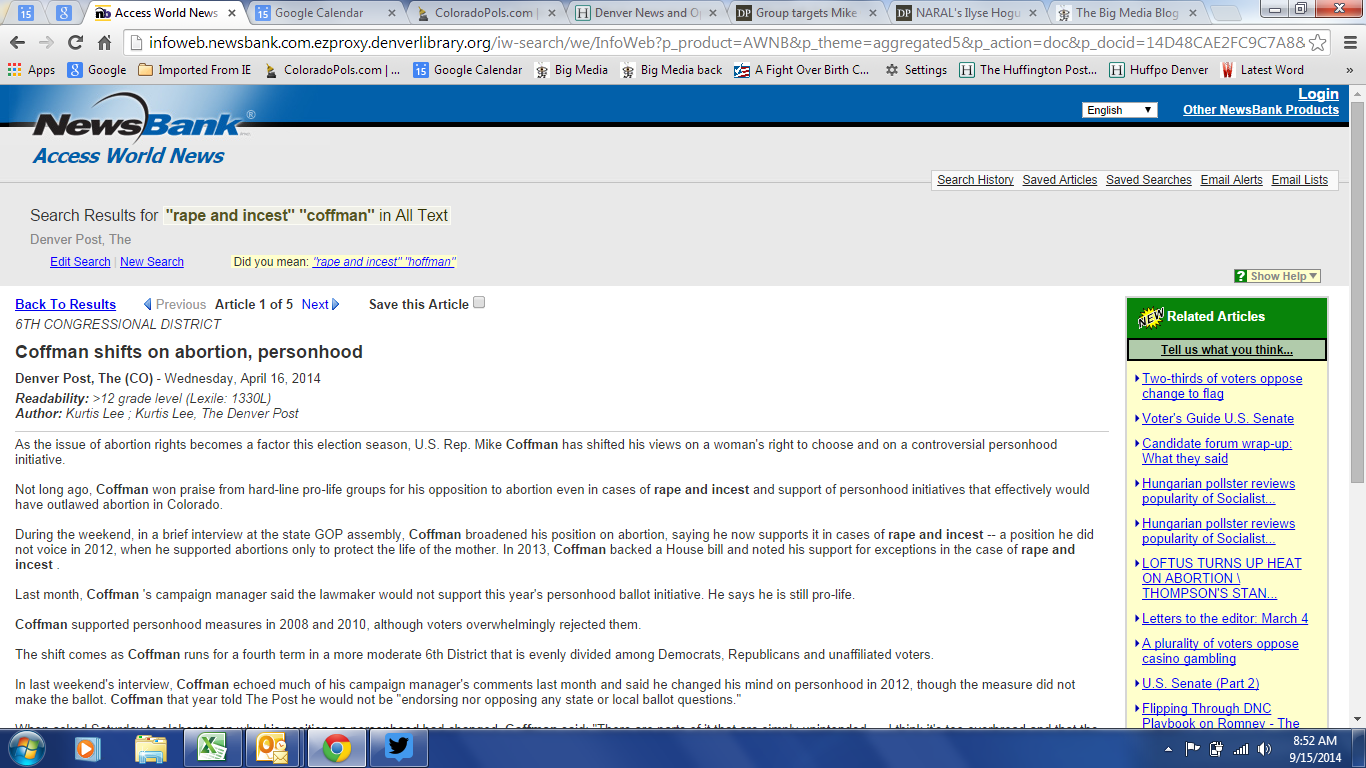
I was perusing the Denver Public Library’s Denver Post archive, on NewsBank, and smiled when I saw an article by former Post reporter Kurtis Lee titled, “Coffman shifts on abortion, personhood.”

That’s the story Denver Post Politics Editor Chuck Plunkett removed from the Post’s website hours after it was published April 16.

I clicked on the article, and there it was, complete and unabridged. It noted that “not long ago, Coffman won praise from hard-line pro-life groups for his opposition to abortion even in cases of rape and incest and support of personhood initiatives that effectively would have outlawed abortion in Colorado.” And it included Coffman’s response when asked to elaborate on why he abandoned his longstanding support for a personhood abortion ban: “There are parts of it that are simply unintended. … I think it’s too overbroad and that the voters have spoken.”

You recall the short-lived publication of the piece unleashed long-winded criticism from progressives, and, to his credit, Plunkett responded with blog posts of his own, explaining his decision to un-publish the piece and offering Coffman’s quotes and other new information in the disappeared article. But Lee’s original piece was never re-published on The Post’s website or in the newspaper.

Asked about the stubborn appearance of the article on The Post’s digital archive at the library, Plunkett said: “Once you take a story off your own web page, of course, it doesn’t mean it disappears from the internet. And here you’ve discovered that it still does exist, in fact, in an archive that we use. I just hope that all the stories that we put in [the archive] that we intend to publish stay in that archive. Every now and then I wonder. We sweat and bleed and go to all this trouble, and then we can’t ever find the stories again.”

Plunkett also said that he felt his blog posts at the time, containing the new information from Lee’s article, obviated the need to re-publish the piece. But if he had to do it over again, he would run the story with “one or two” additional paragraphs.

“Sometimes when you’re in the heat of the moment, you remember what you learned,” Plunkett said. “And what I learned was, if the story has something wrong with it, and it needs to be fixed, you pull the story and you keep working on it. In today’s environment, sometimes that’s not the smart move.”