Got questions for Denver mayoral candidates?

May 23rd, 2011

I’ll be on a panel asking Denver mayoral candidates Michael Hancock and Chris Romer questions Tuesday, May 24, at a debate at the Denver Museum of Nature and Science, Ricketson Auditorium (enter on Museum’s west side), 6:45 p.m. to 9 p.m.

Help me out by sending suggestions for questions to me at jason@bigmedia.org.

Other “media panelists” asking qustions will be Denver Post Columnist Susan Barnes-Gelt, FOX31 Reporter Jon Bowman, Former Denver City Councilwoman Sue Casey, ColoradoBiz Magazine Editor Mike Cote, and The Denver Daily News Reporter Peter Marcus.

Aaron Harbor, host of the Aaron Harbor Show, will moderate the debate, to be aired on “Colorado Now with Aaron Harbor.”

Click here to make your (free) general-admission reservation to attend the event, which will be broadcast at 7 p.m. on K3 Colorado (KCDO-TV Channels 3 & 28.3 broadcast) and Channel 3 on COMCAST, DirecTV & DISH Network

McInnis cleared of dishonest lawyer conduct, but slimy, mean politician conduct still a problem

May 23rd, 2011

Back in November, Scott McInnis told The Denver Post that he’d clear his name within a few short months. It wasn’t clear what he meant, but you had to assume something would show that he didn’t deserve the harsh treatment he got as he ran for governor in the last election.

He couldn’t show that he really did not commit plagiarism, could he? I mean, the exact words in McInnis’ water articles, written for the Hasan Family Foundation for $300,000, were lifted from another writer’s work. This was clear and irrefutable, right?

McInnis couldn’t blame the media? Or Dick Wadhams? Or even The Tea Party.

What could clear his name?

I waited impatiently, and no name-clearing happened. I was getting real desperate to know WTF was in McInnis’ mind, and today rolled around.

It turns out that an attorney connected to the Colorado Supreme Court conducted an investigation, at the behest of Colorado Ethics Watch, on whether McInnis’ behavior meets the lawyerly snuff test.

His investigation, indeed, cleans up McInnis a bit, but it doesn’t clear his name, unless you believe throwing people under buses is a good idea.

John Gleason, who conducted the investigation, aired his conclusion in documents quoted by the Grand Junction Sentinel (posted previously here)  this morning:

“Based on the sworn testimony of Mr. Fischer and his contemporaneous emails, personal notes and other documents produced by him, it is clear that in 2005, Mr. McInnis both disclosed to Mr. Fischer that his draft articles may be published by the Hasan Family Foundation and instructed Mr. Fischer (a water law expert but inexperienced author) that he must not plagiarize anyone’s work. …”

So Gleason clears McInnis of dishonest lawyerly conduct.

But does it clear him of slimy, squeezy, mean politican conduct? Does it make his conduct look, ah, gubernatorial, if I can use that word there.

No way.

No one but a lawyer would believe it means much, in the political name clearing business, if emails stated that Rollie Fischer was told not to plagiarize. And he apparently forgot or didn’t read the fine print.

That’s no reason for McInnis to go on TV and blame the plagiarism on Fischer. He should have taken responsibility himself. His name was on it. Fischer was confused, and so were the Hasans, according to the story in the Grand Junction Sentinel today.

Still, we don’t know if today’s news was, in fact, the name-clearing event that McInnis was referring to in November. You have to guess that it was, or at least that he had found correspondence with Fischer and the Hasans that put the blame for the water plagiarism on Fischer.

If so, if McInnis thought this would Shyne up his image, McInnis still doesn’t get it.

His mistake was throwing his research assistant under the bus. He could have survived the plagiarism, probably. But his handling of it sunk his campaign.

He can’t clear his name of those mistakes. That was his problem then, and that’s what he’s going to have to live with.

Caplis and Silverman mum as D’Souza says Obama views America as “bad guy,” not Iran

May 19th, 2011

Radio Hosts Dan Caplis and Craig Silverman were mum yesterday as Denish D’Souza told them (at about minute 32) that “Obama views not Iran, not North Korea, but America as the bad guy.”

At the same time, Caplis eagerly promoted D’Souza’s appearance today at a GOP fundraiser at Magianno’s at the Denver Pavilions, posting a flyer about the event on the show’s KHOW web page.

Caplis and Silverman could at least have discussed whether it’s intelligent, much less appropriate, for the Colorado GOP to give a microphone to D’Souza who says that the President of the United States thinks our country is worse than Iran or North Korea.

I know the Colorado GOP has to be thick-skinned to hold up its tent, and I’m not saying D’Souza should be censored, but is this the right platform for him?

Asked about his questioning of D’Souza today, Silverman told me:

“There are time constraints in that I have a co-host. In an ideal world, I could have spent three hours individually interrogating Denish D’Souza because I listened to his book cover-to-cover. I don’t agree with his one-size-fits-all theory of Barack Obama, but I do find it interesting…

I didn’t have anything to do with putting up that promo for the luncheon, but I don’t have a big problem with it either. If I had time, I might go see him today. I don’t have to agree with a book to find it interesting…

Denish D’Souza is probably far right, and definitely conservative. I think he’s entitled to his point of view just as Jason Salzman is entitled to your  far-left view. I don’t think either of you should be censored. And if the Colorado Democratic Party wants to have a program with you, I have no problem with it. And if we cover it on KHOW, I would have no problem if we decided to post a promotion for your event.”

D’Souza’s thinking is reminiscent of Tom Tancredo’s comment last year at an appearance with U.S. Senate candidate Ken Buck:

“The greatest threat to the United States today, the greatest threat to our liberty, the greatest threat to the Constitution of the United States, the greatest threat to our way of life, everything we believe in, the greatest threat to the country that was put together by the Founding Fathers is the guy who is in the White House today,” Tancredo said.

Buck felt the need to put some space between him and Tancredo, saying at the time:

“I don’t agree,” [Buck] said. “I think there are a lot of threats to the White House and I don’t think the man in the White House is the greatest threat to this country at all. I am concerned about the direction of the country, but — I love Tom, but I don’t always agree with him.”

But later, you recall, after Jane Norton, gently embraced Tancredo’s comment, Buck also warmed up to Tancredo’s position a bit.

In any case, I think Caplis and Silverman should have called out D’Souza’s extremism more forcibly and questioned its place in the political debate here in Colorado. Silverman isn’t scared to do this, but he missed an opportunity yesterday.

Potter series promotes healthy skepticism of journalism, local author writes.

May 18th, 2011

In an “expanded edition” of his book of essays on the “Values of Harry Potter,”  local libertarian gadfly Ari Armstrong slams a 2008 article in the American Communication Journal, by Amanda Sturgill and others, which argued that the Harry Potter series portrayed journalism in dark and destructive manner.

Armstrong’s basic point is that, sure, journalism in the Potter books, embodied in character Rita Skeeter, was flawed at times, but that’s how journalism is in real life as well. So the book teaches young readers to look at the news media with a critical eye.

“Consumers of journalism will do well to adopt the thoughtful skepticism promoted by the Potter series,” Armstrong writes.

He provides a few examples to illustrate his point that journalists can make mistakes without undermining the value of the news media. One of his examples, unfortunately, is New York Times columnist Paul Krugman’s opinion, written after the Gabrielle Giffords shooting, that “We don’t have proof yet that this was political, but the odds are that it was.” Yes, that was a dumb opinion, but Krugman is not a reporter; he’s paid to opine. You’d think Armstrong could have come up with better examples from the spectacular archive of journalistic foibles.

Still, Armstrong’s critique about the Sturgill article is on target for the most part, as he points to examples, even if they’re brief, of the beneficial role journalism plays in the books, as well its destructive use as propaganda when the news is taken over by Voldemort. There seems to be an obvious lesson in the dangers of state control of the press here, and you wonder why Sturgill ignored this and the other material Armstrong cites.

Armstrong writes:

“The Potter novels teach that, even in the faceof shoddy reporting or outright censorship, the truth can prevail if its advocates keep fighting for it.”

I noticed that Armstrong did not say the truth “will” prevail without quality journalism, and he’s right. You have to wonder today, with serious journalism struggling, whether enough of the truth will get out there for our experiment in democracy to have a happy ending.

So maybe the lesson in the Potter series that Armstrong lauds isn’t the one we really need.  We need more books showing how the truth doesn’t prevail in the end  when journalism is forsaken or corrupt. That’s where things look to be heading to me.

Unlike Boyles, right-wing Christian radio host Enyart apologizes for being a birther

May 12th, 2011

KHOW talk show host Peter Boyles, you recall, didn’t flinch when Obama released his birth certificate last month, saying he had no intention of backing away from the story.

Bob Enyart, who hosts “Bob Enyart Live,” weekdays on Colorado “Colorado’s Christian Station,” KLTT 670 AM, disagreed with those who said President Obama’s birth certificate was not valid, and he apologized to his audience for his “erroneous thinking.”

Conspiracy theorists should look to Enyart for guidance here. He saw evidence and changed course. How do you like that?

Then, in an admirable piece of self-reflection,  he looked deeper, and he reasons that the entire birther discussion was a distraction from the real issues.

I can’t agree with what he sees as the real issues, but he’s entitled to his view, which is, in part:

In the big picture, I regret that I did not stay more focused on the eternal moral issues, which of course include the fundamental issues of government that God will bring up on Judgment Day…. 

…[S]ince I cannot believe that God is going to care, neither about where Obama was born or any other leader who has advocated the killing of the innocent, therefore I am going to get beyond this distraction and focus more on what matters eternally! 

I think this means we won’t be hearing Enyart talk about birtherism anymore. But his Personhood-Amendment crusade? It doesn’t look like its going away, does it?

Colorado Springs Gazette interview started El Paso GOP controversy, county officer says

May 11th, 2011

The elected Secretary of the El Paso Republican Party said her inappropriate remarks to a reporter in March led to last week’s passage of a Republican resolution suggesting that GOP officers from El Paso County not criticize elected Republicans.

The Secretary, Sarah Anderson, told Grassroots Radio Colorado host Jason Worley yesterday that she regrets telling The Colorado Springs Gazette in March that some Republicans were calling Rep. Amy Stephens’ health-insurance exchange bill “Colorado’s presecription for federal crack addiction,” as well as the relatively mild moniker,  “Amycare.”

“That’s what started this,” she told Worley.

Anderson said she later apoligized to Stephens for her comments to the Gazette, and she agreed with Worley that it was a mistake to make those statements to a newspaper reporter who identified Anderson as the “secretary of the El Paso County GOP.” She said she never took a stand using her title again.

But Anderson argued on the radio that she does not think her position as an officer of the El Paso GOP should preclude her from speaking out against health-insurance exchanges, for example.

It would have been interesting if Worley had asked Anderson if she thinks the El Paso County GOP should pass a reverse resolution, if you will, suggesting that elected Republicans not criticize elected GOP officers.

Such a resolution might have stopped Stephens from telling the Colorado Springs Gazette that the uproar over her health-insurance bill was caused, in part, by “anarchists.”

The Gazette: Why do you think there’s been such an uproar from part of the conservative community and the Tea Party?

Stephens: Let’s be clear—it’s not the conservatives. I’d say it’s more libertarians, and other people I view as anarchists, some people in the Tea Party and the 9/12 group. I think there are numerous factors. There’s not one answer.”

Activists mocked Stephens for this remark.

For example, here’s what Mike Krause of the Independence Institute said about it Monday on Grassroots Radio Colorado:

Worley: Oh wait, Mike are you an anarchist?

Krause: Oh no, that’s you guys.

Clark: You’re not going to stand with us brothers in arms in anarchy.

Worley: Independence Institute didn’t back up SB 200, so you must be an anarchist.

Krause:  It’s interesting, and I’ve been listening to you guys talking about this. It’s interesting to us. Let me tell you how we view this. We’ve worked with Amy Stephens in the past and we assume we will again in the future. We are simply having a policy disagreement over this SB200, and so for us, it’s simply principle over politics. We assume we’ll get past it…but I guess we fall in the anarchy wing as much as… look, if you guys are anarchists, you know what, we’re just going to put on black masks with you and go break some windows and burn some stuff.

… Hopefully everyone can make up and move forward, but we’ll see what happens.

Radio show breaks news bit that State Republican Chair allegedly told El Paso GOP Secretary she should “strongly consider” resigning

May 10th, 2011

UPDATE: Ryan Call, Chairman of the Colorado Republican Party, responded to my request for a comment on the topic of this blog post. His response, in its entirety, follows:

I believe Sarah is a bright, talented young individual who has a great deal to offer the Republican Party in a leadership capacity. Her duties and role as a County Party officer are different than an activist or volunteer, or even as other members of her county’s Executive Board. Her elected Party leadership role as an officer includes certain important obligations and duties to her fellow officers, to her County Party Executive Board, and to the Republican Party’s elected officials, candidates and prospective candidates. Like an officer within any organization, her first duty is to that organization and to furthering the mission of the organization, which for the Republican Party is helping to elect Republican candidates, supporting Republican elected officials, and advancing Republican principles and our philosophy of government.

As an example, it would be entirely inappropriate for Mike McCoy, the Denver Bronco’s offensive coordinator and assistant coach, to hold a press conference or issue a statement that is critical of head coach John Fox or takes shots at Kyle Orton, the team’s designated starting quarterback. Similarly, it would be inappropriate for a corporate officer to issue statements or take a position that is contrary to the expressed decisions of the corporate board of directors or the company’s president.

It’s perfectly appropriate for a county party officer to express contrary positions, or engage in rigorous debate on issues and discussion on the best way to advance the Republican Party’s agenda within the Party, or to privately express his or her views and suggestions to elected officials on matters of policy or legislation at anytime—in fact, the Republican Party encourages such debate and discussion. But once a decision on a matter of policy or approach has been made by that county party’s Executive Board following such debate and discussion, it is every county party officer’s duty and obligation to faithfully implement the decision made by the group as a whole.

I have had a couple of conversations with Sarah regarding her duties as a county party officer, but at no time did I tell her to resign, nor will I. I shared with her that as a party officer, when expressing herself publicly she is not just representing herself but also the EL Paso County Republican Party. As such, I expressed my opinion that as an elected officer she has certain obligations to her county party members, fellow officers, and to the Party’s elected officials and candidates, and suggested that if she does not feel she can separate her personal opinions from her role as a County Party Secretary than she should consider resigning her position as a Party officer and thereby be free to speak out and be an advocate for whatever issues or causes, or for or against whatever candidates or Republican officeholders, she felt was most appropriate, free of the duty of loyalty and obligatory support that is a necessary corollary to official Party leadership.

Republican Party district captains, precinct leaders, volunteers, activists, and all Republican voters all should be encouraged to actively be involved in the debate and discussion of ideas within our Party, and in the discussion of how best to advance our Republican principles and ideas, and are free to support (or oppose) their candidates of choice. Dissent, discussion, and debate is not stifled within our Party – it is encouraged.

But the roles and duties of Republican Party officers are somewhat different; I am hopeful that Sarah will come to recognize that, and will choose to continue to faithfully serve as Secretary of the El Paso County Republican Party.

_________________

You know a talk radio show is hitting its stride when it starts breaking news bits.

That’s what Colorado’s flagship Tea Party talk-radio show, Grassroots Radio Colorado, did yesterday. Maybe no one but the Tea-Party ground troops heard the news bit, but it was still newsbitworthy.

Hosts Ken Clark and Jason Worley had El Paso County Republican Party Secretary Sarah Anderson on the show to talk more about the El Paso GOP’s resolution suggesting that party officers should not criticize elected Republicans.

On Grassroots Radio last week, Anderson had agreed with Clark, when he said the resolution was intended to shut up GOP activists, like Anderson.

Over the weekend, Anderson said, Colorado Republican State Chair Ryan Call told her her to “strongly consider” resigning as Secretary, because of her opposition to the resolution.

“Interesting enough, over the weekend, I had it suggested to me that I strongly consider resignation, and I want to say right now that I will not be resigning,” Anderson told Clark and Worley.

“It was suggested to me by a couple different people, most prominently by our State Party Chairman, Ryan Call,” she said. “I do want to stress I was asked to strongly consider it. I was not asked to resign, but I was asked to strongly consider it.”

“I’m irate right now,” Worley said to Anderson after she told him about Call’s suggestion, and he said he was texting Call immediately to find out more about it. On the radio, Worley inaccurately describes the El Paso resolution as a “gag order.”

Call did not immediately return my phone message or email seeking his side of the story. I’ll update this blog post if he responds.

If true, Call’s intervention could be an indicator of how he plans to conduct himself as GOP State Chair, settling disputes by pushing troublemakers like Anderson out of leadership positions instead of trying to bring factions of the party to the table to compromise.

Of course, there may be more to the story than meets the eye. Anderson may have acted in a way unbecoming to the elected office of the Secretary of the El Paso County Republican Party. I’ll try to reach Call and possibly others to find out.

Meanwhile, listening to Anderson talk to Clark and Worley, it sound like Call’s alleged attack hasn’t stopped her from speaking out.

Anderson told the radio audience that El Paso Republicans were trying to enforce the nonbinding resolution asking that party officers not criticize elected Republicans, even though it passed (by a vote of 13 to 3) as a suggestion, not a mandate. And so, she announced, she would continue to speak out.

“I don’t start fights, but I also don’t back down from them when others start them….” Anderson said.

“They want us to shut up and go away,” she said. “The problem is, I know very well, I’ve been involved in politics for a long time, way too long for my age, and we have to stand strong, and we cannot back down.”

“To me this is not about people. I’ve been accused of being other people’s enemy, such as [El Paso Country Republican Party President] Eli [Bremer]. And I don’t. This isn’t a battle about people. It’s a battle about ideas. My enemy, if we’re going to call it that, is the ideology that insulates and protects power in elected officials at all costs. I have to stand for principle. And you have, unfortunately, to pick a side in this. This is now a public battle. Are you going to stand for a Republican Party that stands on principle or are you going to stand for a Republican Party that protects and insulates power. It’s power versus principle. It’s that simple.”

To which one of the hosts replied, “Well, you know, I appreciate that stance because that’s the exact same stance we share here at Grassroots Radio and throughout all the Liberty groups in the state of Colorado.  When we see something wrong, we are going to call you on it.”

The hosts announced that El Paso Chair Bremer was scheduled to be on the radio show, but had to cancel at the last minute. But he promised to appear on the show at a later date, they said.

Radio host says El Paso GOP trying to shut up Republican activists

May 9th, 2011

People on the left tend to lump all “conservative talk radio” in the same category. Hate-filled, ill-informed, contrived.

That’s not the case at all. The shows differ a lot from one another. Some are filled with passion and authenticity. Others, ironically, bring the Politburo or psychedelic drugs to mind.

Some hosts like Republican insider Dan Caplis stick like epoxy to GOP talking points and others, like Tea Partiers Jason Worley and Ken Clark of “Grassroots Radio Colorado” could care less about partisanship, so their show is almost always raw. That’s really the best word for it. And interesting.

Before tuning in, I like to to predict which Republicans (and Democrats) Clark and Worley will be going after on their show on any given day, from 5 p.m. to 7 p.m. on 560 KLZ AM.

So it’s not surprising that Clark was incensed (not in my preferred patchouli way) about the El Paso County Republicans May 2 resolution recommending that party officers refrain from criticizing elected Republicans.

Clark had Sarah Anderson, who’s the Secretary of the El Paso Country Republican Party, on his radio show (560 KLZ AM) May 4 to air out his feelings on the topic:

Clark: So basically what they want you to do is be good little soldiers for the Republican Party. They want to pat you on the head, put you in the back of the bus, and say, shut up, sit down, and do what we tell you. Is that right?

Anderson: Absolutely.

Anderson later pointed out that the resolution, which passed 13-3 in a secret ballot, wasn’t mandatory, just a suggestion.

Still, Clark is entitled to his view, even if the sponsor of the resolution, Bob Denny, told me last week he wasn’t trying to stifle debate.

But Clark’s co-host on Grassroots Radio Colorado, Kanda Calef, who was substituting for Jason Worley, went overboard when she accused progressives of acting like the El Paso Republicans:

Calef: This is very progressive thinking, if I may say so. This is what the left does. They try to stop people from speaking their mind.

Calef was identified by Clark as the radio show’s “researcher,” but she offered no research to back up this claim. As a self-proclaimed progressive, who voted for Ralph Nader in 2000, and later repented, I don’t know what Calef was talking about.

So I called the Colorado Democratic Party to find out if it tries to button up its county officers.

“No, we don’t have anything coming close to broaching that subject,” new Communications Director Matt Inveo told me.

I’m trying to reach Calef, to find her examples of “progressives” acting like the El Paso Country Republicans, and I’ll report her answer later, I hope.

Listening to Clark, you get the feeling his un-Patchouli-like response to the El Paso resolution had a subterranean aspect to it. Like, maybe, there were some issues there, some other experiences with the Colorado GOP trying to shut up him or his allies?

Clark said on the radio: That [the El Paso GOP resolution] is not the only place things like this are happening, I can assure you.

Anderson told Clark: “The bylaws of the El Paso County Republican Party do prevent any officers or members of the executive committee from taking sides in primaries. And that’s always been the case, from my understanding, or certainly has been for quite some time. But it’s never precluded people from addressing issues or even specific legislators during session.”

But is there more than this? I called Worley to find out.

“We talked to people in other GOP counties, and there’s rumblings of stifling debate,” Worley told me today.

As for the Democrats, Inveo told me:

Anytime there is a contested Democratic primary, an office holder within the party cannot use his or her party title in making an endorsement. The party is required to provide the same services to all candidates.

CORRECTION: In an early version of this post, I attributed quotes to Worley that should have been attributed to Clark. Sorry for the error, which I corrected in the text.

El Paso GOP passes resolution urging Republican county officers not to criticize elected Republicans

May 4th, 2011

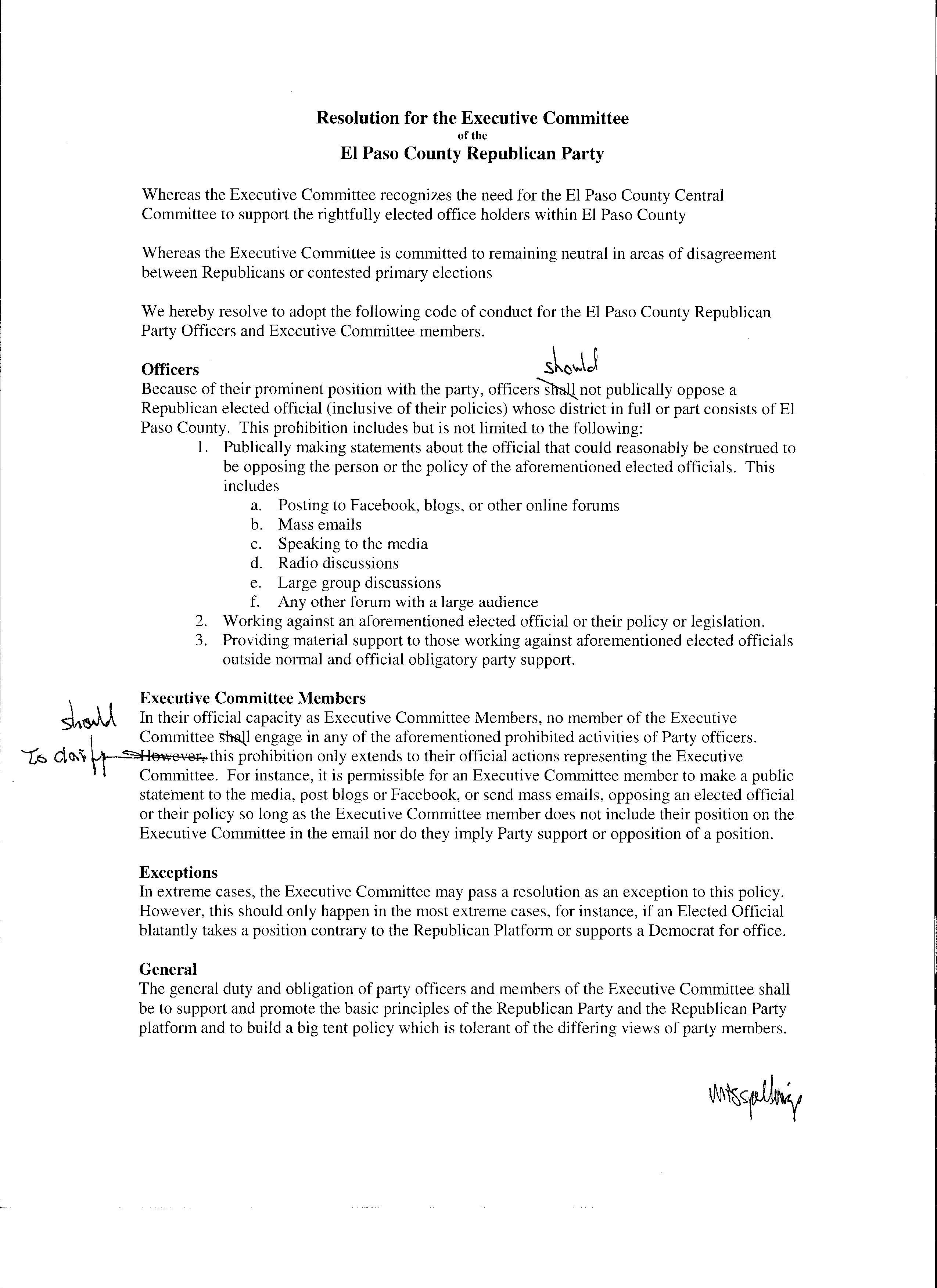
The El Paso County Republican Party executive committee passed a measure last night recommending, but not mandating, that party officers refrain from criticizing elected Republicans.

ReclaimTheBlue blogger Al Maurer broke the story that a resolution was introduced by Republican Bob Denny “on behalf of Rep. Amy Stephens” and was “designed to stifle opposition to SB-200.” HB 200, which cleared the Colorado House today by a 44-21 vote, establishes health insurance exchanges and has been opposed by Tea Party organizations, while supported by business organizations.

Denny, who represents HD-20 on the El Paso County Republican Party executive committee, told me today that Stephens asked him to bring it up, but he did not introduce the measure on her behalf.

“It was precipitated by SB 200, but the issue was broader than that,” Denny said. “She was concerned about it, and I introduced the measure in general terms.”

Denny declined to say who helped draft the resolution.

“Not that we don’t have freedom of speech, but as party officers, when you’re talking to the press or sending a mass email or something, you shouldn’t undermine party elected officials,” he said. “Party officers don’t agree with everything all the time, but we should at least be neutral.”

“The purpose of our officers is to get Republicans into office, and not undermine the work of those we sent to Denver,” Denny said, adding that there’s no way a resolution like this could stifle debate on SB-200 or other issues people care about.

Denny said it wasn’t practical for a party officer to broadcast personal opinions, for example to reporters, outside of his or her role as a party officer, because the party officer would inevitably be seen as representing the Republican Party.

“I was in the Air Force,” he said. “When you put a uniform on and you start talking, you were seen a representing the Air Force. You might say, I’m speaking for myself, but the press are going to pick you up as representing the Air Force.”

The resolution, which Denny said was a recommendation to the GOP central committee, passed after amendments were added, among which was changing “shall” to “should,” specifying that no mandate was passed, only guidance to party officers.

Maurer wrote on his blog post, which was titled, “Stifling Debate in the El Paso County GOP:”

In the end, cooler heads prevailed, and the measure passed with amendments that made it clear that county officers should remain neutral but were not absolutely prevented from speaking out. A big thanks is due to those on the committee who, while recognizing the need for civility in discourse and party discipline and unity, also balanced that with concerns for free speech and reasoned, open debate. You can read the measure for yourself, with my handwritten edits, here.

But watch what you write on Facebook, Twitter or your blog–all mentioned specifically in the measure–Big Sis is watching. Clearly name-calling and personal attacks are simply rude and uncalled for, but no one in public office should have a problem with honest disagreements on policy. We’re not Democrats after all.

Centrism of Post reflected in editorial board

May 3rd, 2011

A while back, The Denver Post’s  Editorial Page Editor Dan Haley provided me a website page listing the names and bios of each of the newspaper’s editorial board members. Here’s the link, and below are the names, which I couldn’t locate using The Post’s search tool. They usually appear at the bottom of The Post’s column of editorials:

William Dean Singleton, chairman and Publisher;
Dan Haley, editorial page editor;
Gerald Grilly, president and CEO;
Vincent Carroll, columnist;
Mike Littwin, columnist;
Alicia Caldwell, editorial writer;
Mike Keefe, cartoonist;
Barbara Ellis, news editor;
Cohen Peart, letters editor.

If you’re thinking, who cares, then you’re reading the right blog post, because you should care for a number of reasons.

This group, or portions of it, meets regularly with muckety-muck public figures, and theoretically decides on which candidates to endorse and which positions the newspaper should take in the political fray.

As a practical matter, the board doesn’t vote on every issue or candidate race. And Post chairman Dean Singleton has veto power but doesn’t participate very often. (Singleton told me in 2006 that he reversed only two endorsements up to that time: for Bush in 2004 and Owens in 1998.)

Here’s what Post Editorial Page Editor Dan Haley recently wrote, in response to my question about how the board makes decisions. (He pointed out that this isn’t very exciting.)

“The board meets routinely to talk through the issues of the day, and what we might want to write about. We generally reach a consensus about what the house editorial should say. If we can’t, I’ll make the decision for us. We rarely have actual votes because they’re not really necessary. And as I noted in my column, our opinion isn’t always my opinion, and that’s as it should be. Singleton doesn’t weigh in that often, but he certainly can. As publisher, he sits on the board.”

Haley had just written a column about how The Post came around to endorsing Chris Romer for mayor, despite Singleton’s preference for Mejia.

In any case, back to why this matters.

This indeed a deadly boring topic for a blog post,  but I’m continually amazed at the inability of people to distinguish the news and opinion sections of The Post.

If you don’t like something about The Post’s opinion page, or think something’s missing, contact the people on the editorial board, not a news reporter. (Of course, you can also write a letter to the editor.)

Conversely, you don’t want to complain about editorials to reporters or news editors, because they will say it’s not their purview. Contact them about problems with news stories, or, again, write a letter to the editor.

Don’t fall into the trap of thinking that no one reads this stuff. The Post still has hundreds of thousands of subscribers, a dedicated following of political elites, plus online viewers.

I think the makeup of the editorial board, and how it functions, lends credence to those who argue that the newspaper’s opinion page is basically centrist, with left and right represented. I don’t mean to open up an endless debate about how you define “left” and “right,” but the editorials don’t look like they were written by Littwin or Carroll very often. (OK, maybe they look like they reflect a bit more of Carroll’s thinking, but I haven’t done my bean count yet to see if this is provable with evidence.)

I know from experience that many people, if they make it to the end of this blog post, will just not believe it. They can’t accept that a newspaper’s editorial page, along with the news section, isn’t under the day-to-day thumb of the owner. I know the owner has an impact, sometimes a huge one, but to write off The Post as controlled by one side or the other is not demonstrably true.