Media omission: What kind of rotten decision-making process did CSU use in suspending the use of some fetal tissue?

August 6th, 2015

If you take a close look at Colorado State University President Tony Frank’s July 23 decision to suspend school’s use of fetal tissue from vendors “implicated in the Planned Parenthood investigation,” you’re left wondering what kind of strange and half-assed process the University implemented in making its new policy.

There’s of course the overarching fact that journalists are saying Planned Parenthood has broken exactly zero laws, and you can be pretty sure that, if laws had been broken, the undercover anti-choice video tapers would have provided the evidence by now.

But beyond that, the description of the process by which CSU arrived at its decision, as described in Frank’s letter to Rep. Doug Lamborn (R-CO Springs), raises serious doubts about whether the process was fair. (Lamborn had complained to Frank about CSU’s fetal-tissue policies.)

Frank: Since receiving your letter, I have reviewed the video that was released by the Center for Medical Progress; sought clarification on the points of law you’ve raised; and discussed the issue further with Colorado state Senator Kevin Lundberg, who provided additional insight. We also convened our Bioethics Advisory Committee to assess the known facts and make a recommendation directly to me regarding University practices going forward.

Frank “reviewed” the heavily edited video? He talked to Lundberg! Lundberg is a passionate advocate to be sure, but he  happens to be one of the least objective sources you could find in the entire state of Colorado, when it comes to abortion issues.

Frank makes no mention that he talked to any entity that might have given him Planned Parenthood’s perspective–and he writes as if he may not have even reviewed the unedited version of the Center for Medical Progress’ video.

CSU’s public-relations office isn’t taking questions from me, though it provided copies of the documents linked in this blog post.

So we have no clue about the input received from the Bioethics Advisory Committee, which made recommendations to Frank and which consists of seven scientists, who might be five-star research geeks but appear to have no clue about the politics and mechanics of this kind of political drama.

Why do I think they have no clue? Take a look at their key recommendation, as stated in the Committee’s July 22 letter to Frank:

The committee recommends that CSU suspend acquisition of fetal tissue from StemExpress or any other vendor in question with Planned Parenthood until the congressional investigations are concluded and there is affirmation that all vendors used by CSU under NIH support are in compliance with federal law regarding the acquisition and use of fetal tissue.

I’m sorry, but this is a ridiculous recommendation, and it was adopted happily by Frank. First, using congressional investigations as a litmus test for innocence is completely absurd, because we all know they are often initiated and terminated for reasons that have everything to do with politics and nothing to do with the rule of law.

And are congressional investigations “concluded” in any rational manner or time frame? Nope.

And whose affirmation is the bioethics committee going to rely on to clear the vendors of wrongdoing? The vendors used by NIH are already affirmed by NIH to be in compliance.

I’m not saying CSU’s Bioethics Advisory Committee is opposed to fetal-tissue research. In fact, you can see from their letter to Frank that they’re strong supporters, and they want it to continue. But the politics is beneath them, and their judicial process–along with Frank’s–appears to be rotten.

Exit interview: Claire Martin answers questions about journalism and her 31 years at The Denver Post

August 5th, 2015

After over 31 years at The Denver Post, Claire Martin departed from the newspaper last month, along with 18 other staffers who accepted a buyout offer. Martin was mostly a feature writer at The Post, and her obituaries received national acclaim. Her writing at The Post will be missed.

Last week, Martin kindly accepted my request to answer a few questions about her career and journalism. Here are her answers, provided via email:

Why are you leaving The Post? Would you have stayed on if not for the economic troubles facing the newspaper and the pressure this puts on reporters?

I am not leaving because of the paper’s economic troubles. The Denver Post is actually profitable, as I understand it. It’s just not profitable enough for the hedge fund company that owns The Denver Post.

I started writing for newspapers in the early 1970s, when I was still in high school, and newspapers were doing well enough to pay for high school correspondents. I don’t know what the profit margins were then, but there was never a general consensus that it was the newspaper’s job to be extremely profitable. The watchdog role was more important. This was when the Washington Post was breaking the Watergate scandal, and the New York Times had published the Pentagon papers, and the culture in newsrooms definitely reflected the watchdog sensibility, not expectations of high profits.

Part of the reason I took the buyout was because it was the first time a buyout was offered at a time when the newspaper was profitable. In my 30-plus years at the Denver Post, I have accepted a wage freeze, a pay cut and other measures we were told were necessary to keep the paper going. It’s kind of exasperating that when the newspaper IS making money, the owner wants to make even more.

I have had a great run at the Denver Post. They liked my idea when I suggested in 1985  that we host a cross-state bicycle tour, and Ride the Rockies became a genuine boon to many of the Colorado towns who hosted the tour for a night.

The editors typically have been open to the other ideas I have had, and I deeply appreciated that support.

In terms of feeling pressured to produce, that has not really been a problem for me. I have more ideas for stories than I have time to write, and nearly always I become absorbed in researching and telling those stories.

How does the upheaval in journalism affect feature writing? In a place like Denver, do you think there will be fewer jobs for feature reporters than, say, political reporters?  Or will everyone be writing about sports?

I do not know, but I think that one possibility is that the lines between features, business, news and even sports will become blurred. I would not be surprised if there were different categories, maybe breaking news, in-depth articles, and briefs — and that would cover news, business, features and sports. I think people in general like sports sections to be distinct from the news, even though technically that line is awfully blurry sometimes — Tom Brady and the deflated football for instance.

Diminished resources aside, what are your biggest concerns about how political journalism is practiced in Colorado today? What do you admire most?

The problem is that there are not enough reporters to adequately cover it. I think there should be much closer examinations of the fracking industry, and the relationship between the fracking interests and lobbyists and the legislators who champion them.

I think Lynn Bartels will be sorely missed, in part because her institutional memory is exhaustive.

The most worrying political reporting-related incident I experienced at the paper was when a reporter — no longer at the paper — was on the phone with a source, and I overheard the reporter reassuring the person on the other end of the phone, *Not to worry, we will get that bastard.*

I was appalled. It is NOT a newspaper reporter’s job to get the bastards. It is our job to research a situation that looks problematic, and to report the facts of that case. If anyone is going to get the bastard, it should be through the legal system. I know there are bastards out there, and God knows there are some I’d certainly like to see suffer the consequences of their behavior. But it’s not my job to catch and punish them.

What’s the worst error you made as a Colorado journalist? Can you name a story or two you’re most proud of?

When I was writing obituaries, easily my favorite gig in those three decades, a woman called and asked if I would interview her BEFORE she died. It was a weird situation. I said I’d need to talk to some of her friends as well. Wound up meeting her in a hospice, along with a couple who’d known her a long time. We chatted, and I asked about her life and took notes. She emphasized the last three decades or so of her life, and when I asked about children and family, said she had none. The couple confirmed that, but they acted weird about it. I should have paid attention to that.

Time passes. The woman dies. The obit runs. My phone rings. On the line, a furious daughter who asked whey she was not consulted for the obituary. The woman had not mentioned a family, but it turned out that she’d estranged herself from her children and former husband. While what she told me at the hospice was not untrue, it also was not the full story.

I go over how I could have figured out the deception, but still can’t see where I could have caught it. I ran a criminal check on everyone I wrote about, to avoid an obit about someone who was a thief or worse, and that hospice patient was clean.

My favorite beat was writing obituaries, but it was also fun writing about how to train for Ride the Rockies, and the odd stories I ran into when I edited the short-lived Colorado Sunday section. Maybe my favorite story is one I wrote in 1989 about an avalanche that crashed into a condominium parking lot at Mt. Crested Butte, trapping three children and suffocating one of them.

What would you say to a young person considering a career in Journalism?

I would advise learning programs like Final Cut Express, and thinking about following the example of the Center for Digital Storytelling’s model of 2-4 minute videos that tell a tightly-focused story. I also would suggest doing a lot of reading, and going into different communities to ask what is NOT being covered that ought to be getting attention.

What will you miss most about your job at The Post?

The eccentric, charming people who were my coworkers, getting unlikely PR pitches, that kind of thing. I am working now on projects I describe as helping to make the world a better place for the aging. I am as excited about some of those projects as I was about stories I worked on.

Do you think you’ll be alive to see The Post close, and, if so, will you write an obituary for the newspaper?

I hope very much that the newspaper will not close during my lifetime. I think the city would be poorer without it, although the readers who think The Denver Post is either too conservative or too liberal would disagree.

As for writing its obituary — wow. An honest obit would require a book, and different Denver Post veterans would tell that story different ways. Dick Kreck would tell one story. Mike McPhee would tell a different one. I would tell yet another. It would be like the blind men trying to describe an elephant. Each would be accurate, as far as his hands and senses could go, and each would be inaccurate. It’s a tricky beast.

Media omission: When it comes to Julie Williams, even conservatives can’t present a unified front

August 4th, 2015

In today’s scripted political environment, you don’t often see one arm of an advocacy organization rip into, say, a school board member, when other arms of the same organization are fighting wildly for the survival of the same school board member.

But that’s what the appendages of the Independence Institute are doing.

On Colorado Public Television July 10, Independence Institute Research Director Dave Kopel criticized Jeffco School Board member Julie Williams.

Kopel said, Williams is “by far the least capable member of that group, and the one who has gotten the rest of the board into trouble with a lot of  foolish, barely thought-out ideas she has expressed inappropriately.”

At the same time, down the figurative hall, the Executive Vice President of the  libertarian/conservative outfit, Amy Oliver, has been slaving to save Williams, defending her and the jeffco board in a relentless string of tweets and sporadic media appearances. Oliver, who keeps any criticism she might have of Williams to herself, was the spokesperson for her organization’s website set up to battle alleged mean-girl tweets directed at the Jeffco board and staff.

Meanwhile, another tentacle of the Indy Institute churns out articles favorable to the board–with nary a word of criticism of Williams.

I’m not saying there’s anything wrong with having a sometimes schizo organization, and it’s actually refreshing. Plus, Kopel speaks for himself. But his criticism of Williams, in the midst of his organization’s agenda, is noteworthy, and may reflect the polarizing effect Williams, in particular, has had on her Jeffco school community.

Recalling Coffman’s proposal for English-only ballots, as the Voting Rights Act turns 50

August 3rd, 2015

Over the weekend, I enjoyed reading Jim Rutenberg’s piece in the New York Times magazine on how conservatives have methodically dismantled the Voting Rights Act, which turns 50 on Thursday, culminating in the U.S. Supreme Court’s 2013 decision gutting major provisions of the law.

Here at home, one conservative who’s been throwing his congressional spear at the Voting Rights Act, widely credited for finally giving African-Americans actual factual access to the voting booth, is Rep. Mike Coffman of Aurora.

Coffman, you recall, introduced legislation in 2011 repealing the law’s requirement that bilingual ballots be provided in areas with large numbers of voters don’t speak English very well.

In other words, Coffman wanted to leave the decision about whether to provide bilingual ballots to local authorities, and if you take the time to read Rutenberg’s article, you’ll see that, as much as we’d all like to believe otherwise, local politicians are apparently still trying to keep black Americans from voting. That’s why we need federal requirements for stuff like bilingual ballots–to make sure everyone can participate in democracy, such as it is.

But Coffman, who once suggested that immigrants “pull out a dictionary” if they’re having trouble understanding an English ballot, doesn’t see it that way.

Coffman: “Since proficiency in English is already a requirement for U.S. citizenship, forcing cash-strapped local governments to provide ballots in a language other than English makes no sense at all,” Coffman told the Denver Post in 2011.

Last year, Coffman doubled down on his support for English-only ballots, saying during a Univision debate that he still opposes the Voting Rights Act’s requirements for mailing Spanish-language ballots, because it’s expensive.

But Coffman said it in a more friendly way, “I would hope that every voter will be able to get the information that he needs in a language he can understand.”

Again, most of us have to share Coffman’s hope, but there’s also reality lurking out there, embodied in politicians who care more about self-preservation than democracy. And you can read about it in the New York Times.

Trump puts media spotlight on immigration policies of Colorado politicians, like Coffman

July 31st, 2015

Reflecting yesterday on Donald Trump’s recent pledge to deport, cattle-car style, each and every one of the 11 million undocumented immigrants in America–and then expedite the return of the “good ones”– the Washington Post’s Greg Sargent called on reporters to extract detailed plans from the herd of Republican presidential candidates regarding their positions on immigration.

Indeed, one hopes that the moderators of the upcoming GOP debate will see an opportunity in Trump’s cattle car musings: why not ask all the GOP candidates whether they agree with him? And if not, where dothey stand on the 11 million exactly? Remember, Mitt Romney’s big “self-deportation” moment came at a GOP primary debate…

The point is that eventually, we’ll need to hear from all the GOP candidates as to what they would do about the 11 million — beyond vaguely supporting legal status, but only after some future point at which we’ve attained a Platonic ideal of border security. Trump may have just made it more likely that this moment will come sooner, rather than later. One can hope, anyway.

It’s a good idea and has direct application here in Colorado, where Republicans, like Rep. Mike Coffman, continue to slide by journalists with vague and shifting statements about immigration.

Like Trump, Coffman has said he favors some sort of “legal status” for adult undocumented immigrants, but it’s not clear whether he’d boot out everyone first, and then allow the good apples to return–or if he’d skip the cattle-car phase and grant “legal status” to the immigrants here.

Either way, would he wait for seamless border security? And what’s good enough, when it comes to the border?

And then, assuming the border is sufficiently seamless, and whether he chooses the cattle-car or no cattle-car opition, does Coffman really want t0 create an underclass of millions of noncitizens in America, with no voice in government? Would we be looking at good old fashioned taxation without representation? What rights (voting?) and responsibilities (military service? taxes?) would be denied? Even Helen Krieble, a Colorado resident who first proposed the cattle-car option, advocates giving a political voice to undocumented immigrants through citizenship.

Details, details. I wouldn’t want to go there either, if I were Coffman–because he’d get bitten by both progressive and conservative sharks. But that’s not a problem for journalists who should be asking him the questions.

Vice chair of state GOP: Look at all the Hispanics on Los Angeles’ “Most Wanted” list!

July 27th, 2015

It’s widely known that Donald Trump’s angry comments about Mexican immigrants bringing drugs, crime, and rape to America are false. Recent immigrants, including undocumented ones, are actually factually less likely to commit crimes than native-born Americans.

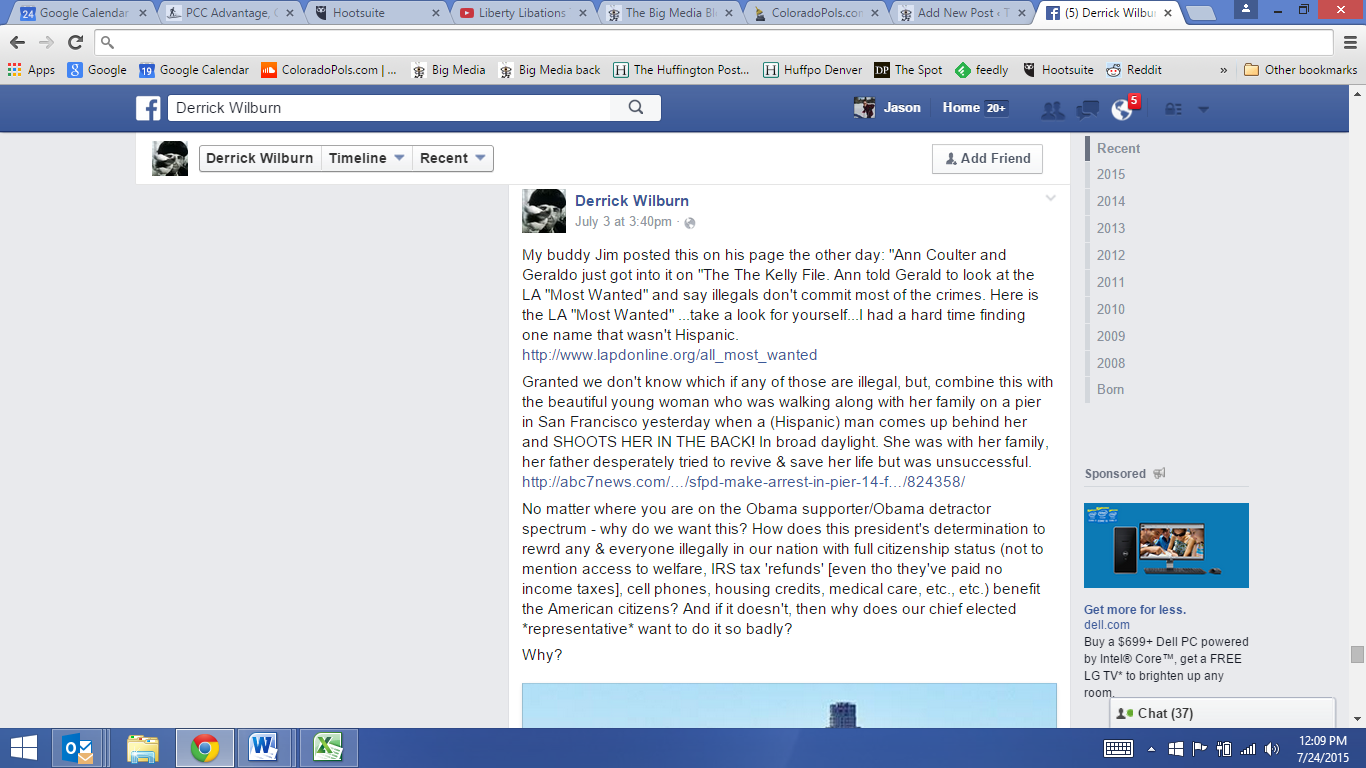
But the facts did not stop Trump, and, closer to him, they didn’t stop Derrick Wilburn, the elected vice chair of the Colorado Republican Party, from polluting his Facebook page with mean bigoted comments about Hispanics.

Earlier this month, Wilburn suggested that his Facebook friends “take a look” at Los Angeles’ “Most Wanted” list, so they can see all the Hispanics.

Wilburn: Ann Coulter and Geraldo just got into it on “The Kelly File.” Ann told Geraldo to look at the LA “Most Wanted” and say illegals don’t commit most of the crimes. Here is the LA “Most Wanted” …take a look for yourself…I had a hard time finding one name that wasn’t Hispanic.

Who cares about real crime data when you can look at the “Most Wanted” list in Los Angeles, find people who appear to be Hispanic, and then apparently agree with Ann Coulter that undocumented immigrants commit most of the crimes?

Wilburn’s post continues: Granted we don’t know which if any of those are illegal, but, combine this with the beautiful young woman who was walking along with her family on a pier in San Francisco yesterday when a (Hispanic) man comes up behind her and SHOOTS HER IN THE BACK! In broad daylight. She was with her family, her father desperately tried to revive & save her life but was unsuccessful.
http://abc7news.com/…/sfpd-make-arrest-in-pier-14-f…/824358/

No matter where you are on the Obama supporter/Obama detractor spectrum – why do we want this? How does this president’s determination to reward any & everyone illegally in our nation with full citizenship status (not to mention access to welfare, IRS tax ‘refunds’ [even tho they’ve paid no income taxes], cell phones, housing credits, medical care, etc., etc.) benefit the American citizens? And if it doesn’t, then why does our chief elected *representative* want to do it so badly?

To Wilburn’s credit, he’ll usually discuss his outrageous Facebook posts with me, but this time family obligations understandably prevented him from talking to me. So we have to let his Facebook post speak for itself in this case.

And what it says is, “I’m mad, and I’m going to act like a bigot. And I don’t really care.” If you can find some other way of interpreting Wilburn’s post, please let me know.

Correction: This post originally stated that Coulter was referring to most crimes in America. Wilburn believes she was referring to most crimes in LA County.

As former talk-radio hosts tell all, KLZ set to announce new morning show host Monday

July 26th, 2015

KLZ 560-AM will install a new morning-show host this week, replacing Randy Corporon, who resigned in protest after station owner Don Crawford, Jr, temporarily banned former Rep. Tom Tancredo and (reportedly) GOP Chair Steve House from KLZ’s airwaves.

“Yes, our man, Rush, will announce and introduce him Monday during his show,” Crawford emailed me last week when asked if he’d decided which conservative would fill Corporon’s shoes. (In recent weeks, the station held on-air auditions for the job.)

Meanwhile, Corporon, along with KLZ’s other “liberty lineup” hosts Ken Clark and Kris Cook, who resigned along with Corporon, lit deeply into Crawford at a recent “Liberty Libations” event. Their presentation (below) to the libations folks illuminates not only their version of the events involved in the trio’s decision to resign from the radio station but also the angry divisions within the state GOP.

I’m not saying you need more evidence of serious conservative infighting to know how serious the conservative infighting is in Colorado, but you still might enjoy these videos. They were posted by Marilyn Marks. It’s all interesting, if you’re a junkie and you want to pass some weekend down time in front of your computer, but it gets especially good at about the 22-minute mark. The second video includes Tancredo talking off screen.

Exit interview: Lynn Bartels leaves journalism after 22 years as reporter in Colorado

July 24th, 2015

Lynn Bartels leaves The Denver Post today, ending a 35-year run in journalism, with 22 of those years in Colorado. After starting her career in New Mexico, Bartels joined the Rocky in 1991 as its night cops reporter. In 2000, she started covering the state legislature. The Denver Post hired Bartels in 2009, immediately after the Rocky closed.

This week, Bartels answered some questions via email about the state of journalism in Colorado and her career as a reporter. (See other interviews in this series here.)

Why are you leaving The Post? Would you have stayed on if not for the economic troubles facing the newspaper and the pressure this puts on reporters?

Bartels: Certainly, I wouldn’t be leaving if a buyout hadn’t been offered. In fact, when I went to sign the paperwork, they asked where my package of stuff was, and I said I threw it away because I didn’t think I was going to take the buyout.

I always said, “I can’t leave newspapers. Who would hire me?” It turns out, I had some interesting opportunities. And that made me look at the industry and consider the buyout. I took the offer that made my family the happiest and where my new boss made me laugh during the interview ordeal. I thought, “I could really work for Wayne Williams.” Friends pointed out when I talked about that job I seemed happy. And it’s still politics and elections, which I love.

During the 1960s through mid-1980s, The Denver Post had 11 political reporters dedicated to covering elections and the legislature. In 2010, there were eight. Now that you’re leaving, there will be three, hopefully. No one would say political journalism here is dead, and the transformation of the news media has positive effects too, but what do you think Colorado is losing as The Post’s coverage of state politics shrinks? How bad is the situation? Or are you optimistic?

Quite frankly, the first blow was the loss of the Rocky. It covered politics in a different way. I wish now I had saved all the papers from 2008. We had Mike Littwin’s amazing stories from around the country and the state. M.E. Sprengelmeyer did a lessons learned from previous convention delegates. Burt Hubbard worked his data magic to do stories on how Colorado had voted over the years for president. I think Kevin Vaughan wrote the best lede in the country the night Barack Obama accepted the nomination at Invesco Field.

We had Roll Call and the Stump. When I did a list of things you might not know about Mark Udall, one item was that his youngest sister was an actress who had appeared in Law & Order.

When I arrived in Denver in 1993, both papers had political teams and legislative teams. It’s hard to imagine that now because it’s one and the same. Both papers had two reporters each covering Denver Mayor Wellington Webb and each paper had a full-time DIA reporter. The Rocky had three folks on education: higher ed, Denver Public Schools and suburban schools.

There was just lots more coverage of government.

Diminished resources aside, what are your biggest concerns about how political journalism is practiced in Colorado today? What do you admire most?

I think the coverage of education by Chalkbeat is outstanding.

I worry about the constant pressure to get things in first and fastest and there’s not the proper vetting.

What’s the worst error you made as a Colorado journalist? Can you name a story or two you’re most proud of?

I’ve made some doozies and actually would rather not go through the walk of shame again. The biggest mistake I’ve made overall in journalism, I believe, was too often letting my weight stand in the way of TV appearances. I turned most of them down just because I “felt fat.” Rocky editor John Temple basically had to force me to do the Denver mayoral debates in 2003. Yes, I went on Rachel Maddow twice but I turned her down more times than that. Ask Dominic Dezzutti at Colorado Public Television about my saying “no.”

I’ve had a front-row seat to some of the biggest stories in the state — the Oklahoma City bombing trials, Columbine — and along the way I’ve met some amazing people. Randy and Judy Brown, Rosemary and Wayne Wicks, the Flemings, I count them all as friends.

I loved it when former Rocky reporter Jeff Kass put on Facebook that most people now are talking about politics, my career was much more than that, including Columbine.

Favorite story? Maybe it was when a series of homeless men turned up dead, the Rocky assigned me to write about who these men were. I fought it (a common theme!) but in the end that might be one of my favorite stories. It turns out these people had friends and family, but for a variety of reasons, including addiction and mental illness, they just didn’t’ go home. I was working that Sunday when people called the Rocky about the piece. One woman was crying and said, “He hung outside our building and I never thought of him as a person until now.”

And I remember one night I had my coat on and I was getting ready to leave when I heard assistant city editor Luke Clarke say the pizza will be here in a few minutes. “Food! Free food! What’s going on?” I asked. The Denver Post today had depositions in the case involving the football recruiting scandal at CU, and we need to go through them. “Want some help?” I asked. And that was my life for the next five months. The Rocky won all kinds of awards for our reporting — yes, I have some sports-writing awards on my resume. The best ever was getting the investigative report a day early. We were all over national TV. I heard it was a very unhappy day at The Denver Post.

Colorado’s 2014 Senate race between Mark Udall and Cory Gardner was amazing, and I can never thank the Post enough for assigning me the race and letting me do my thing. I thank the Post for hiring me in the first place. Forever grateful.

I loved the story Tim Hoover and I wrote after the unbelievable civil unions blowup on the second to last night of the 2012 session. And then there was the front page “Has Hickenlooper lost his mojo?” piece that generated lots of e-mails and calls.

It would be so easy to leave the Post if I were miserable there, but I’m really happy right now with our team. That’s what makes leaving so hard.

What would you say to a young person considering a career in Journalism?

Find someone to teach you shorthand. Learn Spanish. Be as technologically advanced as you can be. Read. Read newspapers and not just online.

What will you miss most about your job at The Post?

I loved talking political intrigue with Editor Greg Moore. But I think what I will miss most of all was saying, “with The Denver Post.” That kind of says it all. People weren’t sure what the Rocky was. People in Colorado did. They loved it. Others? Well, they weren’t sure what it was. West Wing did a funny take on that once.

Other comments?

Here are some odds and ends.

In 2007, I won the Public Service Award from the Colorado Press Association for my stories on ethics issues at the Colorado Legislature. I think I was the first reporter in light years to win that award based on breaking news. There was no project editor, no graphics designer, no photographer assigned to the project, no one manipulating reams of data. It was old fashioned beat reporting and I was thrilled to see it honored.

I think former Post reporter Jessica Fender once summed me up better than most when she said something like, “Bartels will never be the kind of reporter who can go through stacks of documents and find the needle, but she’s the kind of reporter who people will pull aside and point her to this box of documents and say. ‘There’s a needle. Don’t tell anybody I told you.’”

Change has always frightened me. When I was first assigned to “the ledge” in 2000, I was miserable the first few weeks. There were many tears that Rocky editor Tonia Twichell and then Colorado Springs Gazette reporter Michele Ames had to deal with. And in 2014 I can remember crying in the women’s restroom in the Post, talking on the phone to Gardner spokesman Alex Siciliano and saying, “Why did they put me on this race? I don’t know federal issues. I don’t know about LMN.” And he said, “It’s LNG, liquified natural gas. I will walk you through it.” In both cases, I ended up loving the assignment.

In other words when you call me at Wayne’s World next month and ask how it’s going, I will say in a tiny voice, “It’s OK.” But later down the road, if you’re lucky, you’ll get to hear the famous Lynn Laugh, the one where interns used to ask, “Should we call 911?”
No matter who Julie Williams is comparing to Nazis, it’s gross

July 23rd, 2015

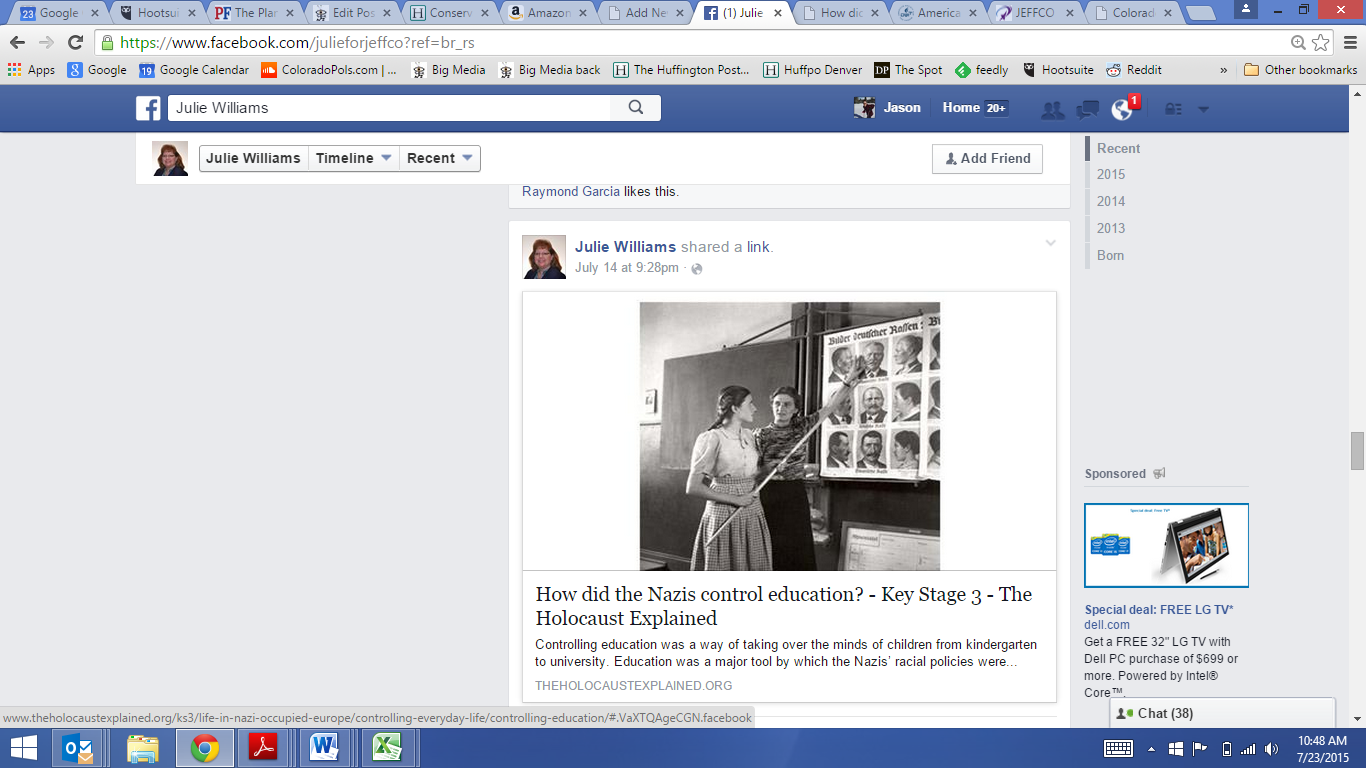
Embattled Jeffco School Board member Julie Williams hopped on her Facebook page July 14 and shared a link titled, “How did the Nazis control education?”

“Controlling education was a way of taking over the minds of children from kindergarten to university,” reads the article, published by Yad Vesham The Holocaust Martyrs’ and Heroes’ Remembrance Authority. “Education was a major tool by which the Nazis’ racial policies were promoted and implemented. “In Nazi Germany, no one was allowed to think for themselves,” states the piece.

The post is shocking and confusing, which might explain why no one commented on it.

I tried calling Williams so she could explain why she posted it, and to confirm, but I haven’t heard back yet.

Is Williams trying to say that the teachers, students, and others who’ve opposed the Jeffco School Board’s reforms are Nazis, because they’re getting involved and expressing their views about education?

Is Williams implying that the folks trying to remove her from the Jeffco School Board are Nazis, or at least acting like them, because they want different education policies than the ones Williams has backed?

Is Williams trying to say that the Common Core curriculum is backed by Nazis or leading somehow to Fascism?

No matter what she’s trying to say by posting the Nazi article, it’s deep-sigh inappropriate and gross. You don’t accuse your opponents of acting like Nazis unless, well, they’re actually factually acting like Nazis. And obviously no none is doing so on either side of this debate.

Media omission: Conservative Jeffco education group has anti-gay lawyer

July 22nd, 2015

Failed state senate candidate Tony Sanchez, who lost the SD-22 Jeffco race last year to Democrat Andy Kerr, is now directing an organization whose registered agent, Barry Arrington, has a history of making anti-LGBT comments and working for extremist groups.

Sanchez’s organization, Freedom for Education, was formed in May to “strive for greater transparency in the policy process and empower local parents/communities.”

Since then, according to its Facebook page, Sanchez has been representing the organization at Tea Party and Republican events, offering conservative perspectives on Jeffco education issues.

Arrington, the registered agent for Sanchez’s organization, surfaced earlier this year after Twin Peaks Charter Academy blocked its valedictorian from giving his graduation speech, in which the valedictorian planned to announce he was gay.

During the ensuing controversy, the school hired Arrington, who heads the Arrington Law Firm, to represent them in the matter, and Rep. Jared Polis asked that Arrington be fired because, “…some political agenda that I don’t understand might be clouding the quality of your advice to the Twin Peaks board.”

The “political agenda” was presumably Arrington’s history of anti-LGBT comments, such as his blog post last year in which he wrote:

“A man’s body is designed to be complementary with a woman’s body and vice versa. All of the confusion about whether same-sex relations are licit would be swept away in an instant if everyone acknowledged this obvious truth.”

Sanchez did not return a call seeking comment on whether his organization would be promoting Arrington’s views, given that the group’s name, Freedom for Education, is a bit of a head scratcher.

Asked by phone whether he would be promoting anti-LGBT ideas to Sanchez’s 501c4 organization, Arrington told me, “I don’t have a substantive role with that organization. I’m just a lawyer, helping them get their paperwork done.”

Arrington has served as a lawyer for a string of right-wing groups.

Arrington represented Dudley Brown’s Rocky Mountain Gun Owners, an extremist anti-gun control group, when it faced charges for inserting a gay couple’s photo in a political ad without permission.

From 2007 through 2011, he was the registered agent for Colorado for Family Values, Inc., an organization long known for its right-wing social agenda.

Last year, Colorado for Family Values produced an ugly advertisement attacking state senate candidate Mario Nicolais, who was running against Sanchez in the Republican primary in Jeffco (SD-22) last year.

In the ad (here), Nicolais was pictured next to openly-gay Democrat Pat Steadman and accused of advancing the “radical agenda of gay marriage” by supporting civil unions. The intent was obviously to turn anti-gay GOP primary voters against Nicolais.

After 2011, the registered agent for Colorado family Values became Mark Hotaling, who, along with his brother Jon, has been accused of orchestrating numerous shocking political tricks, including an anti-gay attack in support of Rep. Doug Lamborn in 2006. The organization also played a prominent role in running the initial 2008 personhood initiative in Colorado.