Contrary to blogger’s claim, reporter sought comment and clarification and utterances of any kind

May 8th, 2017

In a blog post April 29, ColoradoPolitics.com reporter Joey Bunch criticized Western Wire, a news service backed by the oil and gas industry via the Western Energy Alliance, for a post that, Bunch wrote, “left an impression” that last Saturday’s climate protests were canceled due to snow.

Bunch reported:

The article goes on to cite a Facebook post about the event in Colorado Springs being cancelled. The story, however, makes mentions of Denver, including a forecast of 12 inches of snow in the metro area, but never says whether its event is cancelled or a go.

I e-mailed [Western Wire reporter] Johnson to ask about the “Denver-area climate marches” the article refers to, and why an industry site is doing a weather story and sending it out to reporters who might be thinking about covering the event.

He replied that the story specifically cites the Colorado Springs event. “And where exactly in the story did we dissuade reporters from going?” he wrote about the story e-mailed to reporters.

The Western Wire article failed to mention the Colorado Springs march was moved to Sunday at 1:30 p.m. beginning at Colorado Springs City Hall.

Many advocates would cry and wail about Bunch’s post in anonymous tweets, but to his credit, Western Wire’s Matt Dempsey responded directly in a post titled, “Our Friend Joey Bunch Missed The Mark.” He claimed Bunch “missed the point of our reporting entirely.”

I agree with Bunch that Dempsey’s post created the impression that the Denver demonstrations were at least threatened with cancellation, if not cancelled. But Dempsey claims in his post that he had actually wanted reporters to attend the rallies. “After all, the giant snowstorm that hit Colorado highlighted the supreme irony of the anti-fossil fuel activists’ campaign,” wrote Dempsey in his blog post. And he pointed out that Western Wire’s post linked to updated information about the Colorado Springs rally.

But I can’t figure why Dempsey concluded his post this way:.

It also makes us wonder why Joey didn’t just ask for a clarification in his email, instead of seeking comment for a critique of our story. Western Wire, like any other news outlet, is open to readers asking for clarifications or corrections. But that’s not what happened here.

The question to Joey is: Why not?

This is funny because Bunch sought (and got!) a comment from Western Wire. He’s a reporter, not a reader who might seek a correction or clarification. He asked for Western Wire’s thoughts or utterances of any kind–including clarifying variety. That’s what journalists do when they send you an email with questions and an explanation of what they’re doing.

Bunch provided me with the questions and background information that he emailed to Western Wire prior to writing his story. Here it is.

Did you guys try to confirm that with anybody yesterday? You really come away from your story thinking the thing was cancelled. I’m going to blog about the event, and it’s a side note that an industry wire service was seemingly dissuading reporters and attendees from going the day before. I’m not sure what the point of a weather story on Western Wire was all about.

But Dempsey says Bunch should have followed up again, if necessary, to determine Western Wire’s intentions. Dempsey told me, via email:

Our point is that Joey made a bad assumption by asserting that the Western Wire news story suggested the event was cancelled, and that somehow by posting it online and emailing it that we were discouraging reporters from attending.

Instead of trying to understand what the story actually said, he was in a rush to get comment for a rebuttal story of his own.

Following his story we felt a need to weigh in through a commentary piece. Our aim was to be respectful while still making our point.

Bunch is more worried about the journalism practiced at Western Wire.

“I’m not offended at all by Matt Dempsey’s opinion of me, and I don’t know any reporters who are taking it seriously,” Bunch emailed in response to my request for a comment. “I’m not. It’s the disregard for journalistic principles of fairness and accuracy in both blogs that bothers me as a person who’s been doing this for 30-something years. It doesn’t speak well for Western Wire as a news source or the Western Energy Alliance, if it continues to stand behind it.”

Dempsey continues to stand behind his post, maybe not understanding how serious it is to claim a journalist didn’t do the most basic aspect of his job–when in actuality it seems Dempsey didn’t do his by not giving Bunch the info he needed.
Woods posts fake news on Facebook

May 5th, 2017

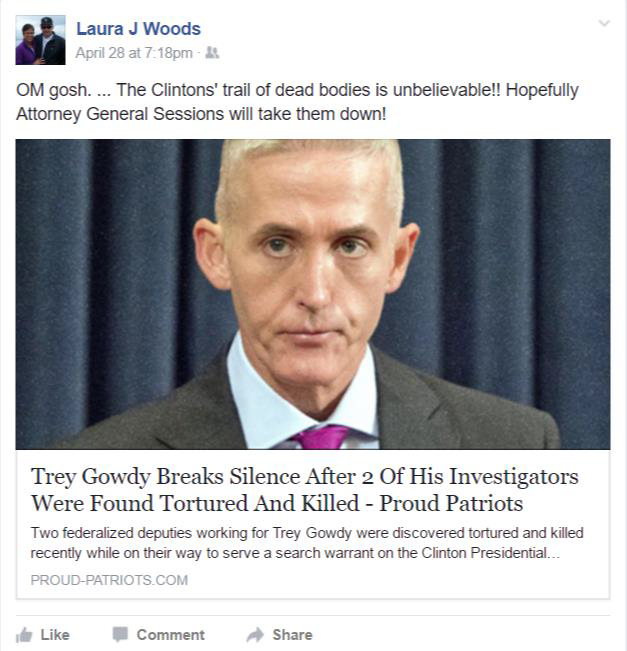
woods trey gowdy 5-17Despite the example set by Trump, it seems that public figures in Colorado are being more careful about posting fake news on their Facebook pages than they were prior to the last election.

And to their credit, some officials in Colorado are removing fake news, if they are convinced it’s inaccurate.

But former State Rep. Laura Woods (R-Westminster), who lost her state senate seat in November, apparently hasn’t gotten the memo about how fake news rots civic discourse, not to mention representative government.

She apparently posted this fake news item, provided to me by a source, last week, headlined, “Trey Gowdy Breaks Silence After 2 of His Investigators Were Found Tortured and Killed-Proud Patriots.”

Woods apparently commented, “OM gosh…The Clintons’ trail of dead bodies is unbelievable. Hopefully Attorney General Sessions will take them down.”

It appears that Woods refused to remove the fake news, even after a someone on her Facebook feed pointed out that it was debunked by Snopes.

Woods doesn’t return my calls, but I invite her to sign the Fake News Pledge for Citizens here.

But it appears she may have found her own way to deal with Fake News, with a site offering right-wing radio host Mark Levin, right-wing columnist Michelle Malkin, and others:

woods alt news site

Brauchler’s early support of vouchers raises questions for reporters

May 3rd, 2017

Education is a motivating issue anywhere in soccer-mom country, but in Colorado its force is compounded by the lingering impact of the emotional 2015 Jefferson County School Board recall election, in which voters overwhelmingly tossed out conservatives.

Republican Bob Beauprez’s outspoken alignment with the losing school board members, including his support of vouchers, during the 2014 gubernatorial election was arguably a key factor in his loss to Democrat John Hickenlooper. And Republicans have lost a string of state legislative races in Jeffco, with the winning Democrats standing against public school privatization.

So along comes the 2018 gubernatorial race, and reporters should note where Republican candidates come down on vouchers, charters, and education issues. Will they distance themselves from the positions of the losing Jeffco School Board members? Or will they align with them?

Republican candidate George Brauchler, the Arapahoe County District Attorney, has already spoken up for vouchers, agreeing “100 percent” with KNUS 710-AM’s Dan Caplis last month that vouchers benefit kids and empower parents, particularly in low-income areas.

Caplis (11 min 30 sec below): I’m a big believer without even increasing the budget, kids would be benefited immediately by healthy education competition, and by empowering those poor and middle income parents with true purchasing power in education through vouchers, etc. Where do you come down on school choice?

Brauchler: I 100 percent agree with you, in every place, specifically inner cities and socio economically depressed areas. Every place you offer parents the opportunity at a charter school or choice, you see a mad scramble to be part of that successful system. And our family is no different. I got four kids, 14, 12, 9, and 7. They are all in charter schools. They’ve all gone to charter grade schools. Two of them are still there. I am a big believer in choice. And they are figuring out a way to put a better product on the field and turn out students with a better education, better scores than the big establishment system. That’s not an indictment of the entire big establishment system. That is a challenge. That is that kind of competition that you and I have talked about that give you a better product. I am a big believer in choice…big-time public school system, which I am a product of, my wife’s a product of, my kids are going to be a product of it, has got to look internally, but also externally at a better way to do what they are doing.”

I can’t find campaign statements by other Republican candidates on public school privatization, but it’s likely they will be coming soon–with Democrats likely to continue to oppose vouchers. In any case, it’s clearly a key issue for reporters to track, given the Jeffco history and the stakes involved.

Listen to Brauchler on KNUS 710-AM’s Dan Caplis Show April 5:

El Paso GOP official removes fake news from his Facebook page

May 2nd, 2017

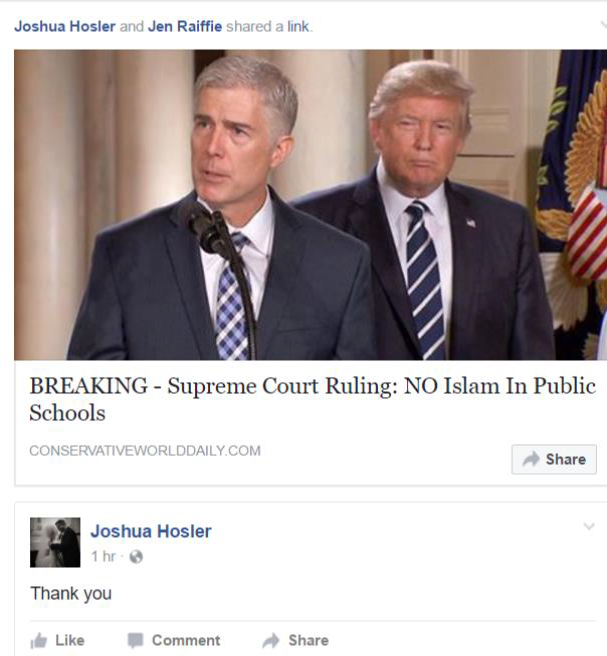
hosler fake news apil 2017Setting an example for Republican and Democratic officials, Joshua Hosler, Vice Chair of the El Paso County Republican Party, removed a fake news item he shared on Facebook, after he learned it was fake news.

The item, produced by ConservativeWorldDaily, alleged that the Supreme Court, in a decision written by Justice Neil Gorsuch, banned the teaching of Islam in Public Schools. Hosler removed it, he told me via Facebook messaging.

In deleting the item, Hosler joins other officials, such as State Rep. Polly Lawrence (R-Roxborough Park) and former State Rep. Kit Roupe (R-Colorado Springs), who both removed fake news from their Facebook pages last year in the wake of a BigMedia.org investigation. U.S. Rep. Jared Polis (D-Boulder) deleted a tweet with unsubstantiated information. Other officials, such as State Sen. Tim Neville (R-Littleton) and State Sen. Ray Scott (R-Grand Junction), did not remove fake news from Facebook.

BigMedia.org’s “BigMedia Factcheck,” which posts facts on the Facebook pages of officials to alert them to the presence of fake news on their Facebook pages, spotlighted the fake-news item in Hosler’s Facebook news feed, and he subsequently removed it.

The Facebook item shared by Hosler is not true, as explained by Factcheck.org:

No, the Supreme Court hasn’t decided that students can’t be taught about Islam in public schools. On April 11, fake news websites began publishing a bogus story that said “[t]he court ruled 5-4, with Justice Gorsuch casting the tie-breaker, that the only Islam taught to our children in public schools will be the history of Radical Islam and what they can do to help stop it.”

It alleged that newly installed Justice Neil Gorsuch wrote the majority opinion, and then provided a faux excerpt that was filled with errors: “We should [sic] be teaching any religions in this country besides standard Judeo-Chritianity [sic], as our founders wanted, and we certainly shouldn’t be filling the children with lies about Islam being a ‘religion of peace’ when they see the carnage on the news almost every day.”

Suspicious Facebook users have rightly flagged the bogus story as potentially fake, using the social media site’s improved tools for reporting a hoax.

Hosler once ran for a State House seat held by former State Rep. Gordon Klingenschmitt but was defeated.

Reporters should persist in asking for Gardner’s nonexistent Obamacare replacement

May 1st, 2017


Appearing on a conservative radio show last week, U.S. Sen. Cory Gardner (R-CO) said it’s “politics at its worst” to be “celebrating the defeat of a replacement” for Obamacare.

Politics at its worst looks more like Gardner’s vicious opposition to Obamacare for seven years, then being unable to point to a replacement he actually supports.

Even now, after all the embarrassing GOP drama on this issue, Gardner is trashing Obamacare without offering a solution.

On KNUS 710-AM’s Dan Caplis Show April 27, Gardner said it was “way too early” to comment on Trump’s latest Obamacare replacement proposal.

And Gardner was undecided, even vaguely critical, of the last month’s failed Trump-Ryan bill that was crashed with such drama.

But Gardner has the audacity to continue to insist that some unknown replacement be produced.

“But what I will tell you is this,” Gardner told Caplis, “We have to put something in place of the Affordable Care Act that actually works. And the Affordable Care Act has hurt hundreds of thousands of Coloradans through higher premiums, made access to insurance nearly impossible because of those higher costs, costs people their doctor. We have to do better. And for anybody, particularly for partisan reasons, to say they want to keep the Affordable Care Act in place, and it’s an absolute failure. And they are celebrating the defeat of a replacement. You know, that’s politics at its worst.”

Gardner was more subdued on 9News’ Balance of Power on Sunday, telling Brandon Rittiman,

“What I am looking for in a health care bill is something that is going to reduce costs and give access to people in the state of Colorado and across the country that they otherwise wouldn’t have. I hope we’ll have bipartisan support to do that.”

So, whether media figures see the hard-edged edition of Gardner (e.g., on talk radio) or the softer Gardner (e.g., on 9News) they should keep asking what health care bill Gardner supports.


Coffman again slides by most reporters, this time on Russia

April 27th, 2017

This is yet another story about Rep. Mike Coffman (R-CO) making a head-spinning change on a serious issue, acting as if no shift had occurred, and sliding by reporters who barely noticed or ignored it.

This time it’s the evolution of Coffman’s stance on Russian meddling in the 2016 election.

In response to a question on whether he supported an independent commission to investigate Russian meddling in the election, Coffman told 9News anchor Kyle Clark April 13 that he believed, based on government investigations, that the Russians interfered in the 2016 election. “I think the Russian meddling part has been resolved,” Coffman told Clark, adding that he wasn’t sure about Trump’s involvement.

You’d have been surprised to hear Coffman say this on 9News if you were listening to Colorado Public Radio in January.

During an interview with CPR’s Ryan Warner, Coffman said Jan. 11 he didn’t yet accept that Russians had tried to influence the election, because intelligence reports are frequently politicized.

Sounding like Trump, Coffman maintained this stance even after Warner pointed out that multiple intelligence agencies had concluded the Russians had intervened.

“I can tell you as an Iraq war veteran, I think sometimes that the intelligence at the highest levels tends to be politicized to make a certain point,” Coffman told Warner, adding that he thought the allegations against the Russians should be investigated.

Just two days later, after attending a full house intelligence briefing on Russian interference, Coffman told the Voice of America something quite different. VOA reported:

“I think it’s a wake-up call beyond our security officials, when we look at what they’ve been doing in Europe and wake up to the fact that they’ve been doing it in America,” Congressman Mike Coffman, a Republican from Colorado, told reporters.

Coffman, one of a handful of Republicans who avoided associating with the Trump campaign during the 2016 election season, described House members’ reactions to the briefing as aggressive, with pointed questions about the role Russia had played in the election of Trump.

“I think they consider the United States an adversary and I hope the incoming administration recognizes that fact,” Coffman said.

Yet, in the ensuing months, Coffman never issued a wider statement about his new confidence in the intelligence that Russia meddled in the 2016 election.

In fact, in February, with Trump attacking the CIA and calling for an investigation into FBI leaks that led to the resignation of National Security Advisor Michael Flynn, Coffman joined the president and also called for an investigation of the FBI.

During his April 13 town hall meeting, he joked about the need for an independent commission to investigate Russian interference. The Aurora Sentinel reported:

“The most dangerous place to be in Washington D.C. right now is between David Nunes or Adam Schiff and a TV camera,” Coffman told the crowd. “I’m not there yet for an independent council, but I’m moving there.”

It was after the April 13 town hall when Coffman told 9News’ Clark that the question of Russian meddling had been settled, but Coffman was still undecided on the independent commission.

The Obama Administration had done an investigation and “members of Congress, myself included, were briefed about Russian interference, which was predominately the hacking of the DNC and the Clinton campaign, Podesta’s email accounts.”

When was this briefing? It doesn’t make much sense that intelligence briefings could have swayed Coffman, because it was no secret that there was a consensus in January on the issue of Russian interference, as Warner had pointed out to Coffman Jan. 11, when Coffman was broadly trashing the intelligence.

So, what changed between January and April that convinced Coffman of the Russian attacks on U.S. elections?

What happened to his concerns about top-level intelligence being routinely politicized to the extent of not being trustworthy?

What’s Coffman’s explanation for his radical shift on Russian interference? Was there insufficient evidence on the table in January when Coffman continued to doubt the intelligence? Did Trump’s stance against the CIA play a role? What happened?

Scott still owes the Sentinel and others an explanation for his ‘fake news’ posts and comments

April 19th, 2017

ColoradoPolitics.com reported the response of Colorado State Sen. Ray Scott (R-Grand Junction) to Sunday’s announcement by Ray Seaton, publisher of the Grand Junction Sentinel, that he will not sue Scott for tweeting that the Sentinel is “fake news.” The blog reported:

Scott meanwhile seems bewildered by the latest development as well as the whole saga. He told our Joey Bunch late Monday, “It’s just weird.”

“The whole thing … is bizarre,” he said. “Now if I say this is a ridiculous op-ed he wrote, is he going to sue me? People can interpret that however they want, because it is bizarre and it is strange. Do I get sued for saying that?”

Scott won’t return my repeated calls, but someone should ask him for more details.

Why did he call the Sentinel “fake news” in the first place, undermining the newspaper’s credibility and viability, when he repeatedly posts Sentinel articles on Facebook that support his views or agenda.

And why does Scott post fake news (defined as “news” that’s been proven false by credible news outlets) on his own Facebook page? And refuse to take such items down, despite repeated requests to do so? (And while I’m at it, why doesn’t he sign the Fake News Pledge? He needs to do so.)

Scott has ducked questions by saying he’s been silenced by Seaton’s lawsuit. Now it’s time to get a full explanation from him.

Brauchler apparently thinks twice about marrying his fate to grassroots activists at the state GOP convention

April 11th, 2017

Reporters covering the weeds of the gubernatorial race should note that GOP candidate George Brauchler is contradicting himself about how he’ll try to access the ballot.

He told The Denver Post he’d rely solely on the decision of delegates at the State Republican convention, while telling a conservative radio host he’d leave open the possibility of getting on the ballot via the petition process that upended the senatorial campaign of former state Rep. Jon Keyser (R-CO Springs).

This is the second time in two weeks of campaigning that Brauchler has made conflicting statements to The Post and talk-radio hosts. Contradicting a 2015 statement he made to The Post, Brauchler claimed last week on air that he was on juror away from securing the death penalty in the Aurora-shooting case, when, in fact, he was three votes away.

With respect to accessing the ballot, here’s what Brauchler told The Post’s John Frank just before his April 5 campaign announcement:

Positioning himself as one of the more conservative candidates in the race, Brauchler said he plans to seek a slot on the primary ballot through a nomination at the Republican Party’s convention, rather than collect petition signatures to qualify.

The political gamble is paired with a not-so-subtle dig at his expected rivals. “Every single one of them is a potential self-funder or has long family connections to politics. I’m not that guy,” he said without noting Stapleton’s ties to the Bush family. “I’m the guy who has spent his entire life in Colorado, and I’m going to get around this state and win it through the grassroots effort.”

And here’s what Brauchler said to KHOW’s Ross Kaminksy the next day, Thursday, April 6:

Kaminsky–One interesting thing, you have said that you plan to get your position on the primary ballot by going to the convention rather than getting signatures. This is a little bit of insider baseball, but I think it says something about you as a candidate, as well.  Can you explain, please?

Brauchler–And I’ll say this:  I haven’t publicly foreclosed the possibility of petition. But honestly – and this is the way I got to be District Attorney – I’m invested in the grassroots aspect of getting elected. I think we have reached a place with campaign-finance and social media where you can have people who have the means — either their own or through third-party efforts — to simply bypass the individual, face-to-face requirements of going out and earning votes. You just show up on TV, show up on the Internet, you put things into people’s mailboxes.  Now, we’re going to do all those things.  But at the end of the day, there’s only one process to get on the ballot that guarantees you are going to get around the state and do retail politics, to press the flesh, look people in the fac,e and answer their questions about who you are and what’s important to them.  And so, I’m invested in really trying to look hard at how we’re going to accomplish getting on the ballot through the assembly process.  But I haven’t foreclosed any other options.

He hadn’t publicly foreclosed the petition option? That’s not how I read The Post interview, which hasn’t been corrected.

Frank was correct that, for Brauchler, relying on Colorado’s State Republican convention would be a “political gamble”–which is probably why the Arapahoe County District Attorney thought twice about it. The outcome of convention is predictably unpredictable, as demonstrated the jaw-bouncing decision of Republicans there last year to hand the GOP senatorial nomination to Darryl Glenn, who went on to lose to Democratic U.S. Sen. Michael Bennet.

Well-heeled candidates like Brauchler usually try to access the ballot via both the convention and petition routes, giving them a backup if they get Glenned, so to speak. Colorado State Sen. Tim Neville (R-Littleton) eschewed the petition process and watched his U.S. Senate dreams die when he was upset by Glenn at the convention last year. Brauchler wants to avoid Neville’s fate.

But the state convention is the stronghold of the GOP’s grassroots contingent, whose support is critical to winning the Republican nomination, even in an open primary–even more so this year because Trump seems to have energized and emboldened Colorado Republicans.

So, by initially saying he’d skip the petition process Brauchler was sending a love note to GOP grassroots activists. But it turns out Brauchler isn’t ready to commit to the marriage. Honestly, I don’t blame him. They can be so difficult and hard to live with.

Listen to Brauchler on KHOW April 6:

Coffman Refuses Interview with Huffpo Journalist, But He Loves Talk Radio!

April 6th, 2017

Huffington Post reporter Matt Fuller tweets this morning that U.S. Rep. Mike Coffman refused to talk to him because, Coffman told him, he’s “not a legit journalist.”

This prompted former Coffman deputy Tyler Sandberg to tweet that “Huffpo is a left-wing blog, not a bastion of journalistic legitimacy.”

That might be true for some Huffpo writers, but not for Fuller, as you can see from his resume.

But even if it were true, Coffman doesn’t use “journalistic legitimacy” as his litmus test for talking to media figures, as demonstrated by the fact that he’s been on conservative talk radio shows at least seven times this year alone. And hundreds of times over the years.

I have nothing against KNUS 710-AM’s Craig Silverman, Krista Kafer, Steve Kelley, and Jimmy Sengenberger–all of whom Coffman’s talked with just this year. Ditto for KHOW 630-AM’s Ross Kaminsky.

But none of them is a “legit journalist.”

I’m not saying Coffman shouldn’t chit chat with conservative talkers, who usually, but not always, scratch his back. He just shouldn’t offer fake excuses to avoid reporters like Fuller.

What can you do to fight fake news?

March 30th, 2017

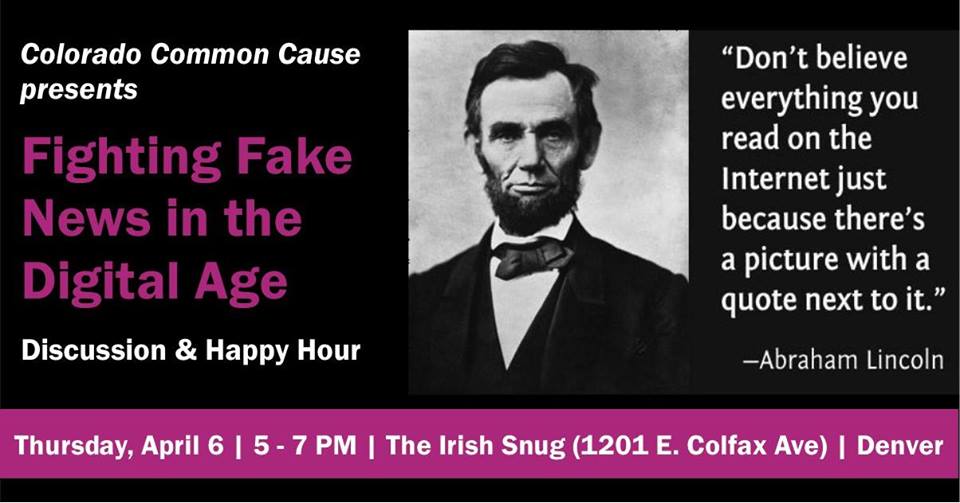
Common Cause Fake News Discussion & Happy HourFake news is obviously one of the greatest threats to democracy, yet there’s little grassroots activism combating it.

That’s why it’s great, necessary, and essential that Colorado Common Cause is hosting a discussion Thursday, April 6, on “Fighting Fake News in the Digital Age.”

The focus is on what we can do to combat fake news, besides complain about it and hope Facebook and Google do something for us.

Join the fake-news discussion and happy hour Thursday, April 6, from 5 p.m. to 7 p.m. at the Irish Snug, 1201 East Colfax Ave. The program starts at 5:30.

RSVP via Colorado Common Cause’s Facebook-event page or by emailing cfry@commoncause.org.

One way to take action, which liberty advocate Ari Armstrong and I will discuss at the Common Cause event, is the Fake News Pledge. (Armstrong opposes it.)

By signing the pledge, lawmakers and citizens promise not to spread information, packaged somehow to look like news, on Facebook if it’s “deemed false or inaccurate by Snopes, Politifact, Factcheck.org, or by a respected news outlet.” If such information is accidentally posted, it will be removed unless “detailed reasons for not deleting it” are provided.

“We’ve all seen it before,” states Colorado Common Cause’s Facebook page promoting Thursday’s event. “Our neighbor, uncle, or friend posts something on a social media site that is factually inaccurate. How should we react? Can we agree on what is truth and what is fiction? And how do we combat “fake news” at a time when this term is thrown around so casually?”